Ch. 16 - Reactions of Aldehydes and Ketones • More Reactions of Carboxylic Acid Derivatives
Bruice - Organic Chemistry 8th Edition
Bruice8th EditionOrganic ChemistryISBN: 9780135213711Non è quello che usi tu?Cambia libro di testo
Capitolo 16, Problema 14

What is the product of the reaction of an ester with excess acetylide ion followed by the addition of pyridinium chloride?

Guida verificata passo dopo passo
1
Identify the functional groups involved in the reaction. An ester contains a carbonyl group (C=O) bonded to an -OR group, and the acetylide ion (C≡C⁻) is a strong nucleophile.
Understand the mechanism of the reaction. The acetylide ion will attack the electrophilic carbonyl carbon of the ester, leading to a nucleophilic acyl substitution reaction. This results in the formation of a ketone intermediate and the release of the leaving group (-OR).
Recognize that the ketone formed in the first step is still reactive. In the presence of excess acetylide ion, the nucleophile will attack the carbonyl carbon of the ketone, forming a tertiary alkoxide ion (C≡C-C(OR)-O⁻).
Account for the role of pyridinium chloride. Pyridinium chloride acts as a proton source, neutralizing the alkoxide ion to form the final alcohol product (C≡C-C(OR)-OH).
Combine all steps to predict the final product. The reaction results in a tertiary alcohol where two acetylide groups are attached to the original carbonyl carbon of the ester.

Risposta video verificata per un problema simile:

Questa soluzione video è stata consigliata dai nostri tutor come utile per risolvere questo problema.
Durata del video:
5m

Concetti chiave

Ecco i concetti essenziali che devi comprendere per rispondere correttamente alla domanda.

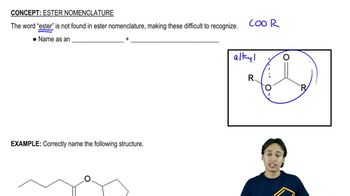
Ester Reactivity

Esters are organic compounds formed from the reaction of an alcohol and a carboxylic acid. They can undergo nucleophilic substitution reactions, where a nucleophile attacks the carbonyl carbon, leading to the formation of a tetrahedral intermediate. Understanding how esters react with nucleophiles, such as acetylide ions, is crucial for predicting the products of these reactions.
Video consigliato:
02:39
Ester Nomenclature

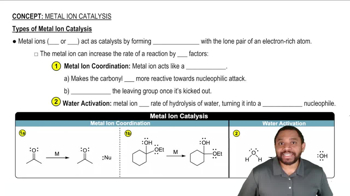
Acetylide Ion

Acetylide ions are strong nucleophiles derived from terminal alkynes by deprotonation. They are capable of attacking electrophilic centers, such as the carbonyl carbon in esters, leading to the formation of a new carbon-carbon bond. Recognizing the role of acetylide ions in nucleophilic addition reactions is essential for determining the outcome of the reaction with esters.
Video consigliato:
Percorso guidato
3:39
Metal Ion Catalysis Concept 1

Pyridinium Chloride

Pyridinium chloride is a reagent often used in organic synthesis to facilitate the conversion of alcohols to better leaving groups or to promote the formation of carbonyl compounds. In the context of the reaction, it can help in the protonation of the alkoxide intermediate formed after the nucleophilic attack, leading to the final product. Understanding its role is important for grasping the complete reaction mechanism.
Video consigliato:
03:13
Acid Chloride Nomenclature