Ch. 16 - Reactions of Aldehydes and Ketones • More Reactions of Carboxylic Acid Derivatives
Bruice - Organic Chemistry 8th Edition
Bruice8th EditionOrganic ChemistryISBN: 9780135213711Non è quello che usi tu?Cambia libro di testo
Capitolo 16, Problema 39(2)

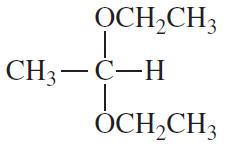
Which of the following are a. hemiacetals? b. acetals? c. hydrates?
2. Structural formula of a compound with two ether groups and a central carbon atom, illustrating molecular connectivity.

Guida verificata passo dopo passo
1
Step 1: Understand the definitions of the terms provided in the question. A hemiacetal contains one -OR group and one -OH group attached to the same carbon atom. An acetal contains two -OR groups attached to the same carbon atom. A hydrate contains two -OH groups attached to the same carbon atom.
Step 2: Analyze the given structure in the image. The central carbon atom is bonded to two -OR groups (methoxy groups, -OCH3) and two alkyl groups. There is no -OH group present in the structure.
Step 3: Compare the structure to the definitions. Since the central carbon atom has two -OR groups and no -OH group, this structure fits the definition of an acetal.
Step 4: Confirm that the structure does not fit the definitions of a hemiacetal or a hydrate. A hemiacetal would require one -OR group and one -OH group, and a hydrate would require two -OH groups, neither of which are present in this structure.
Step 5: Conclude that the given structure is an acetal and does not qualify as a hemiacetal or a hydrate.

Risposta video verificata per un problema simile:

Questa soluzione video è stata consigliata dai nostri tutor come utile per risolvere questo problema.
Durata del video:
3m

Concetti chiave

Ecco i concetti essenziali che devi comprendere per rispondere correttamente alla domanda.

Hemiacetals

Hemiacetals are formed when an aldehyde or ketone reacts with an alcohol, resulting in a compound that contains both an alcohol and an ether functional group. They typically have one -OH group and one -O-alkyl group attached to the same carbon atom. Hemiacetals are often intermediates in the formation of acetals and can be identified by their structure, which includes a carbon atom bonded to both an alcohol and an alkoxy group.
Video consigliato:
06:23
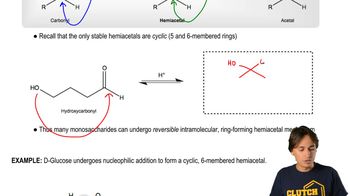
Monosaccharides - Forming Cyclic Hemiacetals

Acetals

Acetals are derived from hemiacetals through a reaction with an additional alcohol, leading to a compound that has two -O-alkyl groups attached to the same carbon atom. They are stable under neutral conditions and are characterized by their resistance to hydrolysis compared to hemiacetals. Acetals play a significant role in organic synthesis and can be used to protect carbonyl groups during chemical reactions.
Video consigliato:
04:29
Acetal Protecting Group

Hydrates

Hydrates are formed when water adds to a carbonyl compound, such as an aldehyde or ketone, resulting in a molecule that contains a hydroxyl group (-OH) and a carbon atom. This process is known as hydration and leads to the formation of a geminal diol, where two hydroxyl groups are attached to the same carbon. Hydrates are often less stable than their carbonyl precursors and can revert back to the original carbonyl compound under certain conditions.
Video consigliato:
09:11
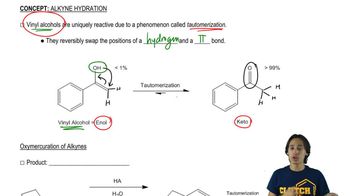
Alkyne Hydration