Ch. 6 - The Reactions of Alkenes • The Stereochemistry of Addition Reactions
Bruice - Organic Chemistry 8th Edition
Bruice8th EditionOrganic ChemistryISBN: 9780135213711Non è quello che usi tu?Cambia libro di testo
Capitolo 6, Problema 77b

Draw the products, including their configurations, obtained from the reaction of 1-ethylcyclohexene with the following reagents:
b. H2, Pd/C

Guida verificata passo dopo passo
1
Step 1: Identify the type of reaction. The reaction involves the addition of hydrogen gas (H₂) in the presence of a palladium catalyst (Pd/C). This is a catalytic hydrogenation reaction, which reduces alkenes to alkanes by adding hydrogen atoms across the double bond.
Step 2: Locate the double bond in the structure of 1-ethylcyclohexene. The double bond is present between two carbon atoms in the cyclohexene ring.
Step 3: Understand the stereochemistry of the reaction. Catalytic hydrogenation typically occurs on the same face of the molecule (syn addition), meaning both hydrogen atoms are added to the same side of the double bond.
Step 4: Replace the double bond with single bonds and add one hydrogen atom to each of the two carbons that were part of the double bond. This converts the cyclohexene ring into a cyclohexane ring.
Step 5: Confirm the product. The resulting molecule is 1-ethylcyclohexane, which is a saturated hydrocarbon. Since the addition of hydrogen is syn, the stereochemistry of the substituents on the ring remains consistent with the original configuration.

Risposta video verificata per un problema simile:

Questa soluzione video è stata consigliata dai nostri tutor come utile per risolvere questo problema.
Durata del video:
5m

Concetti chiave

Ecco i concetti essenziali che devi comprendere per rispondere correttamente alla domanda.

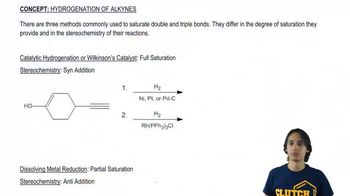
Hydrogenation

Hydrogenation is a chemical reaction that involves the addition of hydrogen (H2) to an unsaturated compound, typically alkenes or alkynes, converting them into saturated hydrocarbons. In the presence of a catalyst like palladium on carbon (Pd/C), the reaction proceeds efficiently, resulting in the formation of alkanes. This process is crucial for understanding how double bonds in alkenes are reduced to single bonds.
Video consigliato:
00:48
The definition of hydrogenation.

Stereochemistry

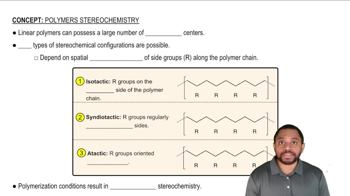
Stereochemistry refers to the study of the spatial arrangement of atoms in molecules and how this affects their chemical behavior. In the context of hydrogenation, the configuration of the product can vary based on the orientation of the reactants and the catalyst's influence. Understanding stereochemistry is essential for predicting the specific isomers formed during reactions, particularly in cyclic compounds like 1-ethylcyclohexene.
Video consigliato:
Percorso guidato
1:38
Polymer Stereochemistry Concept 1

Cycloalkenes

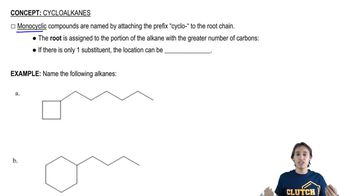
Cycloalkenes are cyclic hydrocarbons that contain at least one carbon-carbon double bond. The structure of 1-ethylcyclohexene, a cycloalkene, influences its reactivity and the products formed during hydrogenation. Recognizing the properties of cycloalkenes, including ring strain and substitution patterns, is vital for predicting the outcome of reactions involving these compounds.
Video consigliato:
01:11
How to find the root name for cycloalkanes