Ch. 6 - The Reactions of Alkenes • The Stereochemistry of Addition Reactions
Bruice - Organic Chemistry 8th Edition
Bruice8th EditionOrganic ChemistryISBN: 9780135213711Non è quello che usi tu?Cambia libro di testo
Capitolo 6, Problema 78

Which stereoisomer of 3-hexene forms a meso compound when it reacts with Br2?

Guida verificata passo dopo passo
1
Identify the structure of 3-hexene. It is an alkene with a double bond between the third and fourth carbon atoms in a six-carbon chain. Draw both possible stereoisomers: the (E)-3-hexene and the (Z)-3-hexene.
Understand the reaction mechanism. When 3-hexene reacts with Br₂, the double bond undergoes an electrophilic addition reaction, forming a vicinal dibromide (a compound with two bromine atoms on adjacent carbons).
Determine the stereochemistry of the product. For a meso compound to form, the product must have a plane of symmetry. This occurs when the two bromine atoms are added in an anti-addition manner, and the resulting molecule is superimposable on its mirror image.
Analyze the stereoisomers of 3-hexene. The (Z)-3-hexene has substituents on the same side of the double bond, which can lead to a symmetrical product after anti-addition of Br₂. The (E)-3-hexene, with substituents on opposite sides of the double bond, does not form a meso compound.
Conclude that the (Z)-3-hexene is the stereoisomer of 3-hexene that forms a meso compound when it reacts with Br₂, due to the symmetry in the product after anti-addition of bromine atoms.

Risposta video verificata per un problema simile:

Questa soluzione video è stata consigliata dai nostri tutor come utile per risolvere questo problema.
Durata del video:
6m

Concetti chiave

Ecco i concetti essenziali che devi comprendere per rispondere correttamente alla domanda.

Stereoisomerism

Stereoisomerism refers to the phenomenon where compounds have the same molecular formula and connectivity of atoms but differ in the spatial arrangement of those atoms. In organic chemistry, stereoisomers can be classified into enantiomers and diastereomers, which are crucial for understanding the reactivity and properties of compounds, especially in reactions involving chiral centers.
Video consigliato:
01:58
Determining when molecules are stereoisomers.

Meso Compounds

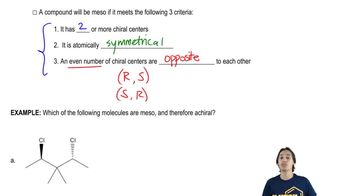
Meso compounds are a specific type of stereoisomer that possess multiple chiral centers but are achiral due to an internal plane of symmetry. This means that despite having chiral centers, the overall molecule does not exhibit optical activity. Recognizing meso compounds is essential for predicting the outcomes of reactions, such as those involving halogenation.
Video consigliato:
04:10
The 3 rules of meso compounds.

Electrophilic Addition Reactions

Electrophilic addition reactions involve the addition of electrophiles to nucleophilic sites in alkenes, leading to the formation of more saturated compounds. In the case of 3-hexene reacting with Br2, the addition occurs across the double bond, and understanding the mechanism of this reaction is key to determining whether a meso compound is formed based on the stereochemistry of the starting alkene.
Video consigliato:
05:39
Features of Addition Mechanisms.