Ch. 6 - The Reactions of Alkenes • The Stereochemistry of Addition Reactions
Bruice - Organic Chemistry 8th Edition
Bruice8th EditionOrganic ChemistryISBN: 9780135213711Non è quello che usi tu?Cambia libro di testo
Capitolo 6, Problema 76e,f

e. What is the electrophile in the second step?
f. What is the nucleophile in the second step?

Guida verificata passo dopo passo
1
Step 1: Understand the context of the reaction. The terms 'electrophile' and 'nucleophile' refer to the species involved in the reaction. An electrophile is an electron-deficient species that seeks electrons, while a nucleophile is an electron-rich species that donates electrons.
Step 2: Identify the second step of the reaction mechanism. Review the reaction sequence provided in the problem or mechanism to determine what occurs in the second step. Look for bond formation or bond-breaking events.
Step 3: Determine the electrophile in the second step. The electrophile is typically the species that accepts a pair of electrons during the reaction. Look for a positively charged species, a partial positive charge, or a molecule with an electron-deficient atom.
Step 4: Determine the nucleophile in the second step. The nucleophile is the species that donates a pair of electrons to form a bond. Look for a negatively charged species, a lone pair of electrons, or a π-bond that can act as an electron source.
Step 5: Confirm your findings by analyzing the electron flow in the second step. Use curved arrows to track the movement of electrons from the nucleophile to the electrophile, ensuring that the roles of each species are consistent with their definitions.

Risposta video verificata per un problema simile:

Questa soluzione video è stata consigliata dai nostri tutor come utile per risolvere questo problema.
Durata del video:
3m

Concetti chiave

Ecco i concetti essenziali che devi comprendere per rispondere correttamente alla domanda.

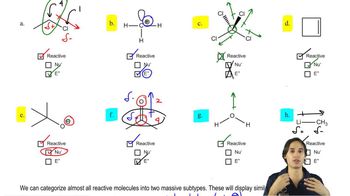
Electrophiles

Electrophiles are species that accept electron pairs from nucleophiles during chemical reactions. They are typically positively charged or neutral molecules with an electron-deficient atom, making them attractive to electron-rich species. Understanding the role of electrophiles is crucial in predicting reaction mechanisms and outcomes in organic chemistry.
Video consigliato:
03:
Nucleophile or Electrophile

Nucleophiles

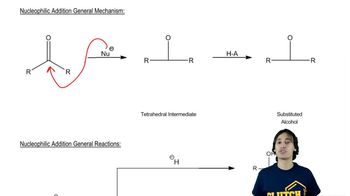
Nucleophiles are electron-rich species that donate an electron pair to electrophiles in a chemical reaction. They can be negatively charged ions or neutral molecules with lone pairs of electrons. Recognizing nucleophiles is essential for understanding how reactions proceed, particularly in substitution and addition reactions.
Video consigliato:
08:27
Nucleophilic Addition

Reaction Mechanisms

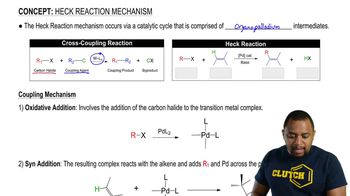
Reaction mechanisms describe the step-by-step process by which reactants transform into products, detailing the roles of electrophiles and nucleophiles. Understanding these mechanisms helps predict the products of reactions and the conditions under which they occur. Analyzing each step allows chemists to manipulate reactions for desired outcomes.
Video consigliato:
02:16
Heck Reaction Mechanism