
Ch. 6 - Stereoisomerism: Arrangement of Atoms in Space
Mullins - Organic Chemistry: A Learner Centered Approach 1st Edition
Mullins1st EditionOrganic Chemistry: A Learner Centered ApproachISBN: 9780137566471Non è quello che usi tu?Cambia libro di testo
Capitolo 5, Problema 29

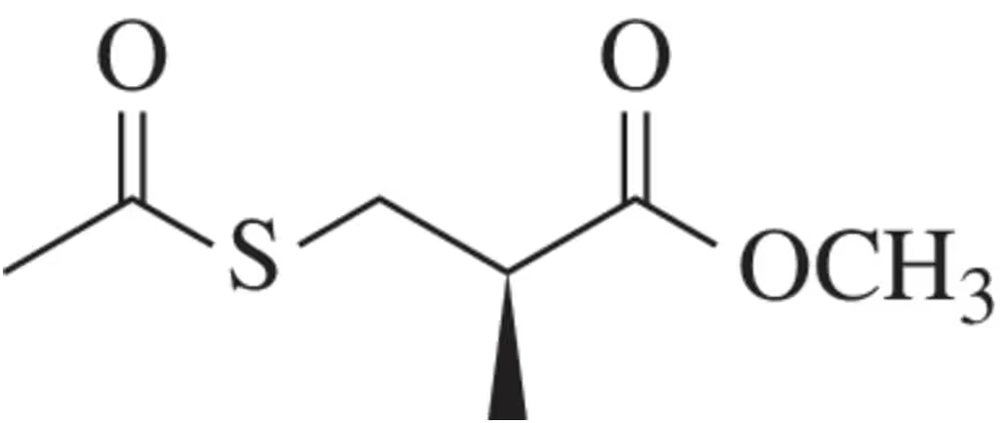
A student wanted to measure the specific rotation of the following propionate derivative (density = 1.12 g/ml).
Chemical structure of a propionate derivative featuring sulfur and oxygen atoms, used for measuring specific rotation.
A sample of the pure compound was placed in a 10.0-cm polarimeter tube, and using the sodium D line, the observed rotation at 20°C was determined to be +46.6° . What is the specific rotation of the propionate derivative?

Guida verificata passo dopo passo
1
Step 1: Recall the formula for specific rotation: \( [\alpha]_D^{20} = \frac{\alpha}{l \cdot c} \), where \( [\alpha]_D^{20} \) is the specific rotation, \( \alpha \) is the observed rotation, \( l \) is the path length of the polarimeter tube in decimeters, and \( c \) is the concentration of the sample in g/mL.
Step 2: Convert the path length of the polarimeter tube from centimeters to decimeters. Since 1 decimeter = 10 centimeters, the path length \( l \) is \( 10.0 \, \text{cm} \div 10 = 1.0 \, \text{dm} \).
Step 3: Determine the concentration \( c \) of the sample. The density of the compound is given as \( 1.12 \, \text{g/mL} \), and assuming the sample is pure, the concentration \( c \) is equal to the density, which is \( 1.12 \, \text{g/mL} \).
Step 4: Substitute the values into the formula for specific rotation: \( [\alpha]_D^{20} = \frac{\alpha}{l \cdot c} \). Here, \( \alpha = +46.6° \), \( l = 1.0 \, \text{dm} \), and \( c = 1.12 \, \text{g/mL} \).
Step 5: Simplify the expression to calculate the specific rotation. Divide the observed rotation \( \alpha \) by the product of \( l \) and \( c \). This will yield the specific rotation \( [\alpha]_D^{20} \).

Risposta video verificata per un problema simile:

Questa soluzione video è stata consigliata dai nostri tutor come utile per risolvere questo problema.
Durata del video:
2m

Concetti chiave

Ecco i concetti essenziali che devi comprendere per rispondere correttamente alla domanda.

Specific Rotation

Specific rotation is a property of chiral compounds that quantifies their ability to rotate plane-polarized light. It is defined as the observed rotation of light (in degrees) divided by the path length of the sample (in decimeters) and the concentration of the solution (in grams per milliliter). The formula is [α] = α / (l × c), where [α] is the specific rotation, α is the observed rotation, l is the path length, and c is the concentration.
Video consigliato:
05:43
Specific rotation vs. observed rotation.

Polarimetry

Polarimetry is an analytical technique used to measure the angle of rotation of polarized light as it passes through a sample. This technique is particularly useful for studying optically active substances, such as chiral compounds. The polarimeter consists of a light source, a polarizer, a sample tube, and an analyzer, allowing for the determination of the specific rotation of the sample based on the observed rotation.

Concentration and Path Length

In the context of specific rotation, concentration refers to the amount of solute (in grams) present in a given volume of solution (in milliliters), while path length is the distance that light travels through the sample (in decimeters). Both factors are crucial for calculating specific rotation, as they directly influence the observed rotation of polarized light. A longer path length or higher concentration will typically result in a greater observed rotation.
Video consigliato:
01:53
Learning Alkane Prefixes up to 12 Carbons in Length