Ch. 6 - Stereoisomerism: Arrangement of Atoms in Space
Mullins - Organic Chemistry: A Learner Centered Approach 1st Edition
Mullins1st EditionOrganic Chemistry: A Learner Centered ApproachISBN: 9780137566471Non è quello che usi tu?Cambia libro di testo
Capitolo 5, Problema 31

Using a 1.0-cm polarimeter cell and a solution prepared by dissolving 2.54 g of glucose in 1 L of H₂O, the specific rotation of d-glucose was calculated to be +52.7° at 20 °C using the sodium D line as the source of light. What was the observed rotation of the solution?

Guida verificata passo dopo passo
1
Understand the formula for specific rotation: \( [\alpha] = \frac{\alpha}{l \cdot c} \), where \([\alpha]\) is the specific rotation, \(\alpha\) is the observed rotation, \(l\) is the path length in decimeters, and \(c\) is the concentration in g/mL.
Convert the path length from cm to dm. Since 1 cm = 0.1 dm, the path length \(l\) is \(1.0 \times 0.1 = 0.1\, \text{dm}\).
Calculate the concentration \(c\) of the solution. The concentration is given by \(c = \frac{\text{mass of solute}}{\text{volume of solution}}\). Here, the mass of glucose is 2.54 g, and the volume of the solution is 1 L (or 1000 mL). Thus, \(c = \frac{2.54}{1000}\, \text{g/mL}\).
Rearrange the specific rotation formula to solve for the observed rotation \(\alpha\): \(\alpha = [\alpha] \cdot l \cdot c\).
Substitute the known values into the formula: \([\alpha] = +52.7\, ^\circ\), \(l = 0.1\, \text{dm}\), and \(c = \frac{2.54}{1000}\, \text{g/mL}\). Perform the multiplication to find the observed rotation \(\alpha\).

Risposta video verificata per un problema simile:

Questa soluzione video è stata consigliata dai nostri tutor come utile per risolvere questo problema.
Durata del video:
2m

Concetti chiave

Ecco i concetti essenziali che devi comprendere per rispondere correttamente alla domanda.

Specific Rotation

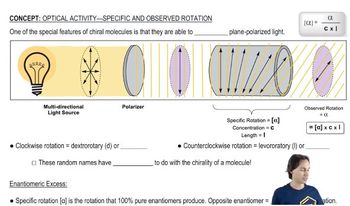
Specific rotation is a property of chiral compounds that quantifies their ability to rotate plane-polarized light. It is defined as the observed rotation of light (in degrees) divided by the path length of the sample (in decimeters) and the concentration of the solution (in grams per milliliter). This value is temperature and wavelength dependent, and for glucose, it is typically reported at 20 °C using the sodium D line.
Video consigliato:
05:43
Specific rotation vs. observed rotation.

Observed Rotation

Observed rotation refers to the actual angle by which plane-polarized light is rotated when it passes through a sample in a polarimeter. It is influenced by the concentration of the optically active substance, the length of the polarimeter cell, and the specific rotation of the substance. The observed rotation can be calculated using the formula: [α] = α / (l * c), where [α] is specific rotation, α is observed rotation, l is the path length, and c is concentration.
Video consigliato:
05:43
Specific rotation vs. observed rotation.

Concentration Calculation

Concentration in this context refers to the amount of solute (glucose) present in a given volume of solution. It is typically expressed in grams per liter (g/L) or grams per milliliter (g/mL). For the given problem, the concentration of glucose can be calculated by dividing the mass of glucose (2.54 g) by the volume of the solution (1 L), which is essential for determining the observed rotation using the specific rotation formula.
Video consigliato:
04:37
Draw all of the monochlorination products and calculate percentage yields.
Pratica correlata
Domanda del libro di testo

Based on the absolute configuration of (S)-butan-2-ol, what can you say about the direction it rotates plane-polarized light?

1349
views

Domanda del libro di testo

A student wanted to measure the specific rotation of the following propionate derivative (density = 1.12 g/ml).

A sample of the pure compound was placed in a 10.0-cm polarimeter tube, and using the sodium D line, the observed rotation at 20°C was determined to be +46.6° . What is the specific rotation of the propionate derivative?

900
views
Domanda del libro di testo

Imagine a sample that is enriched in the R enantiomer. If the % ee of the sample is 83%,

(a) what percent of the mixture is racemic?

(b) What is the ratio of R to S?

1269
views
Domanda del libro di testo

(S)-Propranolol, a drug used for the treatment of anxiety, has a specific rotation of -25.5° . Attempting to prepare it in enantiopure form, a chemist produced a compound that gave a specific rotation of -18.3° . What is the ratio of (S)- to (R)-propranolol produced by the chemist?

1026
views
Domanda del libro di testo

(R)-Selegiline, a monoamine oxidase (MAO) inactivator, was approved by the FDA in 1989 for the treatment of Parkinson's disease. In pure form, it has a specific rotation, [α]²⁰D = - 11.0°. What is the expected specific rotation of a mixture containing 64% S and 36% R?

881
views
Domanda del libro di testo

Cholesterol (50 mg) was dissolved in 10 mL of chloroform and placed in a 1.0-cm polarimeter cell. This solution produced an observed rotation (using the sodium D line at 20°C ) of - 1.58° . What is the specific rotation of cholesterol?

972
views