
Ch. 6 - Stereoisomerism: Arrangement of Atoms in Space
Mullins - Organic Chemistry: A Learner Centered Approach 1st Edition
Mullins1st EditionOrganic Chemistry: A Learner Centered ApproachISBN: 9780137566471Non è quello che usi tu?Cambia libro di testo
Capitolo 5, Problema 28

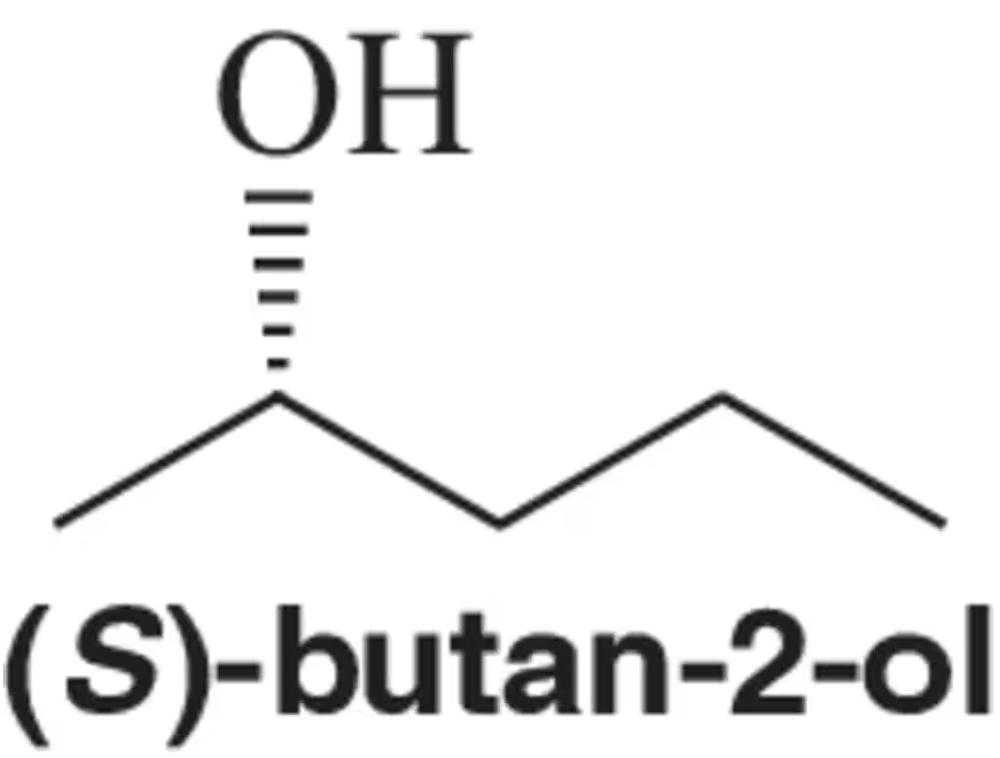
Based on the absolute configuration of (S)-butan-2-ol, what can you say about the direction it rotates plane-polarized light?
Chemical structure of (S)-butan-2-ol, showing the hydroxyl group and its absolute configuration.

Guida verificata passo dopo passo
1
Step 1: Understand the relationship between absolute configuration and optical activity. The absolute configuration (R or S) of a chiral molecule does not directly determine the direction (dextrorotatory or levorotatory) in which it rotates plane-polarized light.
Step 2: Recall that the direction of rotation of plane-polarized light (optical activity) is an experimental property and is denoted as (+) for dextrorotatory (clockwise) or (-) for levorotatory (counterclockwise). This property must be determined experimentally.
Step 3: Note that (S)-butan-2-ol has the absolute configuration 'S', but this does not imply whether it is (+) or (-). For example, (S)-butan-2-ol is known to rotate plane-polarized light in the counterclockwise direction, making it levorotatory (-).
Step 4: Emphasize that the correlation between absolute configuration and optical rotation is specific to each compound and cannot be generalized. Experimental data is required to determine the optical rotation.
Step 5: Conclude that while the absolute configuration of (S)-butan-2-ol is known, its optical rotation direction (counterclockwise, or levorotatory) must be experimentally verified and is not inherently linked to the 'S' configuration.

Risposta video verificata per un problema simile:

Questa soluzione video è stata consigliata dai nostri tutor come utile per risolvere questo problema.
Durata del video:
1m

Concetti chiave

Ecco i concetti essenziali che devi comprendere per rispondere correttamente alla domanda.

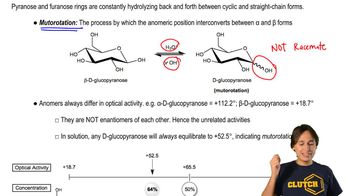
Optical Activity

Optical activity refers to the ability of chiral compounds to rotate the plane of polarized light. This property arises from the asymmetry in the molecular structure, which allows chiral molecules to interact differently with light. The direction of rotation can be either clockwise (dextrorotatory) or counterclockwise (levorotatory), and is denoted by the symbols '+' or '−'.
Video consigliato:
08:17
Mutarotation and Optical Activity

Absolute Configuration

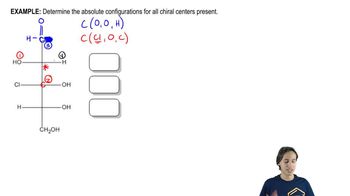
Absolute configuration describes the spatial arrangement of atoms in a chiral molecule, designated as either 'R' (rectus) or 'S' (sinister) based on the Cahn-Ingold-Prelog priority rules. For (S)-butan-2-ol, the 'S' configuration indicates a specific three-dimensional arrangement of its substituents around the chiral center, which influences its optical activity.
Video consigliato:
05:25
Determining Absolute Configurations

Chirality and Stereoisomers

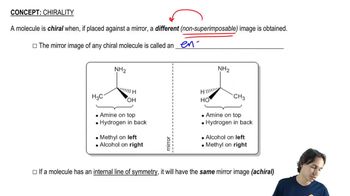
Chirality is a property of a molecule that makes it non-superimposable on its mirror image, leading to the existence of stereoisomers. These stereoisomers, such as (R)- and (S)- forms of butan-2-ol, can exhibit different physical properties, including the direction in which they rotate polarized light. Understanding chirality is crucial for predicting the behavior of organic compounds in optical activity.
Video consigliato:
05:10
What is chirality?
Pratica correlata
Domanda del libro di testo

Using a 1.0-cm polarimeter cell and a solution prepared by dissolving 2.54 g of glucose in 1 L of H₂O, the specific rotation of d-glucose was calculated to be +52.7° at 20 °C using the sodium D line as the source of light. What was the observed rotation of the solution?

1107
views
Domanda del libro di testo

Naproxen is a commercially available anti-inflammatory sold under the name Aleve.

(a) Assign the absolute configuration as R or S.

1548
views
Domanda del libro di testo

A student wanted to measure the specific rotation of the following propionate derivative (density = 1.12 g/ml).

A sample of the pure compound was placed in a 10.0-cm polarimeter tube, and using the sodium D line, the observed rotation at 20°C was determined to be +46.6° . What is the specific rotation of the propionate derivative?

900
views
Domanda del libro di testo

Naproxen is a commercially available anti-inflammatory sold under the name Aleve.

(b) Given that naproxen rotates plane-polarized light in the clockwise direction, should it be referred to as (d) or (l)?

(c) Is it (+) or (-)?

(d) What direction (d or l; + or −) would you expect the enantiomer of naproxen to rotate plane-polarized light?

1479
views
Domanda del libro di testo

Cholesterol (50 mg) was dissolved in 10 mL of chloroform and placed in a 1.0-cm polarimeter cell. This solution produced an observed rotation (using the sodium D line at 20°C ) of - 1.58° . What is the specific rotation of cholesterol?

972
views
Domanda del libro di testo

(R)-Limonene is a cyclic terpene responsible for the smell of oranges and other citrus fruits.

(a) Given that (R)-limonene rotates plane-polarized light in the clockwise direction, should it be referred to as (d) or (l)?

(b) Is it (+) or (-)?

(c) What direction (d or l; + or −) would you expect (S)-limonene to rotate plane-polarized light?

1169
views