 Indietro
Chapter 6: Learning – Introduction to Psychology Study Notes
Guida di studio - Note intelligenti
 Appunti personalizzati basati sui tuoi materiali, ampliati con definizioni chiave, esempi e contesto.
Chapter 6: Learning
Overview of Learning
Learning is a fundamental psychological process involving a change in behavior or thought as a result of experience. It encompasses various mechanisms, including classical conditioning, operant conditioning, cognitive models, and biological influences.
Classical Conditioning
Definition and Key Concepts
Classical conditioning is a type of learning in which an organism learns to associate two stimuli, resulting in a change in behavior. This process was first systematically studied by Ivan Pavlov.
Neutral Stimulus (NS): A stimulus that does not elicit a response initially.
Unconditioned Stimulus (UCS): A stimulus that naturally elicits a response.
Unconditioned Response (UCR): The natural response to the UCS.
Conditioned Stimulus (CS): Previously neutral, now elicits a response after association.
Conditioned Response (CR): The learned response to the CS.
Example: Pavlov's dog experiment: Food (UCS) causes salivation (UCR); a metronome (NS) is paired with food, eventually causing salivation (CR) when presented alone (CS).






Principles of Classical Conditioning
Acquisition: The process of learning the conditioned response by pairing the CS with the UCS.
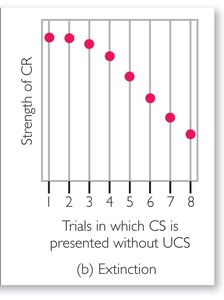
Extinction: The gradual weakening and disappearance of the CR when the CS is presented without the UCS.
Spontaneous Recovery: The reappearance of the CR after a period of extinction.
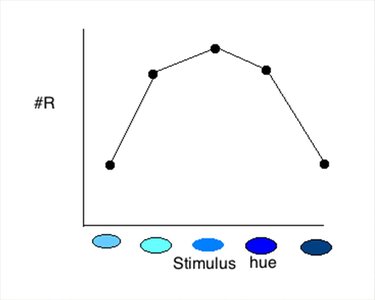
Stimulus Generalization: The tendency for stimuli similar to the CS to elicit the CR.
Stimulus Discrimination: The ability to distinguish between the CS and other similar stimuli.
Higher Order Conditioning: Using a CS as if it were a UCS to condition a new NS.



Applications and Examples
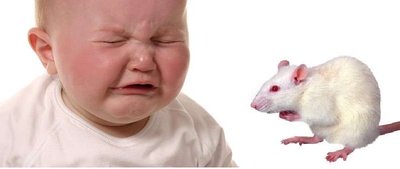
Phobias: Classical conditioning can explain the development of irrational fears.
Advertising: Pairing products with positive stimuli to elicit favorable responses.
Conditioned Taste Aversion: Learning to avoid foods associated with illness.

Operant Conditioning
Definition and Key Concepts
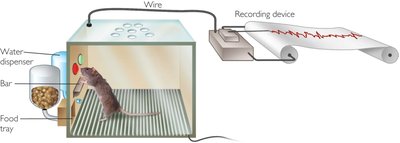
Operant conditioning is a learning process in which behavior is shaped by consequences such as rewards and punishments. The Law of Effect states that behaviors followed by favorable consequences are more likely to be repeated.
Reinforcement: Increases the probability of a behavior.
Punishment: Decreases the probability of a behavior.
Positive Reinforcement: Adding a desirable stimulus.
Negative Reinforcement: Removing an undesirable stimulus.
Positive Punishment: Adding an undesirable stimulus.
Negative Punishment: Removing a desirable stimulus.


Key Differences Between Classical and Operant Conditioning
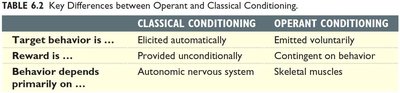
Classical Conditioning | Operant Conditioning |
|---|---|
Elicited automatically | Emitted voluntarily |
Reward provided unconditionally | Reward contingent on behavior |
Autonomic nervous system | Skeletal muscles |

Distinguishing Reinforcement from Punishment
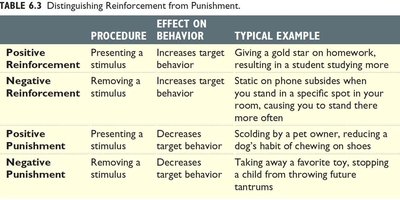
Procedure | Effect on Behavior | Typical Example |
|---|---|---|
Positive Reinforcement | Increases target behavior | Giving a gold star on homework |
Negative Reinforcement | Increases target behavior | Static on phone subsides when you stand in a specific spot |
Positive Punishment | Decreases target behavior | Scolding by a pet owner |
Negative Punishment | Decreases target behavior | Taking away a favorite toy |

Schedules of Reinforcement
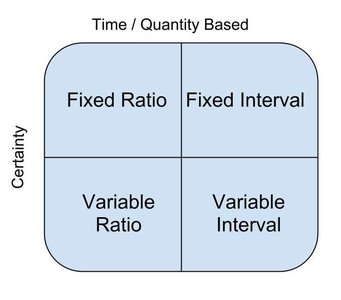
Reinforcement can be delivered on different schedules, affecting how quickly and strongly behaviors are learned.
Continuous Reinforcement: Reward given every time.
Partial (Intermittent) Reinforcement: Reward given only some of the time.
Fixed Ratio: Reward after a set number of responses.
Variable Ratio: Reward after a variable number of responses.
Fixed Interval: Reward after a set amount of time.
Variable Interval: Reward after a variable amount of time.
Primary and Secondary Reinforcers
Primary Reinforcers: Naturally increase target behavior (e.g., food, drink).
Secondary Reinforcers: Neutral objects associated with primary reinforcers (e.g., tokens, clicks).
Cognitive Models of Learning
S-R vs S-O-R Theory
Early behaviorists focused on the Stimulus-Response (S-R) model, ignoring internal processes. The S-O-R model recognizes that interpretation, perception, and motivation affect responses, accounting for individual differences.
Latent Learning
Latent learning is learning that occurs without immediate demonstration or reinforcement. Tolman & Honzik's maze experiments showed that rats could learn the layout of a maze without rewards, demonstrating competence vs. performance.
Observational Learning
Observational learning occurs when individuals learn by watching others, without direct reinforcement. Bandura's experiments demonstrated that people can acquire new behaviors simply by observing others.
Applications: Media and aggression; evidence suggests watching violent media increases aggressive behavior.
Mirror Neurons: Neurons that fire when observing others, implicated in empathy.
Insight Learning
Insight learning involves sudden understanding or problem-solving, often described as "Aha!" moments. Köhler's chimpanzees demonstrated this by solving problems after a period of contemplation.
Biological Influences on Learning
Conditioned Taste Aversion
Conditioned taste aversion is a unique form of classical conditioning where an organism learns to avoid a food after a single pairing with illness, even with long delays. This is adaptive and shows evidence against equipotentiality—the idea that all stimuli are equally easy to condition.
Preparedness and Phobias
Humans are evolutionarily predisposed to fear certain stimuli (e.g., snakes, spiders) more than others (e.g., cars, guns). Instinctive drift refers to the tendency to revert to innate behaviors despite conditioning.
Learning Fads
Sleep-Assisted Learning
Research shows that sleep-assisted learning is mostly ineffective, except when it disrupts sleep.
Accelerated Learning
Programs claiming to dramatically increase learning speed often lack scientific support and have poor control groups.
Learning Styles
Evidence suggests that the quality of teaching is more important than matching instruction to individual learning styles.
Summary Table: Key Differences Between Classical and Operant Conditioning
Aspect | Classical Conditioning | Operant Conditioning |
|---|---|---|
Target behavior | Elicited automatically | Emitted voluntarily |
Reward | Provided unconditionally | Contingent on behavior |
Behavior depends on | Autonomic nervous system | Skeletal muscles |
Summary Table: Reinforcement vs Punishment
Procedure | Effect on Behavior | Typical Example |
|---|---|---|
Positive Reinforcement | Increases target behavior | Giving a gold star on homework |
Negative Reinforcement | Increases target behavior | Static on phone subsides when you stand in a specific spot |
Positive Punishment | Decreases target behavior | Scolding by a pet owner |
Negative Punishment | Decreases target behavior | Taking away a favorite toy |
Additional info: Academic context and examples have been expanded for clarity and completeness. Only images directly relevant to the explanation have been included.
