
Ch. 1 Introduction to Anatomy and Physiology
Amerman- Human Anatomy & Physiology 3e
Amerman3rd EditionHuman Anatomy & PhysiologyISBN: 9780138247201, 9780138247928, 9780138201814Non è quello che usi tu?Cambia libro di testo
Capitolo 1, Problema L3.4

The baroreceptor reflex causes blood pressure to drop when it rises dangerously high. Predict whether this is a positive or negative feedback loop. Explain your reasoning.

Guida verificata passo dopo passo
1
Understand the concept of feedback loops: Feedback loops are mechanisms the body uses to maintain homeostasis. A positive feedback loop amplifies a change, while a negative feedback loop counteracts a change to restore balance.
Identify the role of the baroreceptor reflex: Baroreceptors are specialized sensory receptors located in the walls of blood vessels, such as the carotid arteries and aorta. They detect changes in blood pressure and send signals to the brain to adjust it.
Analyze the response to high blood pressure: When blood pressure rises dangerously high, baroreceptors send signals to the cardiovascular center in the brainstem. The brain responds by decreasing heart rate and dilating blood vessels, which lowers blood pressure.
Determine the type of feedback: Since the baroreceptor reflex works to counteract the rise in blood pressure and restore it to a normal range, this is an example of a negative feedback loop. Negative feedback loops are characterized by their ability to reverse a deviation from a set point.
Explain the reasoning: The baroreceptor reflex is a negative feedback loop because it reduces the initial stimulus (high blood pressure) by activating mechanisms that lower blood pressure, thereby maintaining homeostasis.

Risposta video verificata per un problema simile:

Questa soluzione video è stata consigliata dai nostri tutor come utile per risolvere questo problema.

Concetti chiave

Ecco i concetti essenziali che devi comprendere per rispondere correttamente alla domanda.

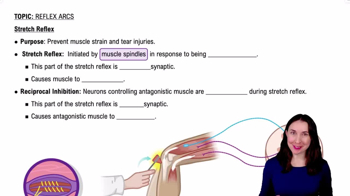
Baroreceptor Reflex

The baroreceptor reflex is a physiological mechanism that helps regulate blood pressure. Baroreceptors, located in the carotid arteries and aorta, detect changes in blood pressure and send signals to the central nervous system. When blood pressure rises, the reflex triggers a response to lower it, primarily through vasodilation and decreased heart rate.
Video consigliato:
3:37
Stretch Reflex

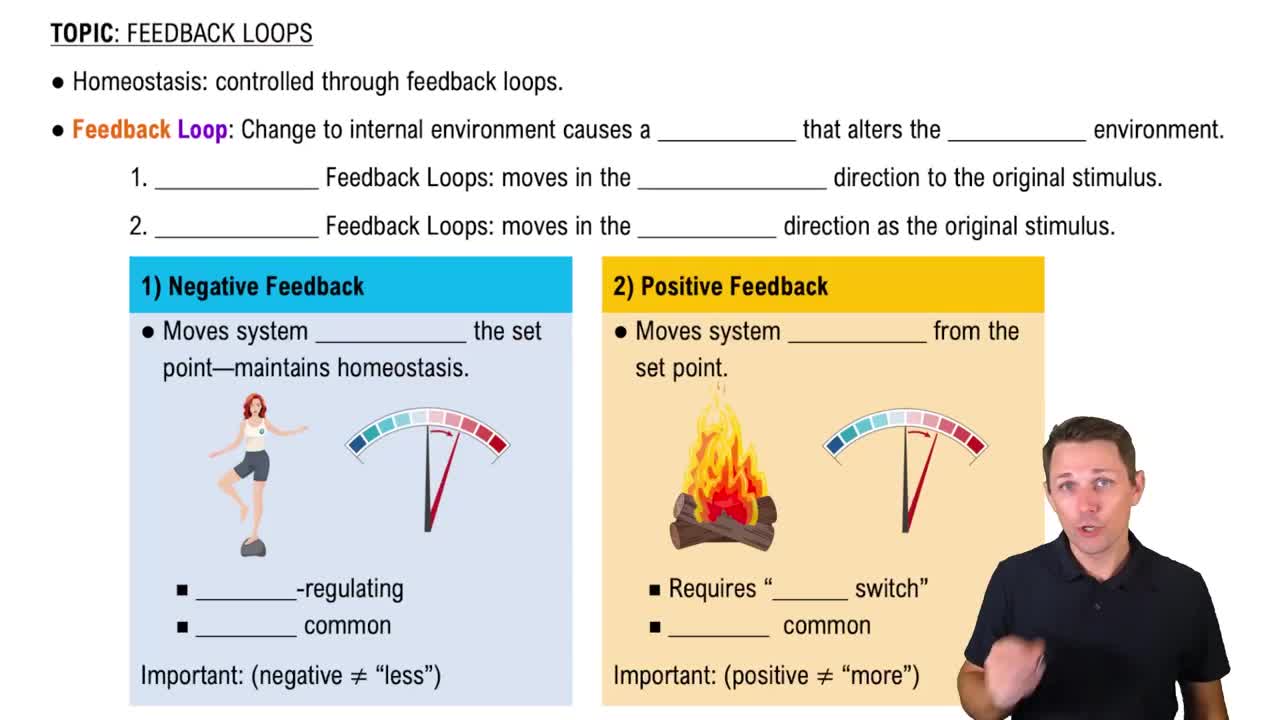
Feedback Loops

Feedback loops are processes in which the output of a system influences its own operation. They can be classified as positive or negative feedback. Positive feedback amplifies changes, leading to an increase in the output, while negative feedback counteracts changes, promoting stability and returning the system to its set point.
Video consigliato:
04:09
Introduction to Feedback Loops

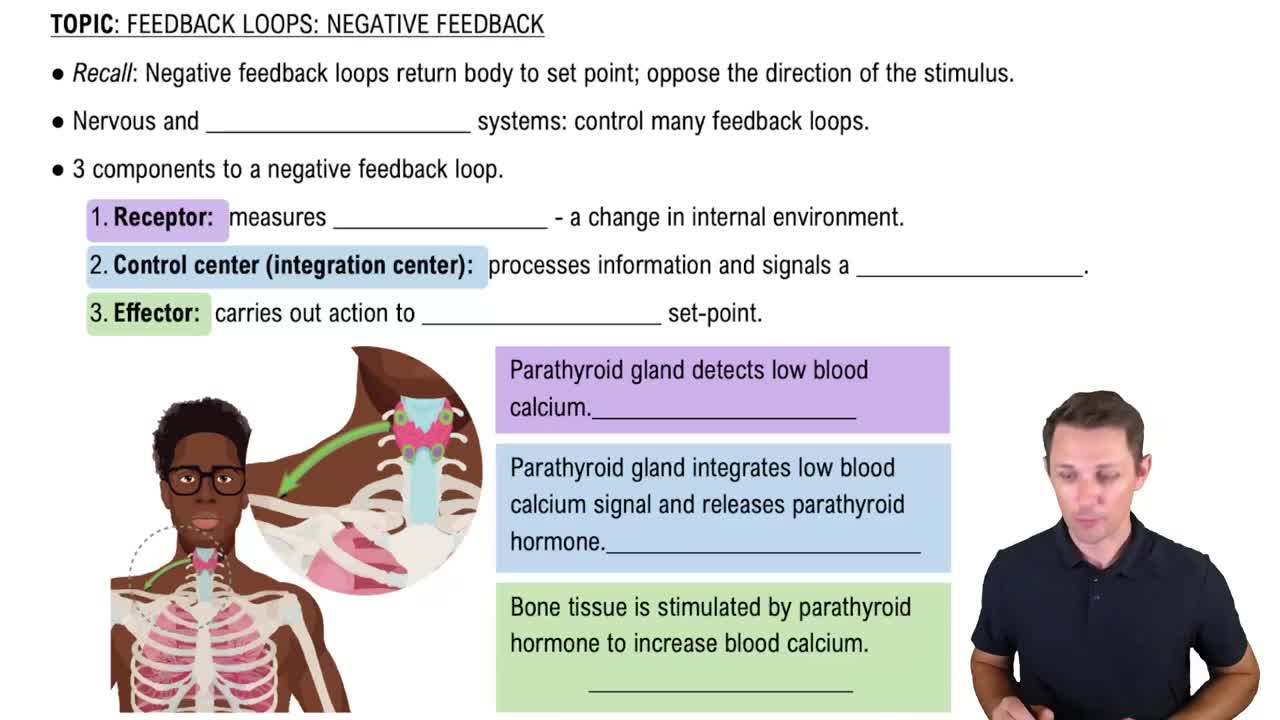
Negative Feedback

Negative feedback is a regulatory mechanism that reduces the output or activity of a system when it deviates from a desired state. In the context of the baroreceptor reflex, when blood pressure rises, the reflex acts to lower it, demonstrating a negative feedback loop. This mechanism is crucial for maintaining homeostasis in the cardiovascular system.
Video consigliato:
03:26
Negative Feedback Loops
Pratica correlata
Domanda del libro di testo

Mark the following statements as true or false. If a statement is false, correct it to make a true statement.

The anatomical position features the person facing forward, feet shoulder-width apart, and palms facing posteriorly.

688
views
Domanda del libro di testo

During a procedure on Ms. Norman's pancreas, a surgeon makes the initial incision in the left anterior hypochondriac region. List all the organs, serous membranes, and body cavities that the surgeon will encounter as she moves through the body to get to the pancreas. (Hint: Refer to A&P in the Real World: Abdominal Pain for help.)

889
views
Domanda del libro di testo

Ms. Norman presents to the clinic with right upper quadrant pain. Predict the organs and cavities that may be involved in causing her pain.

648
views
Domanda del libro di testo

Later that same day, the surgeon performs a procedure on Ms. Norman's right kidney. She makes the incision in the right posterior lumbar region. Will she cut through the same serous membrane(s) and cavities as in the previous procedure? Why or why not? How would this change if the incision were made on the anterior lumbar region?

677
views
Domanda del libro di testo

Mark the following statements as true or false. If a statement is false, correct it to make a true statement.

Living organisms react to changes in their environment known as stimuli.

772
views
Domanda del libro di testo

Groups of many cells working together to perform a common function are known as a(n):

a. Cell

b. Organ

c. Organ system

d. Tissue

2966
views
1
rank