Ch. 10 Muscle Tissue and Physiology
Amerman- Human Anatomy & Physiology 3e
Amerman3rd EditionHuman Anatomy & PhysiologyISBN: 9780138247201, 9780138247928, 9780138201814Non è quello che usi tu?Cambia libro di testo
Capitolo 10, Problema L3.3

Ms. Sanchez was in a motorcycle accident in which she lost the use of her right upper limb muscles due to significant nerve damage. However, when an electrode is inserted into her muscles, they are able to contract. Explain specifically why nerve damage caused her to lose the use of her muscles. Why can they still respond to stimulation from an electrode?

Guida verificata passo dopo passo
1
Understand the role of nerves in muscle contraction: Nerves are responsible for transmitting electrical signals (action potentials) from the central nervous system to muscles. These signals travel along motor neurons and stimulate the release of neurotransmitters, such as acetylcholine, at the neuromuscular junction. This triggers muscle contraction.
Explain the impact of nerve damage: In Ms. Sanchez's case, the nerve damage has disrupted the communication between her central nervous system and the muscles in her right upper limb. Without this communication, her muscles cannot receive the necessary signals to contract voluntarily.
Describe the role of electrodes in muscle stimulation: When an electrode is inserted into her muscles, it bypasses the damaged nerves and directly stimulates the muscle fibers. The electrode generates an electrical current that depolarizes the muscle cell membrane, mimicking the natural action potential that would normally come from the nerves.
Clarify why muscles still respond to electrodes: The muscle fibers themselves are still functional and capable of contracting. The issue lies in the damaged nerves, not the muscles. Since the electrode provides an external source of electrical stimulation, it can directly activate the muscle fibers, causing them to contract.
Summarize the distinction: Ms. Sanchez's inability to use her muscles voluntarily is due to the loss of nerve function, which prevents the transmission of signals from her brain to her muscles. However, the muscles remain intact and can still respond to artificial stimulation, such as that provided by an electrode.

Risposta video verificata per un problema simile:

Questa soluzione video è stata consigliata dai nostri tutor come utile per risolvere questo problema.

Concetti chiave

Ecco i concetti essenziali che devi comprendere per rispondere correttamente alla domanda.

Nerve Damage and Muscle Function

Nerve damage disrupts the communication between the nervous system and muscles, leading to loss of voluntary control. Motor neurons, which transmit signals from the brain to the muscles, become impaired, preventing the brain's commands from reaching the muscles. This results in muscle weakness or paralysis, as seen in Ms. Sanchez's case.
Video consigliato:
Percorso guidato
06:04
Functional Groups

Electrode Stimulation

Electrodes can stimulate muscles directly by bypassing the damaged nerves. When an electrode is inserted into the muscle, it delivers electrical impulses that cause the muscle fibers to contract. This mechanism allows the muscle to respond even when the nerve supply is compromised, demonstrating that the muscle tissue itself can still function independently of nerve signals.
Video consigliato:
Percorso guidato
07:41
Electron Transport Chain

Muscle Contraction Mechanism

Muscle contraction occurs through the interaction of actin and myosin filaments within muscle fibers. When stimulated, these filaments slide past each other, resulting in contraction. This process can still occur in Ms. Sanchez's muscles when stimulated by an electrode, as the muscle's intrinsic mechanisms remain intact despite the loss of nerve input.
Video consigliato:
4:53
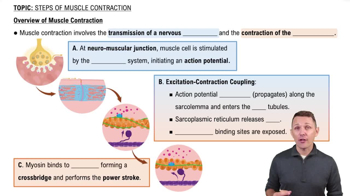
Overview of Muscle Contraction
Pratica correlata
Domanda del libro di testo

Mark the following statements as true or false. If a statement is false, correct it to make a true statement.

Muscle cells are contractile, conductive, distensible cells.

811
views

Domanda del libro di testo

Paola is a 3-year-old girl with a disease that reduces the ability of her mitochondria to generate ATP. Explain the specific effects of this disease on the ability of Paola's muscles to function properly. What other tissues and organs are likely to be especially affected by her disease, and why?

700
views
Domanda del libro di testo

The primary action of the biceps brachii muscle of the anterior arm is to flex the forearm at the elbow. However, when this muscle is inflamed, pain is felt in the shoulder. Explain this finding.

880
views
Domanda del libro di testo

How does a skeletal muscle fiber differ structurally from typical cells?

1050
views
1
rank
Domanda del libro di testo

Some athletes will consume only protein for several days before a competition, which reduces the amount of glycogen in both the muscle fibers and the liver. What effect would this have on their ability to perform activities that require short, powerful bursts of activity? How would it affect their ability to perform endurance activities?

811
views
Domanda del libro di testo

Jesse is a 2-year-old boy who presents with difficulty in walking and poor control of movements. When the doctor examines Jesse, she notices that when his muscles contract, they are very slow to relax and remain contracted well after the movement has been performed. She sends a sample of his tissue for genetic analysis, and the lab reports a genetic defect that causes the pumps in the SR to operate much more slowly than normal. How does a defect in DNA lead to a malfunctioning protein? How does this finding explain Jesse's symptoms?

753
views