Ch. 12 The Central Nervous System
Amerman- Human Anatomy & Physiology 3e
Amerman3rd EditionHuman Anatomy & PhysiologyISBN: 9780138247201, 9780138247928, 9780138201814Non è quello che usi tu?Cambia libro di testo
Capitolo 12, Problema 11b

Mark the following statements about the spinal cord as true or false. If a statement is false, correct it to make a true statement.
The spinal cord extends from the foramen magnum to the level between the first and second lumbar vertebrae.

Guida verificata passo dopo passo
1
Step 1: Understand the anatomy of the spinal cord. The spinal cord is a cylindrical structure that extends from the brainstem (specifically the medulla oblongata) through the foramen magnum, which is the large opening at the base of the skull.
Step 2: Identify the endpoint of the spinal cord. The spinal cord typically terminates at the level of the first or second lumbar vertebra (L1-L2) in adults, forming a structure called the conus medullaris.
Step 3: Evaluate the statement provided. The statement says, 'The spinal cord extends from the foramen magnum to the level between the first and second lumbar vertebrae.' This matches the anatomical description of the spinal cord's extent.
Step 4: Determine whether the statement is true or false. Since the statement accurately describes the anatomical range of the spinal cord, it is true.
Step 5: If the statement were false, you would need to correct it by specifying the accurate anatomical range of the spinal cord, but in this case, no correction is necessary as the statement is true.

Risposta video verificata per un problema simile:

Questa soluzione video è stata consigliata dai nostri tutor come utile per risolvere questo problema.

Concetti chiave

Ecco i concetti essenziali che devi comprendere per rispondere correttamente alla domanda.

Anatomy of the Spinal Cord

The spinal cord is a cylindrical structure that extends from the base of the brain (foramen magnum) down to the lower back, typically ending at the level of the first or second lumbar vertebra (L1-L2) in adults. This anatomical knowledge is crucial for understanding the organization and function of the central nervous system.
Video consigliato:
4:14
Clitoral Anatomy

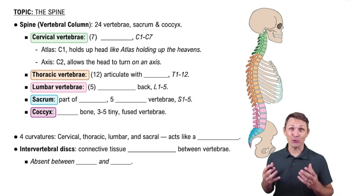
Vertebral Column

The vertebral column, or spine, is made up of individual vertebrae that protect the spinal cord and provide structural support. It consists of cervical, thoracic, lumbar, sacral, and coccygeal regions, with the lumbar region being particularly important for lower back function and mobility.
Video consigliato:
6:29
Spine (Vertebral Column)

Spinal Cord Segmentation

The spinal cord is segmented into regions that correspond to the vertebrae: cervical, thoracic, lumbar, sacral, and coccygeal. Each segment gives rise to spinal nerves that innervate specific body areas, making it essential to understand these segments for diagnosing and treating neurological conditions.
Video consigliato:
7:55
Structure of the Sympathetic Nervous System