
Ch. 13 The Peripheral Nervous System
Amerman- Human Anatomy & Physiology 3e
Amerman3rd EditionHuman Anatomy & PhysiologyISBN: 9780138247201, 9780138247928, 9780138201814Non è quello che usi tu?Cambia libro di testo
Capitolo 13, Problema 1a

Mark the following statements as true or false. If a statement is false, correct it to make a true statement.


a. The somatic sensory division of the PNS detects sensory stimuli from the organs in the thoracic and abdominopelvic cavities.

Guida verificata passo dopo passo
1
Step 1: Understand the terminology in the statement. The somatic sensory division of the peripheral nervous system (PNS) is responsible for detecting sensory stimuli from the skin, muscles, bones, and joints, not from internal organs. Sensory stimuli from internal organs are detected by the visceral sensory division of the PNS.
Step 2: Analyze the statement provided. The statement claims that the somatic sensory division detects sensory stimuli from organs in the thoracic and abdominopelvic cavities. This is incorrect because these organs are part of the visceral sensory division's domain.
Step 3: Correct the false statement. Replace 'somatic sensory division' with 'visceral sensory division' to make the statement true. The corrected statement should read: 'The visceral sensory division of the PNS detects sensory stimuli from the organs in the thoracic and abdominopelvic cavities.'
Step 4: Review the corrected statement to ensure it aligns with the functions of the visceral sensory division, which is responsible for monitoring internal organ activity and transmitting sensory information to the central nervous system.
Step 5: Confirm the distinction between somatic and visceral sensory divisions to reinforce understanding. The somatic sensory division deals with external stimuli (e.g., touch, pain, temperature), while the visceral sensory division handles internal stimuli from organs.

Risposta video verificata per un problema simile:

Questa soluzione video è stata consigliata dai nostri tutor come utile per risolvere questo problema.

Concetti chiave

Ecco i concetti essenziali che devi comprendere per rispondere correttamente alla domanda.

Somatic Sensory Division

The somatic sensory division of the peripheral nervous system (PNS) is responsible for transmitting sensory information from the skin, muscles, and joints to the central nervous system (CNS). It primarily detects stimuli related to touch, temperature, pain, and proprioception, which helps the body understand its position and movement in space.
Video consigliato:
Percorso guidato
09:40
Introduction to Cell Division

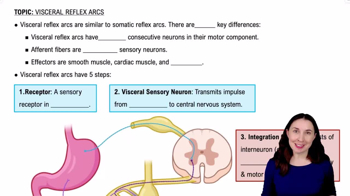
Visceral Sensory Division

The visceral sensory division of the PNS is responsible for conveying sensory information from the internal organs, particularly those in the thoracic and abdominopelvic cavities, to the CNS. This division detects sensations such as hunger, thirst, and the fullness of the bladder, which are crucial for maintaining homeostasis and responding to internal bodily states.
Video consigliato:
2:12
Visceral Reflex Arcs

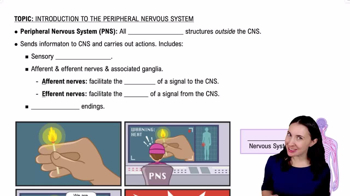
Peripheral Nervous System (PNS)

The peripheral nervous system (PNS) consists of all the nerves outside the brain and spinal cord, connecting the CNS to limbs and organs. It is divided into the somatic and autonomic nervous systems, with the somatic system controlling voluntary movements and sensory information, while the autonomic system regulates involuntary functions like heart rate and digestion.
Video consigliato:
3:33
Peripheral Nervous System