Ch. 13 The Peripheral Nervous System
Amerman- Human Anatomy & Physiology 3e
Amerman3rd EditionHuman Anatomy & PhysiologyISBN: 9780138247201, 9780138247928, 9780138201814Non è quello che usi tu?Cambia libro di testo
Capitolo 13, Problema 5

Which cranial nerves are (a) sensory only, (b) primarily motor, and (c) mixed?

Guida verificata passo dopo passo
1
Step 1: Understand the classification of cranial nerves based on their function. Cranial nerves can be categorized as sensory (carrying sensory information), motor (controlling muscle movements), or mixed (having both sensory and motor functions).
Step 2: Identify the cranial nerves that are sensory only. These include cranial nerves responsible for senses like smell, vision, and hearing. Examples are the Olfactory nerve (CN I), Optic nerve (CN II), and Vestibulocochlear nerve (CN VIII).
Step 3: Identify the cranial nerves that are primarily motor. These nerves control muscle movements, such as those involved in eye movement or tongue movement. Examples include the Oculomotor nerve (CN III), Trochlear nerve (CN IV), Abducens nerve (CN VI), Accessory nerve (CN XI), and Hypoglossal nerve (CN XII).
Step 4: Identify the cranial nerves that are mixed. These nerves have both sensory and motor components, such as controlling muscles while also transmitting sensory information. Examples include the Trigeminal nerve (CN V), Facial nerve (CN VII), Glossopharyngeal nerve (CN IX), and Vagus nerve (CN X).
Step 5: Summarize the classification: (a) Sensory only: CN I, CN II, CN VIII; (b) Primarily motor: CN III, CN IV, CN VI, CN XI, CN XII; (c) Mixed: CN V, CN VII, CN IX, CN X.

Risposta video verificata per un problema simile:

Questa soluzione video è stata consigliata dai nostri tutor come utile per risolvere questo problema.

Concetti chiave

Ecco i concetti essenziali che devi comprendere per rispondere correttamente alla domanda.

Cranial Nerves

Cranial nerves are a set of twelve pairs of nerves that emerge directly from the brain, primarily responsible for sensory and motor functions of the head and neck. Each cranial nerve has a specific role, such as transmitting sensory information or controlling muscle movements. Understanding their classification is essential for identifying their functions.
Video consigliato:
8:20
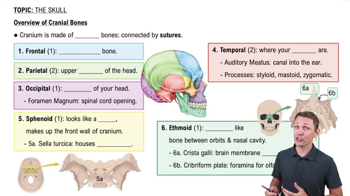
Overview of Cranial Bones

Sensory, Motor, and Mixed Nerves

Cranial nerves can be classified into three categories: sensory nerves, which carry sensory information to the brain; motor nerves, which transmit signals from the brain to muscles; and mixed nerves, which contain both sensory and motor fibers. This classification helps in understanding the specific functions and pathways of each cranial nerve.
Video consigliato:
1:36
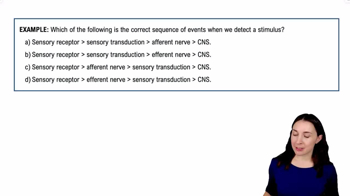
Introduction to Sensory Receptors Example 1

Function of Specific Cranial Nerves

Each cranial nerve has distinct functions and is designated by Roman numerals I through XII. For example, the olfactory nerve (I) is sensory only, responsible for smell, while the facial nerve (VII) is mixed, controlling facial expressions and conveying taste sensations. Familiarity with these functions is crucial for accurately answering questions about cranial nerves.
Video consigliato:
8:20
Overview of Cranial Bones
Pratica correlata
Domanda del libro di testo

Why is visceral pain often perceived as cutaneous pain?

810
views

Domanda del libro di testo

A receptor potential:

a. Always leads to an action potential

b. Never leads to an action potential

c. Causes hyperpolarization of the neuron

d. Leads to an action potential if the stimulus is strong enough

1056
views
Domanda del libro di testo

First-order somatic sensory neurons are_____neurons whose cell bodies are located in the_____.


a. Multipolar, posterior horn

b. Pseudounipolar, posterior root ganglion

c. Bipolar, anterior horn

d. Pseudounipolar, posterior horn

732
views
Domanda del libro di testo

First, write the Roman numeral that corresponds to each named cranial nerve (after the abbreviation CN). Second, match the cranial nerve with its correct function from the column on the right.


CN____               

______Vestibulocochlear nerve

CN____           

______Trigeminal nerve

CN____           

_______Hypoglossal nerve

CN____           

_______Abducens nerve

CN____           

_______Vagus nerve

CN____           

_______Olfactory nerve

CN____            

_______Accessory nerve

CN____           

_______Oculomotor nerve

CN____           

_______Facial nerve

CN____           

_______Optic nerve

CN____           

_______Glossopharyngeal nerve

CN____           

_______Trochlear nerve


a. Motor to the lateral rectus muscle

b. Motor to the muscles of facial expression; lacrimation; salivation; taste to the anterior two-thirds of the tongue

c. Sense of smell

d. Motor to the muscles for swallowing; salivation; taste to the posterior one-third of the tongue; somatic sensation from the throat

e. Senses of hearing and equilibrium

f. Motor to the superior oblique muscle

g. Motor to the tongue

h. Motor to the sternocleidomastoid and trapezius muscles

i. Sense of vision

j. Motor to muscles of swallowing and speaking; parasympathetic innervation to thoracic and abdominal viscera; sense of taste from the throat

k. Sensory to the face; motor to the muscles of mastication

l. Motor to four of six extrinsic eye muscles; constricts the pupil; changes the shape of the lens; opens the eyelid

765
views
Domanda del libro di testo

Define each of the following terms in your own words, using 20 or fewer words.

b. Nerve plexus

630
views
Domanda del libro di testo

Define each of the following terms in your own words, using 20 or fewer words.

c. Posterior root ganglion

625
views