Ch. 14 The Autonomic Nervous System and Homeostasis
Amerman- Human Anatomy & Physiology 3e
Amerman3rd EditionHuman Anatomy & PhysiologyISBN: 9780138247201, 9780138247928, 9780138201814Non è quello che usi tu?Cambia libro di testo
Capitolo 14, Problema 17d

Mark the following statements as true or false. If a statement is false, correct it to make a true statement.
d. The crossed-extension reflex occurs simultaneously with the simple stretch reflex.

Guida verificata passo dopo passo
1
Understand the definitions of the reflexes mentioned: The crossed-extension reflex is a polysynaptic reflex that helps maintain balance by extending the opposite limb when the other limb is withdrawn. The simple stretch reflex is a monosynaptic reflex that responds to muscle stretch to maintain muscle length and posture.
Analyze the timing of these reflexes: The crossed-extension reflex typically occurs in response to a noxious stimulus (e.g., stepping on something sharp) and is part of a withdrawal reflex. The simple stretch reflex, on the other hand, is triggered by muscle stretch and is not directly related to noxious stimuli.
Determine if these reflexes are functionally linked: The crossed-extension reflex is associated with the withdrawal reflex, not the simple stretch reflex. They serve different purposes and are not simultaneous processes.
Evaluate the statement: Since the crossed-extension reflex and the simple stretch reflex are not directly connected and do not occur simultaneously, the statement is false.
Correct the false statement: The crossed-extension reflex occurs simultaneously with the withdrawal reflex, not the simple stretch reflex.

Risposta video verificata per un problema simile:

Questa soluzione video è stata consigliata dai nostri tutor come utile per risolvere questo problema.

Concetti chiave

Ecco i concetti essenziali che devi comprendere per rispondere correttamente alla domanda.

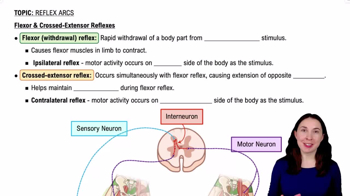
Crossed-Extension Reflex

The crossed-extension reflex is a protective response that occurs when one limb is withdrawn from a painful stimulus, causing the opposite limb to extend. This reflex helps maintain balance and stability during withdrawal from harmful stimuli. It is a polysynaptic reflex, meaning it involves multiple synapses and neurons, allowing for coordinated movement across different parts of the body.
Video consigliato:
2:42
Flexor & Crossed-Extensor Reflexes

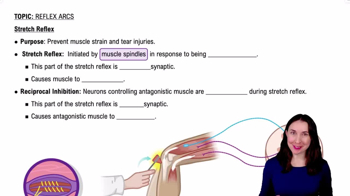
Simple Stretch Reflex

The simple stretch reflex, also known as the monosynaptic reflex, occurs when a muscle is stretched and responds by contracting. This reflex is mediated by a direct connection between sensory neurons and motor neurons in the spinal cord, allowing for a quick response to maintain posture and muscle tone. An example is the knee-jerk reflex, where tapping the patellar tendon causes the quadriceps to contract.
Video consigliato:
3:37
Stretch Reflex

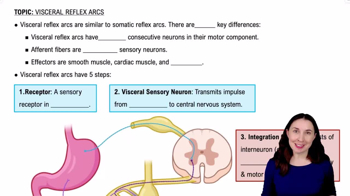
Reflex Arc

A reflex arc is the neural pathway that mediates a reflex action. It typically involves a sensory receptor, sensory neuron, integration center (often in the spinal cord), motor neuron, and an effector (muscle or gland). Understanding the reflex arc is crucial for distinguishing between different types of reflexes, such as monosynaptic and polysynaptic, and their respective roles in the body's response to stimuli.
Video consigliato:
2:12
Visceral Reflex Arcs