
Ch. 15 The Special Senses
Amerman- Human Anatomy & Physiology 3e
Amerman3rd EditionHuman Anatomy & PhysiologyISBN: 9780138247201, 9780138247928, 9780138201814Non è quello che usi tu?Cambia libro di testo
Capitolo 15, Problema 4

The primary olfactory cortex is located in the:
a. Frontal lobe
b. Occipital lobe
c. Parietal lobe
d. Temporal lobe

Guida verificata passo dopo passo
1
Understand the question: The problem is asking about the location of the primary olfactory cortex, which is responsible for processing smells. This requires knowledge of brain anatomy and the functions of its lobes.
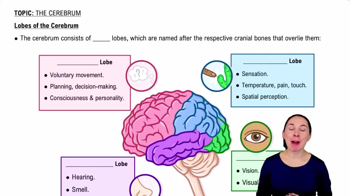
Recall the function of each brain lobe: The frontal lobe is involved in decision-making and motor control, the occipital lobe processes visual information, the parietal lobe handles sensory information like touch, and the temporal lobe is associated with auditory processing and memory, as well as the sense of smell.
Identify the role of the primary olfactory cortex: The primary olfactory cortex is the region of the brain that processes olfactory (smell) information received from the olfactory bulb.
Connect the function of the primary olfactory cortex to the correct lobe: Since the sense of smell is processed in the temporal lobe, the primary olfactory cortex is located there.
Conclude that the correct answer is the temporal lobe, based on the functional association of smell processing with this region of the brain.

Risposta video verificata per un problema simile:

Questa soluzione video è stata consigliata dai nostri tutor come utile per risolvere questo problema.

Concetti chiave

Ecco i concetti essenziali che devi comprendere per rispondere correttamente alla domanda.

Primary Olfactory Cortex

The primary olfactory cortex is the region of the brain responsible for processing smells. It is crucial for the perception of odors and is involved in the identification and discrimination of different scents. This area plays a significant role in the overall sensory experience and is linked to memory and emotion.
Video consigliato:
4:31
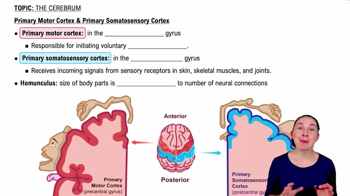
Primary Motor Cortex & Primary Somatosensory Cortex

Brain Lobes

The brain is divided into four main lobes: frontal, parietal, occipital, and temporal. Each lobe has distinct functions; for instance, the frontal lobe is associated with decision-making and problem-solving, while the temporal lobe is primarily involved in auditory processing and memory. Understanding the location and function of these lobes is essential for identifying where specific brain functions occur.
Video consigliato:
2:50
Lobes of the Cerebrum

Temporal Lobe

The temporal lobe is located on the sides of the brain and is primarily responsible for processing auditory information and encoding memory. It houses the primary auditory cortex and is also where the primary olfactory cortex is situated, making it integral to the sense of smell. Recognizing the role of the temporal lobe is key to answering questions related to olfactory processing.
Video consigliato:
2:50
Lobes of the Cerebrum
Pratica correlata
Domanda del libro di testo

Which of the following statements is true regarding gustatory cells?

a. They have microvilli that project into the taste pore.

b. There are only 10–20 gustatory cells in a typical taste bud.

c. They have a lifespan of approximately 6 months.

d. Some form synapses with neurons that give rise to the trigeminal nerve.

828
views
Domanda del libro di testo

Match the taste with the chemical substance that produces it. 

___Sweet      

___Sour     

___Salty      

___Bitter      

___Umami

a. Many alkaloids

b. Sucrose

c. Glutamate

d. Sodium ions

e. Hydrogen ions

834
views
Domanda del libro di testo

Suppose the round window in your middle ear became very stiff. What effect would this have on hearing, and why?

827
views
Domanda del libro di testo

If severe congestion from a cold prevented your pharyngotympanic tube from opening, what could happen to your tympanic membrane? Explain your answer.

708
views
Domanda del libro di testo

Your 60-year-old patient, Mr. Guster, has Bell's palsy, which causes dysfunction of those portions of the facial nerve that control muscles of facial expression. He is surprised when you tell him to tape the eyelids of his right eye closed at night to prevent dryness. Why might Bell's palsy cause dryness of the eye on the affected side?

739
views
Domanda del libro di testo

Which of the following cranial nerves is not involved in the gustatory sense?

a. Vagus nerve (X)

b. Hypoglossal nerve (XII)

c. Facial nerve (VII)

d. Glossopharyngeal nerve (IX)

1425
views