Ch. 19 Blood
Amerman- Human Anatomy & Physiology 3e
Amerman3rd EditionHuman Anatomy & PhysiologyISBN: 9780138247201, 9780138247928, 9780138201814Non è quello che usi tu?Cambia libro di testo
Capitolo 19, Problema 11

Platelets are derived from cells called:
a. Thromboblasts
b. Leukoblasts
c. Megakaryocytes
d. Thrombokaryocytes

Guida verificata passo dopo passo
1
Understand the role of platelets in the body: Platelets are small, disc-shaped cell fragments that play a crucial role in blood clotting and wound healing.
Learn about the origin of platelets: Platelets are derived from larger precursor cells found in the bone marrow.
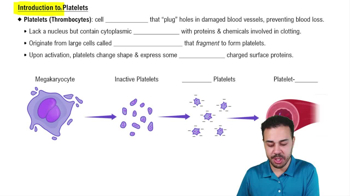
Identify the precursor cell type: The precursor cells responsible for producing platelets are called megakaryocytes. These cells undergo a process called fragmentation to release platelets into the bloodstream.
Clarify the terminology: Thromboblasts, leukoblasts, and thrombokaryocytes are not correct terms for the precursor cells of platelets. Megakaryocytes are the correct answer.
Review the process: Megakaryocytes develop in the bone marrow, and their cytoplasm fragments into small pieces, which become platelets that circulate in the blood.

Risposta video verificata per un problema simile:

Questa soluzione video è stata consigliata dai nostri tutor come utile per risolvere questo problema.

Concetti chiave

Ecco i concetti essenziali che devi comprendere per rispondere correttamente alla domanda.

Platelet Production

Platelets, or thrombocytes, are small cell fragments essential for blood clotting. They are produced in the bone marrow through a process called thrombopoiesis, where large precursor cells called megakaryocytes undergo fragmentation to release platelets into the bloodstream.
Video consigliato:
Percorso guidato
5:16
Introduction to Platelets

Megakaryocytes

Megakaryocytes are large bone marrow cells responsible for the production of platelets. They have a unique structure with a large nucleus and extensive cytoplasmic processes that extend into the blood vessels, where they shed platelets. Understanding their role is crucial for comprehending platelet formation.
Video consigliato:
Percorso guidato
5:16
Introduction to Platelets

Hematopoiesis

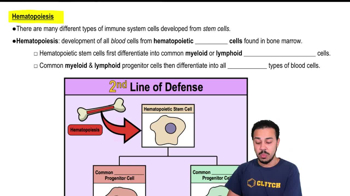
Hematopoiesis is the process of blood cell formation, occurring primarily in the bone marrow. It encompasses the development of all blood cells, including red blood cells, white blood cells, and platelets. This concept is fundamental to understanding how megakaryocytes fit into the broader context of blood cell production.
Video consigliato:
Pratica correlata
Domanda del libro di testo

Leukocytes are:

a. Nucleated cells that function in blood clotting

b. Nucleated cells that function in immunity

c. Anucleate cells that function in blood clotting

d. Anucleate cells that function in immunity

1138
views

Domanda del libro di testo

Number the steps of hemostasis in order, putting 1 by the first event, 2 by the second, and so on. 

____The intrinsic/contact activation and extrinsic/tissue factor pathways produce factor Xa. 

____The clot retracts. 

____Thrombin converts fibrinogen to fibrin, and fibrin glues the plug together. 

____Platelets are activated, and the platelet plug forms. 

____Vasoconstriction and increased tissue pressure decrease blood flow through the vessel. 

____Tissue plasminogen activator activates plasmin, which degrades fibrin. 

____The common pathway produces thrombin.

780
views
Domanda del libro di testo

Lymphocytes are derived from the _____ cell line, whereas the other leukocytes are derived from the _____ cell line.

920
views
Domanda del libro di testo

Match the following leukocytes with the correct definition. 

__Basophil      

__B lymphocyte      

__Neutrophil      

__Monocyte       

__T lymphocyte      

__Eosinophil 

a. Destroys bacteria; directly phagocytoses bacteria

b. Responds to parasitic worm infection and mediates the allergic response

c. Activates all parts of the immune response; directly kills cancer or virally infected cells

d. Secretes inflammatory mediators

e. Agranulocyte that matures into macrophage

f. Agranulocyte that secretes antibodies

1348
views
Domanda del libro di testo

How do the intrinsic/contact activation and extrinsic/tissue factor coagulation pathways differ? How are they similar?

626
views
Domanda del libro di testo

What are the overall goals of the common pathway of coagulation?

657
views