Ch. 21 The Respiratory System
Amerman- Human Anatomy & Physiology 3e
Amerman3rd EditionHuman Anatomy & PhysiologyISBN: 9780138247201, 9780138247928, 9780138201814Non è quello che usi tu?Cambia libro di testo
Capitolo 21, Problema 13

When the alveolar Pco₂ decreases, the pulmonary arterioles_____. When the arteriolar Pco₂ increases, the bronchioles_______.

Guida verificata passo dopo passo
1
Understand the relationship between alveolar Po₂ (partial pressure of oxygen) and pulmonary arterioles. When alveolar Po₂ decreases, pulmonary arterioles constrict to redirect blood flow to areas of the lung with higher oxygen levels. This is a mechanism called hypoxic pulmonary vasoconstriction.
Recognize the relationship between arteriolar Pco₂ (partial pressure of carbon dioxide) and bronchioles. When arteriolar Pco₂ increases, bronchioles dilate to allow more airflow and facilitate the removal of excess carbon dioxide from the lungs.
Identify the physiological purpose of these responses: the constriction of pulmonary arterioles ensures efficient oxygen uptake by redirecting blood flow, while the dilation of bronchioles enhances gas exchange by increasing ventilation.
Relate these mechanisms to homeostasis. The body uses these adjustments to maintain optimal levels of oxygen and carbon dioxide in the blood, ensuring proper cellular function.
Summarize the key points: decreased alveolar Po₂ leads to pulmonary arteriole constriction, and increased arteriolar Pco₂ leads to bronchiole dilation, both of which are adaptive responses to maintain effective gas exchange in the lungs.

Risposta video verificata per un problema simile:

Questa soluzione video è stata consigliata dai nostri tutor come utile per risolvere questo problema.

Concetti chiave

Ecco i concetti essenziali che devi comprendere per rispondere correttamente alla domanda.

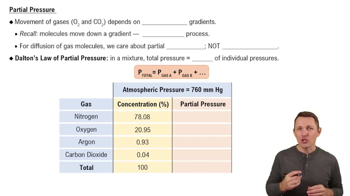
Alveolar Partial Pressure of Oxygen (Po₂)

The alveolar partial pressure of oxygen (Po₂) refers to the amount of oxygen present in the alveoli of the lungs. A decrease in Po₂ indicates reduced oxygen availability for gas exchange, which triggers physiological responses in the pulmonary arterioles to redirect blood flow to better-ventilated areas of the lung, optimizing oxygen uptake.
Video consigliato:
6:12
Partial Pressure

Pulmonary Arterioles Response

Pulmonary arterioles are small blood vessels that regulate blood flow in the lungs. When the alveolar Po₂ decreases, these arterioles constrict, a process known as hypoxic pulmonary vasoconstriction. This response helps to divert blood away from poorly ventilated regions of the lung, ensuring that blood is directed towards areas with higher oxygen levels for more efficient gas exchange.
Video consigliato:
Percorso guidato
9:59
Steps of the Interferon Response

Bronchial Response to Carbon Dioxide (Pco₂)

The partial pressure of carbon dioxide (Pco₂) in the bronchioles influences airway resistance and ventilation. An increase in Pco₂ leads to bronchodilation, which relaxes the smooth muscle in the bronchioles, allowing for increased airflow. This response enhances the elimination of carbon dioxide from the body and improves overall respiratory efficiency.
Video consigliato: