Ch. 21 The Respiratory System
Amerman- Human Anatomy & Physiology 3e
Amerman3rd EditionHuman Anatomy & PhysiologyISBN: 9780138247201, 9780138247928, 9780138201814Non è quello che usi tu?Cambia libro di testo
Capitolo 21, Problema 8

Which of the following statements about pulmonary ventilation is false?
a. Normal expiration requires the use of the expiratory muscles to decrease lung volume.
b. The inspiratory muscles increase lung volume, which decreases intrapulmonary pressure.
c. For inspiration to occur, intrapulmonary pressure must decrease below atmospheric pressure.
d. The intrapleural pressure is less than the intrapulmonary pressure; this prevents the lungs from collapsing during expiration.

Guida verificata passo dopo passo
1
Step 1: Understand the concept of pulmonary ventilation, which involves the movement of air into and out of the lungs. It is driven by pressure differences between the atmosphere and the lungs.
Step 2: Review the mechanics of inspiration. During inspiration, the inspiratory muscles (diaphragm and external intercostals) contract, increasing lung volume and decreasing intrapulmonary pressure below atmospheric pressure, allowing air to flow into the lungs.
Step 3: Examine the mechanics of expiration. Normal expiration is typically a passive process that relies on the elastic recoil of the lungs and thoracic cavity. Expiratory muscles (e.g., internal intercostals and abdominal muscles) are only actively used during forced expiration.
Step 4: Analyze the role of intrapleural pressure. Intrapleural pressure is always less than intrapulmonary pressure, creating a negative pressure that prevents lung collapse by keeping the lungs adhered to the thoracic wall.
Step 5: Evaluate each statement in the problem. Compare the mechanics of pulmonary ventilation to the statements provided. Identify the false statement by determining which one contradicts the physiological processes described above.

Risposta video verificata per un problema simile:

Questa soluzione video è stata consigliata dai nostri tutor come utile per risolvere questo problema.

Concetti chiave

Ecco i concetti essenziali che devi comprendere per rispondere correttamente alla domanda.

Pulmonary Ventilation

Pulmonary ventilation refers to the process of moving air in and out of the lungs, which is essential for gas exchange. It involves two main phases: inspiration, where air is drawn into the lungs, and expiration, where air is expelled. Understanding the mechanics of these phases, including the roles of various muscles and pressures, is crucial for analyzing statements about ventilation.

Intrapulmonary and Intrapleural Pressure

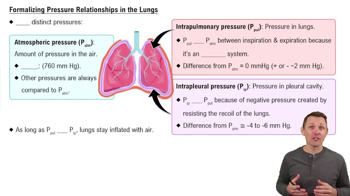
Intrapulmonary pressure is the pressure within the lung alveoli, while intrapleural pressure is the pressure within the pleural cavity surrounding the lungs. During normal breathing, intrapulmonary pressure fluctuates with the phases of ventilation, whereas intrapleural pressure remains consistently lower than intrapulmonary pressure, which helps keep the lungs inflated and prevents collapse.
Video consigliato:
5:46
Formalizing Pressure Relationships in the Lungs

Role of Respiratory Muscles

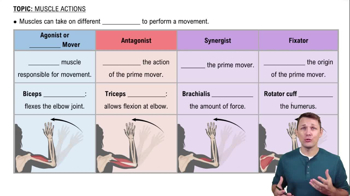
The respiratory muscles, including the diaphragm and intercostal muscles, play a vital role in altering lung volume and pressure during breathing. During inspiration, these muscles contract to increase lung volume, leading to a decrease in intrapulmonary pressure. Conversely, during expiration, the muscles relax, allowing lung volume to decrease, which increases intrapulmonary pressure and facilitates air expulsion.
Video consigliato:
5:41
Muscle Actions
Pratica correlata
Domanda del libro di testo

Mark the following statements as true or false. If a statement is false, correct it to make a true statement.

The epithelium of the oropharynx changes from stratified columnar epithelium to simple squamous epithelium to enable it to resist abrasion from food.

103
views
Domanda del libro di testo

Mark the following statements as true or false. If a statement is false, correct it to make a true statement.

The tidal volume is the amount of air left in the lungs after maximal expiration.

657
views
Domanda del libro di testo

Mark the following statements as true or false. If a statement is false, correct it to make a true statement.

The pseudostratified ciliated columnar epithelium of the respiratory tract warms, filters, and humidifies the inspired air.

129
views
Domanda del libro di testo

The function of the epiglottis is to:

a. Contract muscularly to cover the laryngopharynx

b. Vibrate to produce sound

c. Trigger a cough reflex

d. Cover the glottis during swallowing

134
views
Domanda del libro di testo

Match each term with the correct definition. 

Airway resistance     

Surface tension     

Surfactant     

Pulmonary compliance     

V/Q ratio

a. A detergent-like chemical secreted by bronchial smooth muscle that reduces surface tension

b. The matching of ventilation to perfusion

c. Largely determined by the diameter of the airways

d. Caused by the formation of hydrogen bonds between water molecules

e. Determined by the surface tension of the alveoli, the elastic tissue of the lungs, and the condition of the chest wall

778
views
Domanda del libro di testo

Mark the following statements as true or false. If a statement is false, correct it to make a true statement.

The functional residual capacity is the volume of air normally left in the lungs after a tidal expiration.

711
views