
Ch. 24 The Urinary System
Amerman- Human Anatomy & Physiology 3e
Amerman3rd EditionHuman Anatomy & PhysiologyISBN: 9780138247201, 9780138247928, 9780138201814Non è quello che usi tu?Cambia libro di testo
Capitolo 24, Problema L3.A2

Mr. Yao is a patient with kidney disease who presents to your clinic for monitoring. You notice on his chart that his GFR was estimated through inulin administration to be about 35 ml/min. What does this tell you about the health of his kidneys? Mr. Yao is taking a medication that is normally excreted from the body in the urine. You order blood work and find that the concentration of this medication in his plasma is much higher than normal. How does his decreased GFR explain the elevated level of medication in his plasma?

Guida verificata passo dopo passo
1
Step 1: Understand the concept of Glomerular Filtration Rate (GFR). GFR is a measure of how well the kidneys filter blood. A normal GFR is typically around 90-120 ml/min. A GFR of 35 ml/min indicates significantly reduced kidney function, which is consistent with kidney disease.
Step 2: Recognize the role of the kidneys in excreting medications. The kidneys filter waste products and medications from the blood into the urine. If kidney function is impaired, the filtration process is less efficient, leading to reduced excretion of medications.
Step 3: Relate decreased GFR to medication clearance. With a GFR of 35 ml/min, Mr. Yao's kidneys are filtering blood at a much slower rate. This means that the medication is not being removed from the plasma as effectively, causing its concentration in the blood to rise.
Step 4: Consider the implications of reduced medication excretion. The elevated plasma concentration of the medication could lead to toxicity or reduced therapeutic effectiveness. Adjustments to the medication dosage may be necessary to account for impaired kidney function.
Step 5: Highlight the importance of monitoring kidney function and medication levels. Regular blood work and GFR assessments are crucial for patients with kidney disease to ensure proper medication management and prevent complications.

Risposta video verificata per un problema simile:

Questa soluzione video è stata consigliata dai nostri tutor come utile per risolvere questo problema.

Concetti chiave

Ecco i concetti essenziali che devi comprendere per rispondere correttamente alla domanda.

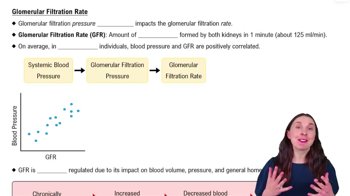
Glomerular Filtration Rate (GFR)

GFR is a measure of how well the kidneys filter blood, specifically the volume of fluid filtered from the renal glomeruli into the Bowman's capsule per minute. A normal GFR is typically around 90-120 ml/min, and a GFR of 35 ml/min indicates significantly reduced kidney function, suggesting chronic kidney disease or acute kidney injury. This reduction in GFR can lead to the accumulation of waste products and medications in the bloodstream.
Video consigliato:
3:15
Glomerular Filtration Rate

Renal Excretion of Medications

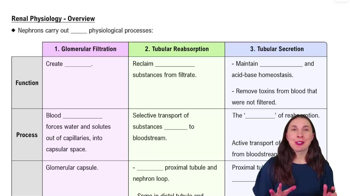
Many medications are eliminated from the body through renal excretion, which involves filtration, secretion, and reabsorption processes in the kidneys. When GFR is decreased, the kidneys are less effective at filtering these medications from the blood, leading to higher plasma concentrations. This can result in potential toxicity or adverse effects, as the body is unable to clear the drug efficiently.
Video consigliato:
4:58
Overview of Renal Physiology

Pharmacokinetics in Kidney Disease

Pharmacokinetics refers to how the body absorbs, distributes, metabolizes, and excretes drugs. In patients with kidney disease, altered pharmacokinetics can affect drug dosing and efficacy. With a decreased GFR, the clearance of renally-excreted medications is impaired, necessitating careful monitoring and potential dosage adjustments to avoid toxicity and ensure therapeutic effectiveness.
Video consigliato:
1:00
The Kidneys Example 1
Pratica correlata
Domanda del libro di testo

Drugs that treat hypertension, or high blood pressure, have the following actions. Discuss the specific effect that each drug will have on the kidneys.

b. Blocking the receptor for angiotensin-II on blood vessels and in the renal tubule cells

614
views
Domanda del libro di testo

Explain how each of the drugs in question 1 from this section would lower blood pressure.

803
views
Domanda del libro di testo

Deana is a 4-year-old girl with a rare genetic defect that causes the Na+/glucose symporters in the proximal tubule to reabsorb fewer glucose and sodium ions than normal. Predict the effects this defect will have on the composition and volume of Deana's urine. Explain why you would expect to see increased activity of the tubuloglomerular feedback and the renin-angiotensin-aldosterone system in Deana's kidneys.

705
views
Domanda del libro di testo

Mark the following statements as true or false. If a statement is false, correct it to make a true statement.

b. Internally, the kidneys consist of an outer renal medulla, a middle renal pelvis, and an inner renal cortex.

855
views
1
rank
Domanda del libro di testo

Mark the following statements as true or false. If a statement is false, correct it to make a true statement.

a. The kidneys are retroperitoneal and covered by three layers of connective tissue.

803
views
1
rank
Domanda del libro di testo

Drugs that treat hypertension, or high blood pressure, have the following actions. Discuss the specific effect that each drug will have on the kidneys.

a. Blocking the action of aldosterone on the kidneys

665
views