
Mr. Gupta has been diagnosed with nephrotic syndrome, which is characterized by the loss of plasma proteins such as albumin into the urine. What impact will this have on his colloid osmotic pressure? How will this affect the net filtration pressure in his capillary beds? What effect will this likely cause?
Ch. 24 The Urinary System
Amerman3rd EditionHuman Anatomy & PhysiologyISBN: 9780138247201, 9780138247928, 9780138201814Non è quello che usi tu?Cambia libro di testo
Capitolo 24, Problema L2.1a
Predict the effects the following scenarios would have on glomerular filtration:
a. Having excess proteins in the blood, increasing colloid osmotic pressure
Guida verificata passo dopo passo1
Understand the concept of glomerular filtration: Glomerular filtration is the process by which the kidneys filter blood, removing waste and excess substances while retaining necessary components. It is driven by the balance of hydrostatic pressure and colloid osmotic pressure across the glomerular capillaries.
Define colloid osmotic pressure: Colloid osmotic pressure (also called oncotic pressure) is the pressure exerted by proteins, such as albumin, in the blood plasma. This pressure opposes the movement of fluid out of the capillaries and into the filtrate in the Bowman's capsule.
Analyze the effect of excess proteins in the blood: Excess proteins in the blood increase the colloid osmotic pressure. This means there is a stronger force pulling water back into the capillaries from the filtrate, opposing the hydrostatic pressure that drives filtration.
Relate the increased colloid osmotic pressure to glomerular filtration rate (GFR): When colloid osmotic pressure increases, it reduces the net filtration pressure (NFP), which is the difference between hydrostatic pressure and colloid osmotic pressure. A lower NFP results in a decreased glomerular filtration rate (GFR).
Conclude the physiological impact: The increase in colloid osmotic pressure due to excess proteins in the blood would lead to a reduction in the amount of filtrate formed in the kidneys, potentially impairing the kidney's ability to remove waste and regulate fluid balance.

Risposta video verificata per un problema simile:
Questa soluzione video è stata consigliata dai nostri tutor come utile per risolvere questo problema.
Concetti chiave
Ecco i concetti essenziali che devi comprendere per rispondere correttamente alla domanda.
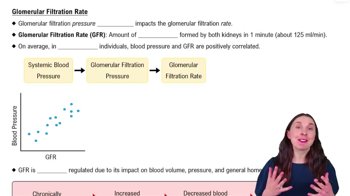
Glomerular Filtration Rate (GFR)
Glomerular Filtration Rate (GFR) is a measure of how well the kidneys filter blood, specifically the volume of fluid filtered from the renal glomeruli into the Bowman's capsule per unit time. It is a crucial indicator of kidney function and is influenced by factors such as blood pressure, blood flow, and the composition of blood, including protein levels.
Video consigliato:
Glomerular Filtration Rate
Colloid Osmotic Pressure
Colloid osmotic pressure is the pressure exerted by proteins in the blood plasma that helps to retain water within the circulatory system. When there is an increase in colloid osmotic pressure, such as from excess proteins in the blood, it can counteract the hydrostatic pressure in the glomeruli, thereby reducing the net filtration pressure and potentially decreasing the GFR.
Video consigliato:
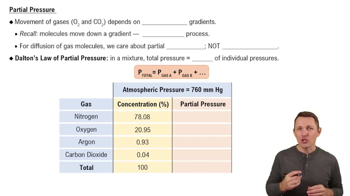
Partial Pressure
Starling Forces
Starling forces refer to the physical forces that govern the movement of fluid across capillary membranes, including hydrostatic pressure and osmotic pressure. In the context of glomerular filtration, these forces determine the net filtration pressure, which is essential for understanding how changes in blood composition, like increased protein levels, can affect the filtration process in the kidneys.
Video consigliato:
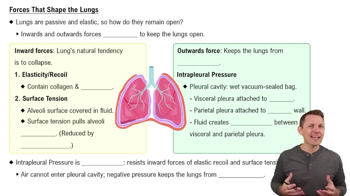
Forces That Shape the Lungs
Pratica correlata
Domanda del libro di testo
860
views
Domanda del libro di testo
Why must the kidneys establish a concentration gradient in the interstitial fluid of the renal medulla in order to produce concentrated urine?
729
views
Domanda del libro di testo
Predict the effects the following scenarios would have on glomerular filtration:
c. Having high arterial blood pressure (hypertension)
700
views
Domanda del libro di testo
Predict the effects the following scenarios would have on glomerular filtration:
b. Having low arterial blood pressure (hypotension)
698
views
Domanda del libro di testo
Trace the pathway taken by a molecule of urea through the kidney from the glomerulus to the renal pelvis if the urea is recycled.
1057
views
Domanda del libro di testo
Explain why urinary tract infections, which involve the urethra and urinary bladder, are much more common in females than males.
889
views
