Ch. 25 Fluid, Electrolyte, and Acid-Base Homeostasis
Amerman- Human Anatomy & Physiology 3e
Amerman3rd EditionHuman Anatomy & PhysiologyISBN: 9780138247201, 9780138247928, 9780138201814Non è quello che usi tu?Cambia libro di testo
Capitolo 25, Problema 15

Which of the following mechanisms is/are used by the kidneys to regulate the pH of the blood? Circle all that apply.
a. Hydrogen ions are secreted from the proximal and distal tubules and the collecting system.
b. Hydrogen ions are reabsorbed from the nephron loop.
c. New bicarbonate ions are formed from glutamine and carbon dioxide in the interstitial fluid that enters proximal tubule cells.
d. Bicarbonate ions can be secreted.
e. Bicarbonate ions are reabsorbed directly from the filtrate.

Guida verificata passo dopo passo
1
Step 1: Understand the role of the kidneys in pH regulation. The kidneys help maintain acid-base balance by regulating the concentration of hydrogen ions (H⁺) and bicarbonate ions (HCO₃⁻) in the blood. This is achieved through processes such as secretion, reabsorption, and the generation of new bicarbonate ions.
Step 2: Analyze option (a). Hydrogen ions (H⁺) are secreted into the filtrate by the proximal and distal tubules, as well as the collecting system. This secretion helps remove excess H⁺ from the blood, thereby reducing acidity. This mechanism is a key part of pH regulation.
Step 3: Analyze option (b). Hydrogen ions (H⁺) are not reabsorbed from the nephron loop. Instead, they are typically secreted into the filtrate to be excreted in urine. This option does not align with the kidney's role in pH regulation.
Step 4: Analyze option (c). New bicarbonate ions (HCO₃⁻) can be formed in the proximal tubule cells from glutamine and carbon dioxide (CO₂). This process helps replenish bicarbonate levels in the blood, which is crucial for buffering excess hydrogen ions and maintaining pH balance.
Step 5: Analyze options (d) and (e). Bicarbonate ions (HCO₃⁻) are not typically secreted by the kidneys (option d is incorrect). Instead, they are reabsorbed from the filtrate, primarily in the proximal tubule, to maintain blood pH (option e is correct). This reabsorption prevents the loss of bicarbonate, which is essential for buffering acids in the blood.

Risposta video verificata per un problema simile:

Questa soluzione video è stata consigliata dai nostri tutor come utile per risolvere questo problema.

Concetti chiave

Ecco i concetti essenziali che devi comprendere per rispondere correttamente alla domanda.

Kidney Function in pH Regulation

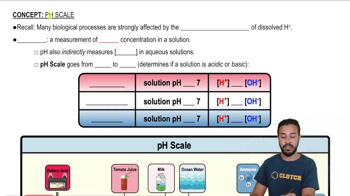
The kidneys play a crucial role in maintaining the acid-base balance of the blood by regulating the excretion and reabsorption of hydrogen ions (H+) and bicarbonate ions (HCO3-). This process helps to neutralize excess acids or bases, ensuring that blood pH remains within a narrow range, typically around 7.35 to 7.45.
Video consigliato:

Hydrogen Ion Secretion and Reabsorption

Hydrogen ions are secreted into the renal tubules from the blood, primarily in the proximal and distal tubules, as well as the collecting ducts. This secretion helps to lower blood acidity. Conversely, the kidneys can also reabsorb hydrogen ions from the nephron loop, which contributes to the regulation of blood pH by controlling the amount of acid excreted.
Video consigliato:
Percorso guidato
05:03
Hydrogen Bonding

Bicarbonate Ion Dynamics

Bicarbonate ions are essential for buffering blood pH. The kidneys can generate new bicarbonate ions from metabolic processes, such as the conversion of glutamine and carbon dioxide in the proximal tubule cells. Additionally, bicarbonate can be reabsorbed from the filtrate back into the bloodstream, which further aids in maintaining the acid-base balance.
Video consigliato:
01:55
Ions - Sodium and Potassium Example 3