
Ch. 26 The Reproductive System
Amerman- Human Anatomy & Physiology 3e
Amerman3rd EditionHuman Anatomy & PhysiologyISBN: 9780138247201, 9780138247928, 9780138201814Non è quello che usi tu?Cambia libro di testo
Capitolo 26, Problema 1

At the end of meiosis, each cell has ________ chromosomes and they are genetically ________ from the original cell.

Guida verificata passo dopo passo
1
Step 1: Understand the process of meiosis. Meiosis is a type of cell division that reduces the chromosome number by half, resulting in four haploid cells. This is essential for sexual reproduction.
Step 2: Recall that human somatic cells are diploid (2n), meaning they have two sets of chromosomes (46 total). Meiosis reduces this number to haploid (n), meaning each resulting cell has one set of chromosomes (23 in humans).
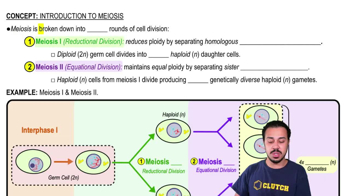
Step 3: Recognize that meiosis involves two rounds of division: meiosis I and meiosis II. During meiosis I, homologous chromosomes are separated, and during meiosis II, sister chromatids are separated.
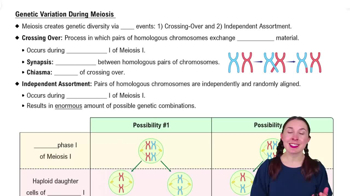
Step 4: Understand genetic variation. During meiosis, processes like crossing over (exchange of genetic material between homologous chromosomes) and independent assortment (random distribution of chromosomes) ensure that the resulting cells are genetically different from the original cell and from each other.
Step 5: Fill in the blanks based on the above understanding: At the end of meiosis, each cell has half the number of chromosomes (haploid) and they are genetically different from the original cell due to the mechanisms of genetic variation.

Risposta video verificata per un problema simile:

Questa soluzione video è stata consigliata dai nostri tutor come utile per risolvere questo problema.

Concetti chiave

Ecco i concetti essenziali che devi comprendere per rispondere correttamente alla domanda.

Meiosis

Meiosis is a specialized type of cell division that reduces the chromosome number by half, resulting in four genetically diverse gametes. It consists of two sequential divisions: meiosis I and meiosis II. This process is crucial for sexual reproduction, as it ensures that offspring have the same number of chromosomes as their parents when gametes fuse during fertilization.
Video consigliato:
Percorso guidato
4:49
Meiosis I & Meiosis II

Chromosome Number

In humans, somatic cells contain 46 chromosomes, organized into 23 pairs. During meiosis, the chromosome number is halved, resulting in gametes that each contain 23 chromosomes. This reduction is essential for maintaining the species' chromosome number across generations when gametes combine during fertilization.
Video consigliato:
Percorso guidato
04:17
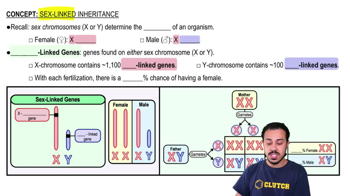
Sex-Linked Inheritance

Genetic Variation

Genetic variation refers to the differences in DNA sequences among individuals, which arise during meiosis through processes such as crossing over and independent assortment. These mechanisms shuffle genetic material, producing gametes that are genetically distinct from the original cell and from each other, contributing to the diversity of traits in a population.
Video consigliato:
5:19
Genetic Variation During Meiosis