
Ch. 3 The Cell
Amerman- Human Anatomy & Physiology 3e
Amerman3rd EditionHuman Anatomy & PhysiologyISBN: 9780138247201, 9780138247928, 9780138201814Non è quello che usi tu?Cambia libro di testo
Capitolo 3, Problema 4

Which of the following best describes the arrangement of the main component of the plasma membrane?
a. A monolayer of phospholipids with the phosphate heads facing the cytosol and the fatty acid tails facing the extracellular fluid
b. A bilayer of phospholipids with the phosphate heads facing the cytosol and extracellular fluid, and the fatty acid tails facing one another
c. A bilayer of phospholipids with the phosphate heads of one layer facing the fatty acid tails of the other
d. A bilayer of phospholipids with a layer of triglycerides sandwiched in the middle

Guida verificata passo dopo passo
1
Understand the structure of the plasma membrane: The plasma membrane is primarily composed of a phospholipid bilayer, which is crucial for its function as a selective barrier.
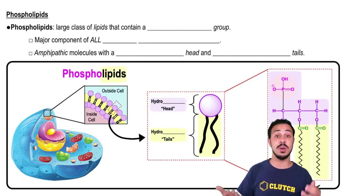
Recall the structure of a phospholipid: Each phospholipid molecule has a hydrophilic (water-attracting) phosphate head and two hydrophobic (water-repelling) fatty acid tails.
Visualize the arrangement of the bilayer: In the plasma membrane, the hydrophilic phosphate heads face outward toward the aqueous environments (cytosol inside the cell and extracellular fluid outside the cell), while the hydrophobic fatty acid tails face inward, away from water, and toward each other.
Eliminate incorrect options: a monolayer (option a) does not describe the plasma membrane, and a bilayer with phosphate heads facing fatty acid tails (option c) or a layer of triglycerides in the middle (option d) are not accurate representations of the plasma membrane structure.
Select the correct description: The correct answer is the bilayer of phospholipids with the phosphate heads facing the cytosol and extracellular fluid, and the fatty acid tails facing one another (option b).

Risposta video verificata per un problema simile:

Questa soluzione video è stata consigliata dai nostri tutor come utile per risolvere questo problema.

Concetti chiave

Ecco i concetti essenziali che devi comprendere per rispondere correttamente alla domanda.

Phospholipid Bilayer

The phospholipid bilayer is a fundamental structure of the plasma membrane, consisting of two layers of phospholipids. Each phospholipid molecule has a hydrophilic (water-attracting) 'head' and two hydrophobic (water-repelling) 'tails.' In the bilayer, the heads face outward towards the aqueous environments inside and outside the cell, while the tails face inward, away from water, creating a semi-permeable barrier.
Video consigliato:

Fluid Mosaic Model

The fluid mosaic model describes the plasma membrane's structure, emphasizing its dynamic nature. It suggests that the membrane is not a rigid structure but rather a fluid combination of various lipids and proteins that can move laterally within the layer. This model accounts for the diverse functions of membrane proteins and the flexibility of the membrane, allowing for processes like cell signaling and transport.
Video consigliato:
3:33
Serous Cavity and Fluid

Membrane Composition and Function

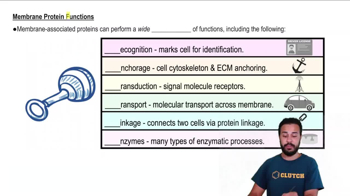
The composition of the plasma membrane, primarily made up of phospholipids, cholesterol, and proteins, is crucial for its function. The arrangement of these components affects membrane fluidity, stability, and the ability to facilitate transport and communication between the cell and its environment. Understanding this composition helps explain how substances move across the membrane and how cells interact with their surroundings.
Video consigliato:
Percorso guidato
03:54
Membrane Protein Functions