Ch. 3 The Cell
Amerman- Human Anatomy & Physiology 3e
Amerman3rd EditionHuman Anatomy & PhysiologyISBN: 9780138247201, 9780138247928, 9780138201814Non è quello che usi tu?Cambia libro di testo
Capitolo 3, Problema L2.1d

Write a single sentence, using no more than 25 words, to summarize each of the following cellular processes:
Secondary active transport

Guida verificata passo dopo passo
1
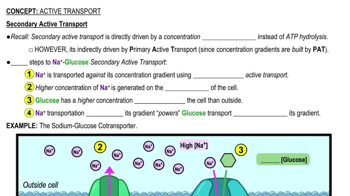
Understand the concept of secondary active transport: it uses the energy from the electrochemical gradient created by primary active transport to move substances across the membrane.
Identify the key components involved: primary active transport establishes the gradient, and secondary active transport utilizes it to move molecules like glucose or ions.
Focus on the mechanism: secondary active transport often involves symporters or antiporters that couple the movement of one substance with another.
Summarize the process in a concise sentence: Secondary active transport uses energy indirectly from a gradient to move molecules against their concentration gradient via carrier proteins.
Ensure the sentence is clear, accurate, and within the word limit, emphasizing the indirect energy use and the role of carrier proteins.

Risposta video verificata per un problema simile:

Questa soluzione video è stata consigliata dai nostri tutor come utile per risolvere questo problema.

Concetti chiave

Ecco i concetti essenziali che devi comprendere per rispondere correttamente alla domanda.

Secondary Active Transport

Secondary active transport is a cellular process that moves ions or molecules against their concentration gradient by utilizing the energy from the movement of another substance, typically an ion, down its gradient.
Video consigliato:
Percorso guidato
06:57
Secondary Active Transport

Concentration Gradient

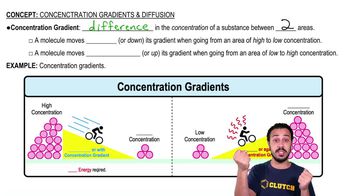
A concentration gradient refers to the difference in the concentration of a substance across a space or membrane, which drives the movement of substances from areas of higher concentration to areas of lower concentration.
Video consigliato:
Percorso guidato
04:51
Concentration Gradients and Diffusion

Ion Coupling

Ion coupling in secondary active transport involves the simultaneous movement of one ion (often sodium or hydrogen) down its gradient, which provides the energy needed to transport another molecule against its gradient.
Video consigliato:
01:55
Ions - Sodium and Potassium Example 3