
Ch. 6 Bones and Bone Tissue
Amerman- Human Anatomy & Physiology 3e
Amerman3rd EditionHuman Anatomy & PhysiologyISBN: 9780138247201, 9780138247928, 9780138201814Non è quello che usi tu?Cambia libro di testo
Capitolo 6, Problema 6

The branching pieces of bone in spongy bone are called:


a. Lamellae
b. Lacunae
c. Osteoclasts
d. Trabeculae

Guida verificata passo dopo passo
1
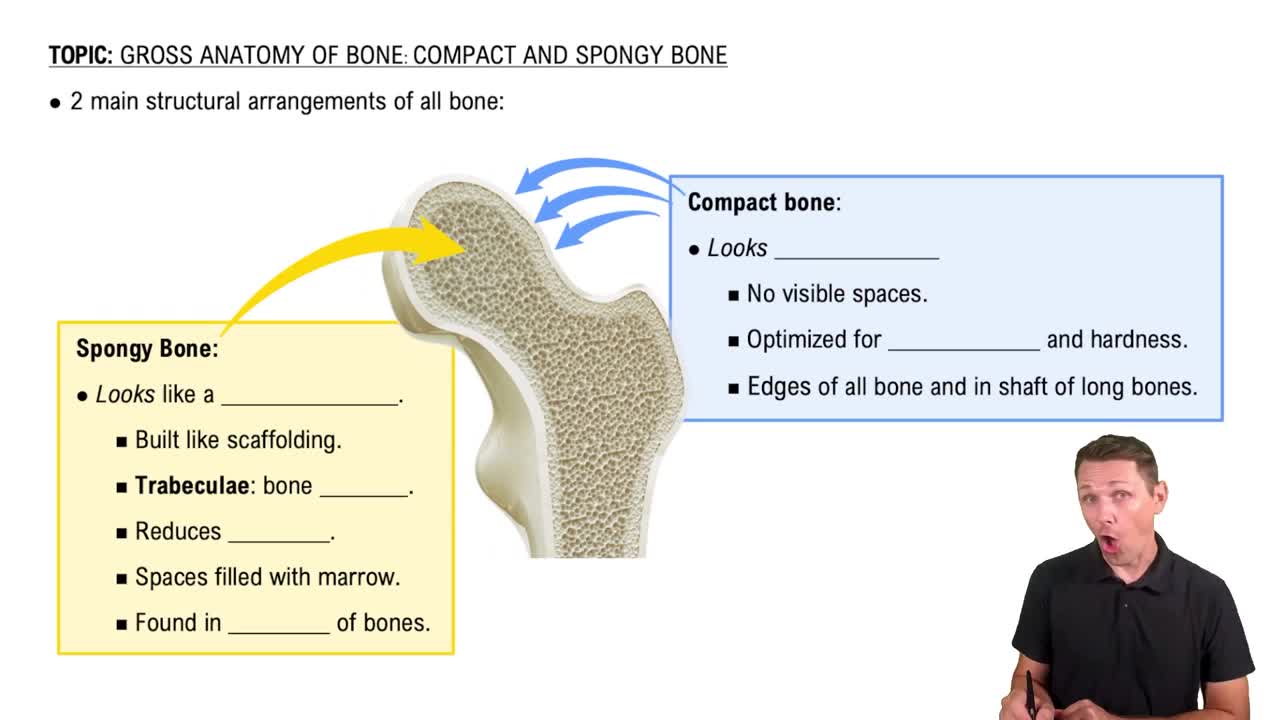
Step 1: Understand the structure of spongy bone. Spongy bone, also known as cancellous bone, is characterized by a porous, lattice-like structure that provides strength while reducing weight. This structure is made up of branching pieces of bone tissue.
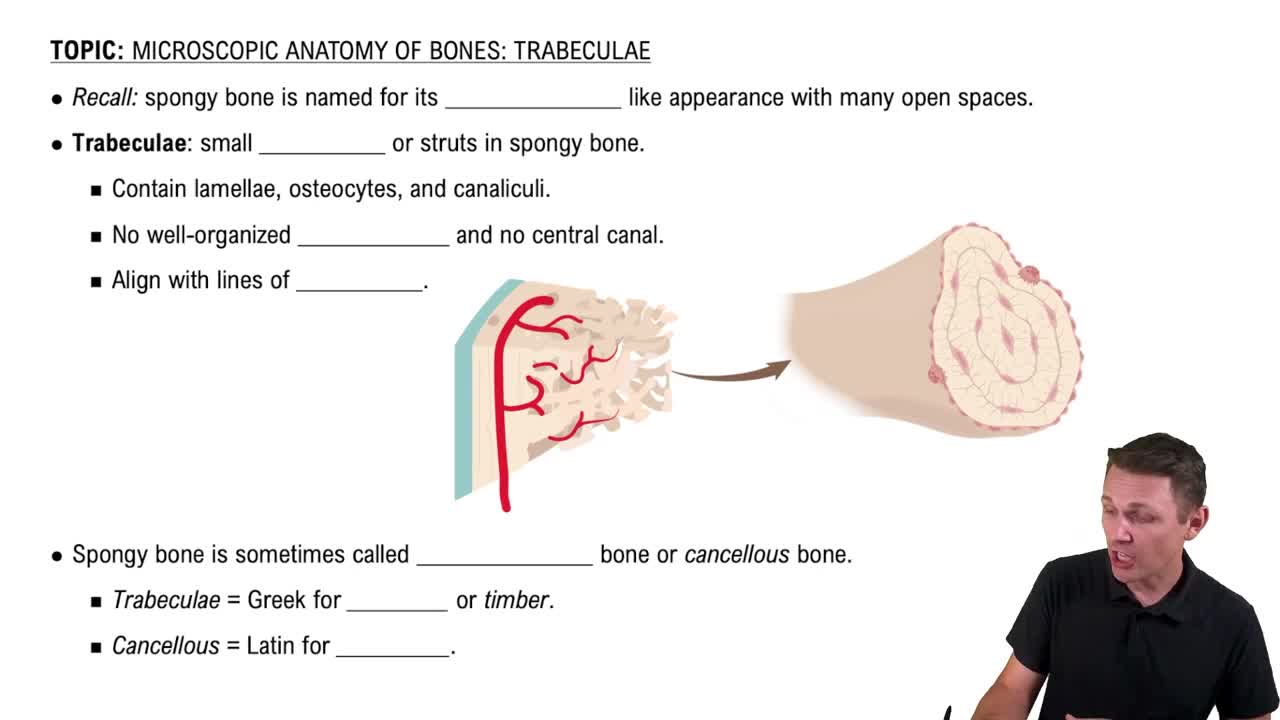
Step 2: Review the term 'trabeculae.' Trabeculae are the small, beam-like structures that form the lattice framework of spongy bone. They are aligned along lines of stress to provide structural support and house bone marrow.
Step 3: Differentiate trabeculae from other terms in the options. For example, 'lamellae' are concentric rings of bone matrix found in compact bone, not spongy bone. 'Lacunae' are small spaces that house osteocytes, and 'osteoclasts' are bone-resorbing cells, not structural components.
Step 4: Match the correct term to the description in the question. The branching pieces of bone in spongy bone are trabeculae, as they form the characteristic lattice structure.
Step 5: Confirm your understanding by visualizing or referencing a diagram of spongy bone to see how trabeculae contribute to its structure and function.

Risposta video verificata per un problema simile:

Questa soluzione video è stata consigliata dai nostri tutor come utile per risolvere questo problema.

Concetti chiave

Ecco i concetti essenziali che devi comprendere per rispondere correttamente alla domanda.

Spongy Bone Structure

Spongy bone, also known as cancellous bone, is a type of bone tissue characterized by a porous, lattice-like structure. This architecture provides strength while minimizing weight, allowing for efficient support and flexibility. It is primarily found in the interior of bones and is crucial for the production of blood cells in the bone marrow.
Video consigliato:
3:43
Compact and Spongy Bone

Trabeculae

Trabeculae are the small, rod-like or plate-like structures that form the framework of spongy bone. They create a network that supports the bone's overall structure and houses bone marrow. Trabeculae are essential for distributing stress and forces throughout the bone, enhancing its strength and resilience.
Video consigliato:
4:06
Trabeculae

Bone Cells

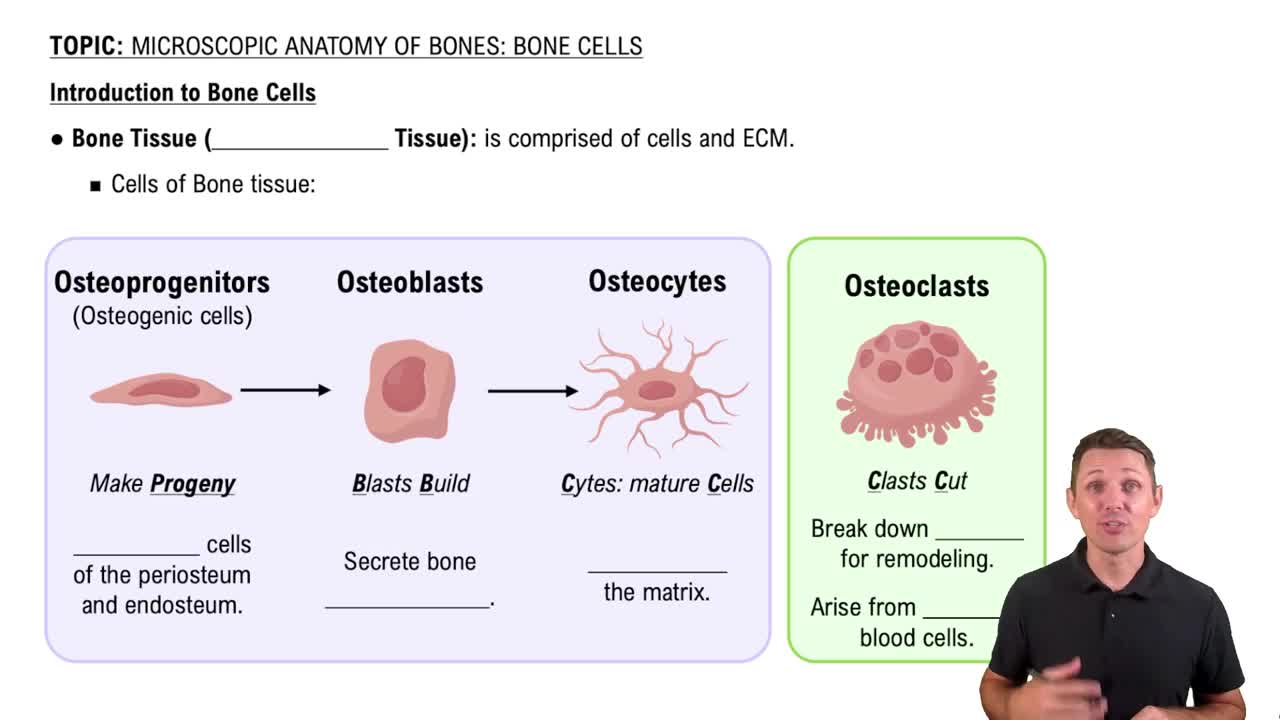
Bone cells, including osteoblasts, osteocytes, and osteoclasts, play vital roles in bone formation, maintenance, and resorption. Osteoblasts are responsible for building new bone, osteocytes maintain bone tissue, and osteoclasts break down bone. Understanding these cells is crucial for comprehending how bones adapt to stress and repair themselves.
Video consigliato:
4:19
Introduction to Bone Cells
Pratica correlata
Domanda del libro di testo

Mark the following statements about bone tissue as true or false. If a statement is false, correct it to make a true statement.


e. Osteoblasts are responsible for bone resorption, and osteoclasts are responsible for bone deposition.

63
views
Domanda del libro di testo

What is the difference between a primary and secondary ossification center in a long bone?

1487
views
1
rank
Domanda del libro di testo

Which bones form via intramembranous ossification?


a. Irregular bones

b. Certain flat bones

c. Long bones

d. Short bones

e. More than one of the above

918
views
Domanda del libro di testo

The subunit of compact bone is the _____ . It consists of rings of bone matrix called ______that surround a structure called the______ that contains blood vessels and nerves. Other structures called _______also contain blood vessels and nerves. Osteocytes are housed in_____and communicate via_______.

779
views
Domanda del libro di testo

Mark the following statements about bone tissue as true or false. If a statement is false, correct it to make a true statement.


f. Osteocytes are mature and less active osteoblasts that have become surrounded by bone ECM.

706
views
Domanda del libro di testo

Of the following statements, identify those that are properties of intramembranous ossification, endochondral ossification, or both.

a. The bone is formed via a hyaline cartilage model.

b. Bone tissue forms from ossification centers.

c. Bone forms from within a mesenchyme membrane.

d. The early spongy bone is formed, after which the early compact bone develops.

e. The original primary bone is replaced with secondary bone.

f. A bone collar forms, followed by the early spongy bone.

793
views