Ch. 10 Blood
Marieb - Essentials of Human Anatomy & Physiology 13th Edition
Marieb13th EditionEssentials of Human Anatomy & PhysiologyISBN: 9780135624340Non è quello che usi tu?Cambia libro di testo
Capitolo 10, Problema 21

If you had a high hematocrit, would you expect your hemoglobin determination to be high or low? Why?

Guida verificata passo dopo passo
1
Understand the relationship between hematocrit and hemoglobin: Hematocrit is the percentage of red blood cells (RBCs) in the blood, while hemoglobin is the protein within RBCs responsible for oxygen transport. Generally, a higher hematocrit indicates a higher concentration of RBCs, which often correlates with higher hemoglobin levels.
Consider the physiological basis: Hemoglobin is contained within RBCs, so if the hematocrit is high (more RBCs in the blood), it is reasonable to expect that the hemoglobin concentration would also be elevated, assuming normal RBC function and no underlying pathology.
Account for potential exceptions: High hematocrit does not always guarantee high hemoglobin. For example, in conditions like polycythemia vera, both hematocrit and hemoglobin are elevated, but in cases of dehydration, hematocrit may appear high due to reduced plasma volume without a proportional increase in hemoglobin.
Evaluate the cause of high hematocrit: Determine whether the high hematocrit is due to increased RBC production (e.g., erythropoiesis stimulated by hypoxia) or other factors like dehydration. This context helps confirm whether hemoglobin levels are likely to be high.
Conclude based on the relationship: If the high hematocrit is due to increased RBC production and normal RBC function, hemoglobin determination would likely be high. However, if the high hematocrit is due to plasma volume reduction (e.g., dehydration), hemoglobin levels may not be proportionally elevated.

Risposta video verificata per un problema simile:

Questa soluzione video è stata consigliata dai nostri tutor come utile per risolvere questo problema.
Durata del video:
1m

Concetti chiave

Ecco i concetti essenziali che devi comprendere per rispondere correttamente alla domanda.

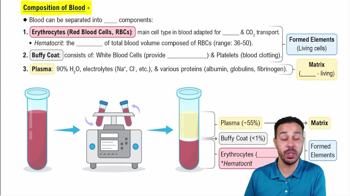
Hematocrit

Hematocrit is the proportion of blood volume that is occupied by red blood cells (RBCs). It is expressed as a percentage and is a key indicator of blood's oxygen-carrying capacity. A high hematocrit suggests a higher concentration of RBCs, which can occur in conditions like dehydration or polycythemia.
Video consigliato:
Percorso guidato
7:49
Composition of Blood

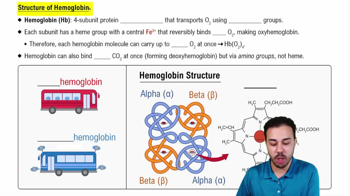
Hemoglobin

Hemoglobin is a protein found in red blood cells responsible for transporting oxygen from the lungs to the body's tissues and returning carbon dioxide from the tissues back to the lungs. The hemoglobin level is often measured alongside hematocrit to assess overall blood health and oxygen delivery capacity. Typically, hemoglobin levels correlate with hematocrit values.
Video consigliato:
Percorso guidato
6:45
Structure of Hemoglobin

Relationship between Hematocrit and Hemoglobin

There is a direct relationship between hematocrit and hemoglobin levels; as hematocrit increases, hemoglobin levels usually increase as well. This is because a higher proportion of RBCs in the blood generally means more hemoglobin is present, enhancing the blood's ability to carry oxygen. Therefore, if hematocrit is high, one would expect hemoglobin levels to also be high.
Video consigliato:
Percorso guidato
6:45
Structure of Hemoglobin