Ch. 11 Cardiovascular System
Marieb - Essentials of Human Anatomy & Physiology 13th Edition
Marieb13th EditionEssentials of Human Anatomy & PhysiologyISBN: 9780135624340Non è quello che usi tu?Cambia libro di testo
Capitolo 11, Problema 15

More than one choice may apply.
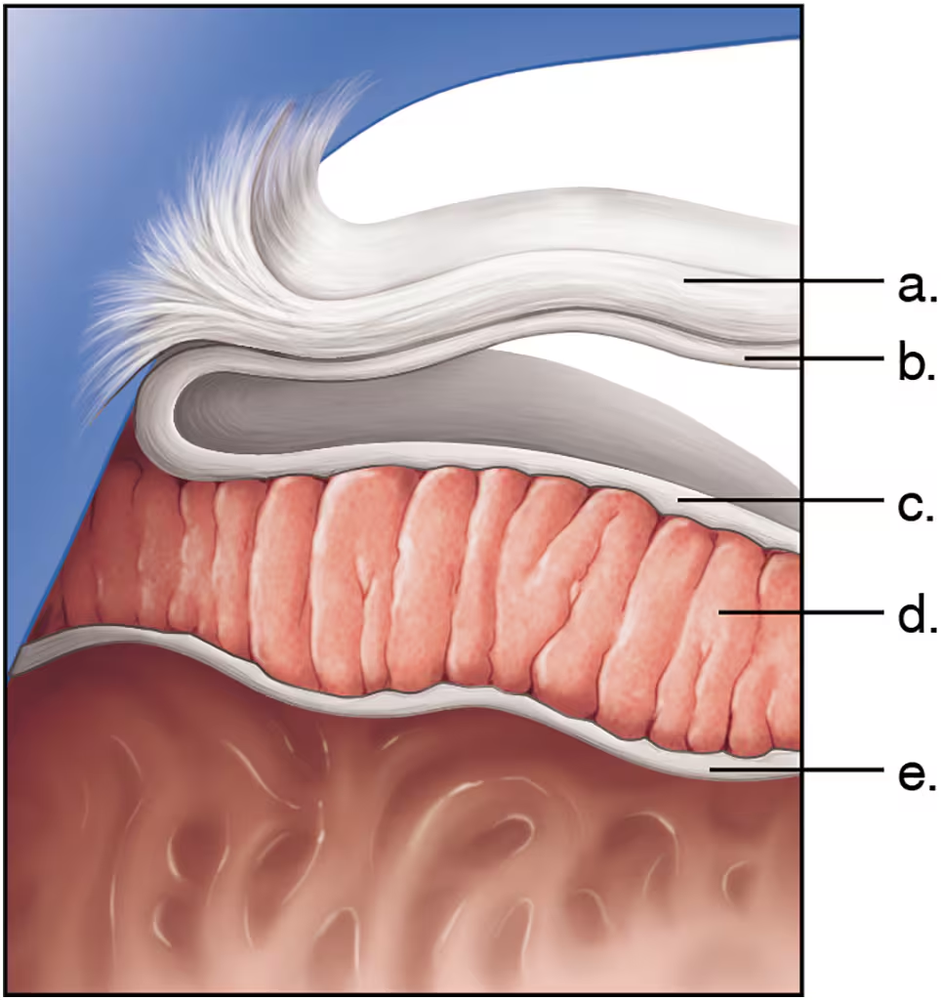
Using the figure, identify the most external part of the pericardium.
Illustration of the heart's pericardium layers, labeled a to e, highlighting the most external part.

Guida verificata passo dopo passo
1
Examine the figure provided in the problem. Identify the layers of the pericardium, which is the membrane surrounding the heart.
Understand the structure of the pericardium. It consists of two main layers: the fibrous pericardium (outermost layer) and the serous pericardium (inner layer, which is further divided into the parietal and visceral layers).
Focus on the fibrous pericardium, as it is the most external part of the pericardium. It is a tough, dense connective tissue layer that protects the heart and anchors it to surrounding structures like the diaphragm and sternum.
Compare the labeled parts in the figure with your knowledge of the pericardium's anatomy. Look for the label that corresponds to the fibrous pericardium.
Select the correct option(s) from the multiple-choice answers that match the fibrous pericardium based on the figure and your understanding of its location and structure.

Risposta video verificata per un problema simile:

Questa soluzione video è stata consigliata dai nostri tutor come utile per risolvere questo problema.
Durata del video:
4m

Concetti chiave

Ecco i concetti essenziali che devi comprendere per rispondere correttamente alla domanda.

Pericardium Structure

The pericardium is a double-walled sac that encloses the heart, consisting of an outer fibrous layer and an inner serous layer. The outer layer, known as the fibrous pericardium, provides protection and anchors the heart within the thoracic cavity, while the inner serous layer is further divided into parietal and visceral layers, facilitating heart movement.
Video consigliato:
4:16
Structure of the Eyeball Example 1

Anatomical Orientation

Understanding anatomical orientation is crucial for identifying structures in relation to one another. In this context, recognizing terms like 'external' and 'internal' helps in determining which part of the pericardium is being referred to, as well as its position relative to surrounding structures such as the heart and lungs.
Video consigliato:
02:40
Anatomical Position

Function of the Pericardium

The pericardium serves several important functions, including protecting the heart from infections, reducing friction during heartbeats, and preventing overexpansion of the heart. Knowledge of these functions can aid in understanding why the external part of the pericardium is significant in the context of heart health and anatomy.
Video consigliato:
Percorso guidato
06:04
Functional Groups