How does the heart's ability to contract differ from that of other muscles of the body?
Ch. 11 Cardiovascular System

Marieb13th EditionEssentials of Human Anatomy & PhysiologyISBN: 9780135624340Non è quello che usi tu?Cambia libro di testo
Capitolo 11, Problema 23
Name three different factors that increase heart rate.
Guida verificata passo dopo passo1
Identify the role of the autonomic nervous system in regulating heart rate, focusing on the sympathetic nervous system's effect.
Consider the impact of physical activity or exercise on heart rate, noting how increased demand for oxygen and nutrients by muscles leads to an elevated heart rate.
Examine the influence of emotional states, such as stress or anxiety, which can activate the sympathetic nervous system and increase heart rate.
Explore the effect of certain hormones, like adrenaline (epinephrine), which are released during stress or excitement and can increase heart rate.
Discuss how environmental factors, such as temperature, can affect heart rate, with higher temperatures potentially leading to an increased heart rate to help dissipate heat.

Risposta video verificata per un problema simile:
Questa soluzione video è stata consigliata dai nostri tutor come utile per risolvere questo problema.
Durata del video:
2mConcetti chiave
Ecco i concetti essenziali che devi comprendere per rispondere correttamente alla domanda.
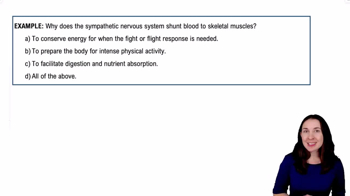
Sympathetic Nervous System Activation
The sympathetic nervous system is part of the autonomic nervous system that prepares the body for 'fight or flight' responses. When activated, it releases adrenaline, which increases heart rate to supply more oxygen and nutrients to muscles, enhancing physical performance during stress or danger.
Video consigliato:
Sympathetic Nervous System Example 1
Physical Activity
Engaging in physical activity, such as exercise or strenuous movement, requires more oxygen and energy, prompting the heart to pump faster. This increase in heart rate helps meet the heightened demand for blood flow to active muscles, facilitating improved performance and endurance.
Video consigliato:
Percorso guidato
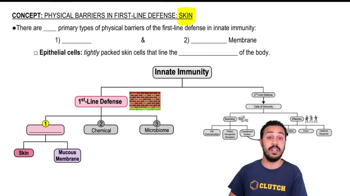
Physical Barriers
Emotional Stress
Emotional stress, such as anxiety or excitement, can trigger an increase in heart rate. The body's response to emotional stimuli involves the release of stress hormones like cortisol and adrenaline, which stimulate the heart to beat faster as part of the body's overall response to perceived threats or challenges.
Video consigliato:
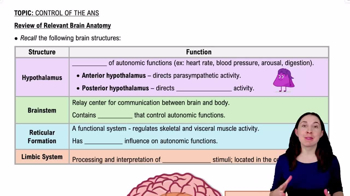
Review of Relevant Brain Anatomy
Pratica correlata
Domanda del libro di testo
1073
views
Domanda del libro di testo
Capillary permeability increase and plasma proteins leak into the interstitial fluid as part of the inflammatory process. Why is this desirable?
1645
views
Domanda del libro di testo
What is the function of the hepatic portal circulation? In what way is a portal circulation a 'strange' circulation?
1515
views
Domanda del libro di testo
Draw a diagram of the heart showing the three layers composing its wall and its four chambers. Label each. Show where the AV and semilunar valves are, and name them. Show and label all blood vessels entering and leaving the heart chambers.
1490
views
Domanda del libro di testo
Name three factors that are important in promoting venous return.
166
views
Domanda del libro di testo
Trace one drop of blood from the time it enters the right atrium of the heart until it enters the left atrium. What is this circuit called?
1597
views