
Ch. 12 The Lymphatic System and Body Defenses
Marieb - Essentials of Human Anatomy & Physiology 13th Edition
Marieb13th EditionEssentials of Human Anatomy & PhysiologyISBN: 9780135624340Non è quello che usi tu?Cambia libro di testo
Capitolo 12, Problema 20

Name the five classes of immunoglobulins. Which is most likely to be found attached to a B cell membrane? Which is most abundant in plasma? Which is important in allergic responses? Which is the first Ig to be released during the primary response? Which can cross the placental barrier?

Guida verificata passo dopo passo
1
Understand that immunoglobulins (Ig) are antibodies produced by B cells and plasma cells, and they play a critical role in the immune response. There are five main classes of immunoglobulins: IgG, IgA, IgM, IgE, and IgD.
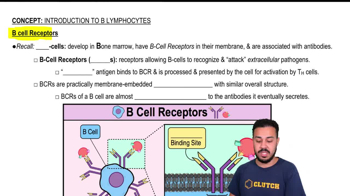
Identify the immunoglobulin most likely to be found attached to a B cell membrane. This is IgD, which acts as a receptor on the surface of immature B cells and helps in the activation of B cells.
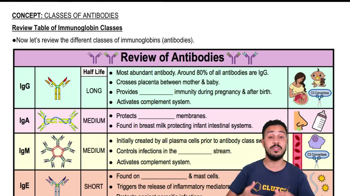
Determine the immunoglobulin that is most abundant in plasma. This is IgG, which constitutes the majority of antibodies in the blood and extracellular fluid, providing long-term immunity.
Recognize the immunoglobulin important in allergic responses. This is IgE, which binds to allergens and triggers the release of histamine from mast cells and basophils, leading to allergic reactions.
Identify the immunoglobulin that is the first to be released during the primary immune response and the one that can cross the placental barrier. IgM is the first antibody produced during the primary response, while IgG is the only antibody capable of crossing the placental barrier to provide passive immunity to the fetus.

Risposta video verificata per un problema simile:

Questa soluzione video è stata consigliata dai nostri tutor come utile per risolvere questo problema.
Durata del video:
1m

Concetti chiave

Ecco i concetti essenziali che devi comprendere per rispondere correttamente alla domanda.

Immunoglobulin Classes

Immunoglobulins, or antibodies, are classified into five main classes: IgG, IgA, IgM, IgE, and IgD. Each class has distinct functions and characteristics, such as their structure, location in the body, and role in the immune response. Understanding these classes is essential for answering questions about their specific functions and prevalence in different contexts.
Video consigliato:
Percorso guidato
3:48
Review Table of Immunoglobin Classes

B Cell Membrane and IgD

IgD is the immunoglobulin most commonly found attached to the surface of B cells. It plays a crucial role in the activation and regulation of B cells during the immune response. Recognizing the role of IgD helps in understanding how B cells initiate their function in response to antigens.
Video consigliato:
Percorso guidato
4:37
B Cell Receptors

IgG and Plasma Abundance

IgG is the most abundant immunoglobulin in plasma, accounting for about 75-80% of the total immunoglobulin pool. It is vital for long-term immunity and can neutralize pathogens, opsonize bacteria, and activate complement. Its high prevalence in plasma makes it a key player in the body's defense mechanisms.
Video consigliato: