Ch. 3 Cells and Tissues
Marieb - Essentials of Human Anatomy & Physiology 13th Edition
Marieb13th EditionEssentials of Human Anatomy & PhysiologyISBN: 9780135624340Non è quello che usi tu?Cambia libro di testo
Capitolo 3, Problema 7

In which of the following tissue types might you expect to find goblet cells?
a. Simple cuboidal
b. Simple columnar
c. Simple squamous
d. Stratified squamous
e. Transitional

Guida verificata passo dopo passo
1
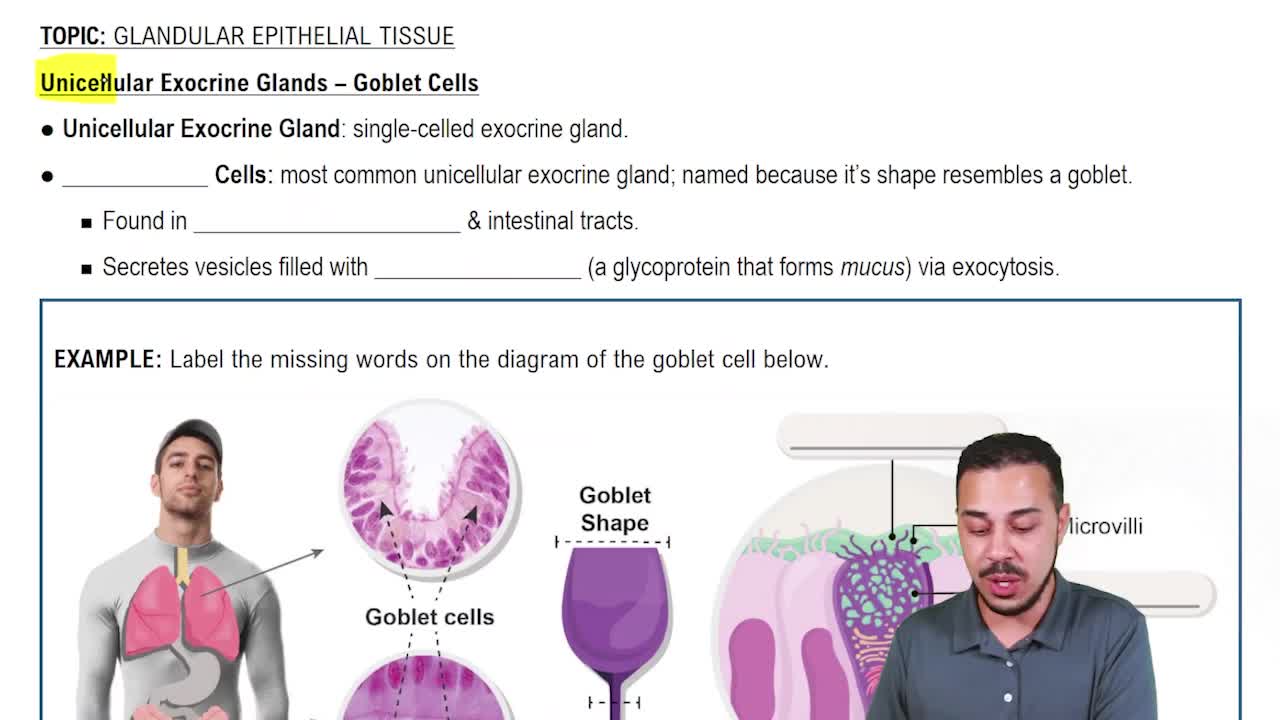
Understand the function of goblet cells: Goblet cells are specialized epithelial cells responsible for secreting mucus, which helps lubricate and protect surfaces. They are typically found in tissues that require mucus secretion for protection or movement.
Review the characteristics of each tissue type: Simple cuboidal epithelium is involved in secretion and absorption but does not typically contain goblet cells. Simple columnar epithelium often contains goblet cells, especially in areas like the digestive tract where mucus secretion is needed. Simple squamous epithelium is thin and primarily involved in diffusion and filtration, not mucus secretion. Stratified squamous epithelium is designed for protection and does not typically contain goblet cells. Transitional epithelium is specialized for stretching and does not usually have goblet cells.
Match the tissue types with the presence of goblet cells: Goblet cells are most commonly found in simple columnar epithelium, as this tissue type is associated with mucus secretion in areas like the respiratory and digestive tracts.
Eliminate tissue types that do not align with goblet cell function: Simple squamous, stratified squamous, and transitional epithelium do not support mucus secretion and are unlikely to contain goblet cells. Simple cuboidal epithelium may occasionally have goblet cells, but it is not a primary location for them.
Conclude that the tissue type most likely to contain goblet cells is simple columnar epithelium, with a possibility of simple cuboidal epithelium in certain cases. This aligns with the functional role of goblet cells in mucus secretion.

Risposta video verificata per un problema simile:

Questa soluzione video è stata consigliata dai nostri tutor come utile per risolvere questo problema.
Durata del video:
3m

Concetti chiave

Ecco i concetti essenziali che devi comprendere per rispondere correttamente alla domanda.

Goblet Cells

Goblet cells are specialized epithelial cells that secrete mucus. They are primarily found in the respiratory and gastrointestinal tracts, where they play a crucial role in lubrication and protection of the mucosal surfaces. Their presence is indicative of certain types of epithelial tissue, particularly those involved in secretion.
Video consigliato:
04:39
Unicellular Exocrine Glands - Goblet Cells

Epithelial Tissue Types

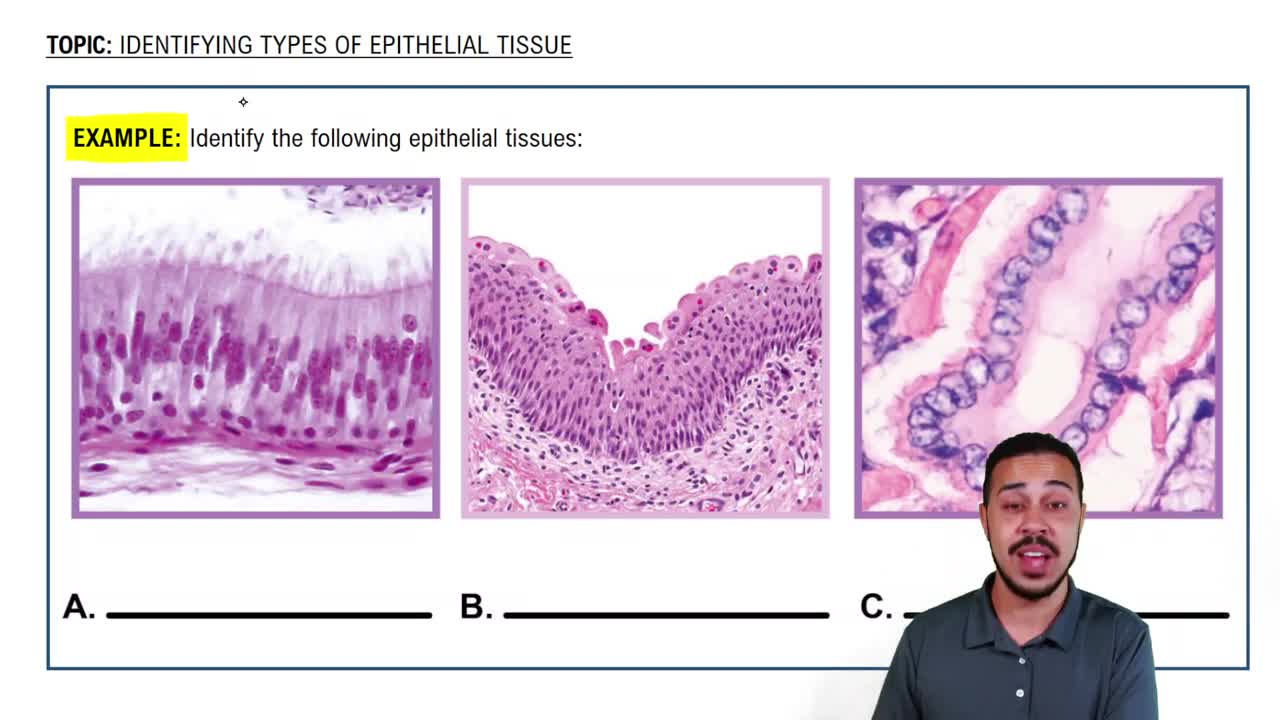
Epithelial tissue is classified into various types based on cell shape and arrangement. The main types include simple (single layer) and stratified (multiple layers) epithelium, with shapes such as squamous (flat), cuboidal (cube-shaped), and columnar (tall and column-like). Understanding these classifications helps in identifying where specific cell types, like goblet cells, are likely to be found.
Video consigliato:
07:25
Identifying Types of Epithelial Tissue Example 1

Mucous Membranes

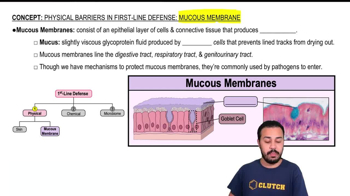
Mucous membranes line various cavities and structures in the body, including the respiratory and digestive tracts. They are composed of epithelial tissue and are often associated with goblet cells, which produce mucus to protect and lubricate the surfaces. Recognizing the role of mucous membranes is essential for understanding where goblet cells are typically located.
Video consigliato:
Percorso guidato
2:36
Mucous Membranes
Pratica correlata
Domanda del libro di testo

Match the appropriate structure with the proper description and/or function.

1. Made of dense, irregular connective tissue

 2. Produce sebum

3. Helps regulate body temperature by producing sweat

4. Cause fingerprints

5. Houses the hair root

6. Superficial keratinized stratified squamous epithelium

7. Deep pressure receptors

8. Vascular layer that houses skin appendages

a. Dermal papillae

b. Lamellar corpuscles

c. Dermis

d. Hair follicle

e. Epidermis

f. Eccrine sweat gland

g. Reticular layer

h. Sebaceous glands

83
views
Domanda del libro di testo

What kind of connective tissue acts as a sponge, soaking up fluid when edema occurs?

a. Areolar connective

b. Adipose connective

c. Dense irregular connective

d. Reticular connective

e. Vascular

122
views
Domanda del libro di testo

Which epithelium is 'built' to withstand friction?

a. Simple squamous

b. Stratified squamous

c. Simple cuboidal

d. Simple columnar

e. Pseudostratified

39
views
Domanda del libro di testo

A cell stimulated to increase its steroid production will have abundant:

a. Ribosomes

b. Rough ER

c. Smooth ER

d. Golgi apparatus

e. Secretory vesicles

101
views
Domanda del libro di testo

A cell with abundant peroxisomes would most likely be involved in:

a. Secretion

b. Storage of glycogen

c. ATP manufacture

d. Movement

e. Detoxification activities

39
views
Domanda del libro di testo

For diffusion to occur, there must be:

a. A selectively permeable membrane

b. Equal amounts of solute

c. A concentration difference

d. Some sort of carrier system

e. All of the above

37
views