The hamstring and quadriceps muscle groups are antagonists of each other, and each group is a prime mover in its own right. What action does each muscle group perform?
Ch. 6 The Muscular System

Marieb13th EditionEssentials of Human Anatomy & PhysiologyISBN: 9780135624340Non è quello che usi tu?Cambia libro di testo
Capitolo 6, Problema 14
In addition to acting to flex the spine and compress the abdominal contents, the abdominal muscles are extremely important in protecting and containing the abdominal viscera. What is it about the arrangement of these muscles that makes them so well suited for their job?
Guida verificata passo dopo passo1
Understand the role of the abdominal muscles: The abdominal muscles serve multiple functions, including flexing the spine, compressing the abdominal contents, and protecting the internal organs (abdominal viscera). Their arrangement is key to performing these tasks effectively.
Examine the layers of abdominal muscles: The abdominal wall is composed of several layers of muscles, including the external oblique, internal oblique, transversus abdominis, and rectus abdominis. These layers are arranged in different orientations, which enhances their strength and functionality.
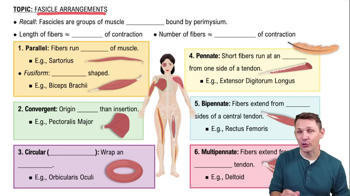
Analyze the fiber orientation: The muscle fibers of the abdominal muscles run in different directions. For example, the external oblique fibers run diagonally downward, the internal oblique fibers run diagonally upward, and the transversus abdominis fibers run horizontally. This crisscross arrangement provides structural integrity and allows for multidirectional support.
Consider the role of aponeuroses: The abdominal muscles are connected by strong, flat tendinous sheets called aponeuroses. These aponeuroses interweave and form a protective sheath around the abdominal viscera, further enhancing the containment and protection of internal organs.
Evaluate the functional synergy: The abdominal muscles work together as a cohesive unit to provide dynamic support. Their layered arrangement and fiber orientation allow them to distribute force evenly, resist pressure changes within the abdominal cavity, and protect the viscera from external impacts.

Risposta video verificata per un problema simile:
Questa soluzione video è stata consigliata dai nostri tutor come utile per risolvere questo problema.
Durata del video:
3mConcetti chiave
Ecco i concetti essenziali che devi comprendere per rispondere correttamente alla domanda.
Muscle Arrangement and Function
The abdominal muscles are arranged in layers, including the rectus abdominis, external obliques, internal obliques, and transversus abdominis. This layered structure allows for both flexion and rotation of the spine while providing stability and support to the abdominal cavity. The orientation of these muscles also aids in intra-abdominal pressure regulation, which is crucial for protecting internal organs.
Video consigliato:
Fascicle Arrangements
Intra-abdominal Pressure
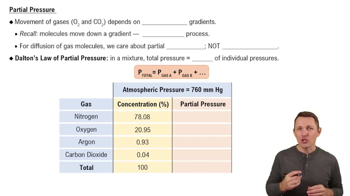
Intra-abdominal pressure refers to the pressure within the abdominal cavity, which is influenced by the contraction of the abdominal muscles. This pressure plays a vital role in stabilizing the spine and pelvis during movement and physical activities. By increasing intra-abdominal pressure, the abdominal muscles help protect the viscera from injury and maintain proper organ positioning.
Video consigliato:
Partial Pressure
Core Stability
Core stability involves the ability of the muscles in the abdomen, lower back, and pelvis to work together to support the spine and maintain balance. The abdominal muscles contribute significantly to core stability by providing a solid foundation for movement and reducing the risk of injury. A stable core is essential for efficient movement patterns and overall physical performance.
Video consigliato:
Percorso guidato
Organization of DNA in the Cell
Pratica correlata
Domanda del libro di testo
1597
views
Domanda del libro di testo
Name three muscles or muscle groups used as sites for intramuscular injections. Which is most often used in babies?
1502
views
Domanda del libro di testo
Define neuromuscular junction, motor unit, tetanus, graded response, aerobic respiration, anaerobic glycolysis, muscle fatigue, and neurotransmitter.
840
views
Domanda del libro di testo
Explain the general relationship between the muscles that flex and extend the wrist, including their location on the body.
1442
views
Domanda del libro di testo
Muscle tone keeps muscles healthy. What is muscle tone, and what causes it? What happens to a muscle that loses its tone?
772
views
Domanda del libro di testo
Describe the events that occur from the time calcium ions enter the axon terminal at the neuromuscular junction until muscle cell contraction occurs.
869
views