Ch. 6 The Muscular System
Marieb - Essentials of Human Anatomy & Physiology 13th Edition
Marieb13th EditionEssentials of Human Anatomy & PhysiologyISBN: 9780135624340Non è quello che usi tu?Cambia libro di testo
Capitolo 6, Problema 5

Which are ways in which muscle names have been derived?
a. Attachments
b. Size
c. Function
d. Location

Guida verificata passo dopo passo
1
Step 1: Understand that muscle names are often derived based on specific characteristics to help identify their structure, function, or location in the body.
Step 2: Recognize that 'attachments' refer to the points where muscles connect to bones or other structures, such as the sternocleidomastoid muscle, which is named for its attachment points (sternum, clavicle, and mastoid process).
Step 3: Note that 'size' is another common naming convention, where terms like 'maximus' (largest), 'minimus' (smallest), or 'longus' (long) describe the relative size of the muscle.
Step 4: Understand that 'function' describes the action the muscle performs, such as the flexor muscles (which flex joints) or extensor muscles (which extend joints).
Step 5: Recognize that 'location' refers to the anatomical region where the muscle is found, such as the brachialis muscle located in the arm (brachium).

Risposta video verificata per un problema simile:

Questa soluzione video è stata consigliata dai nostri tutor come utile per risolvere questo problema.
Durata del video:
1m

Concetti chiave

Ecco i concetti essenziali che devi comprendere per rispondere correttamente alla domanda.

Attachments

Muscle names often reflect their points of origin and insertion, indicating where they attach to bones. For example, the 'sternocleidomastoid' muscle is named for its attachments to the sternum, clavicle, and mastoid process of the skull. This naming convention helps in understanding the muscle's role in movement and stability.
Video consigliato:
02:06
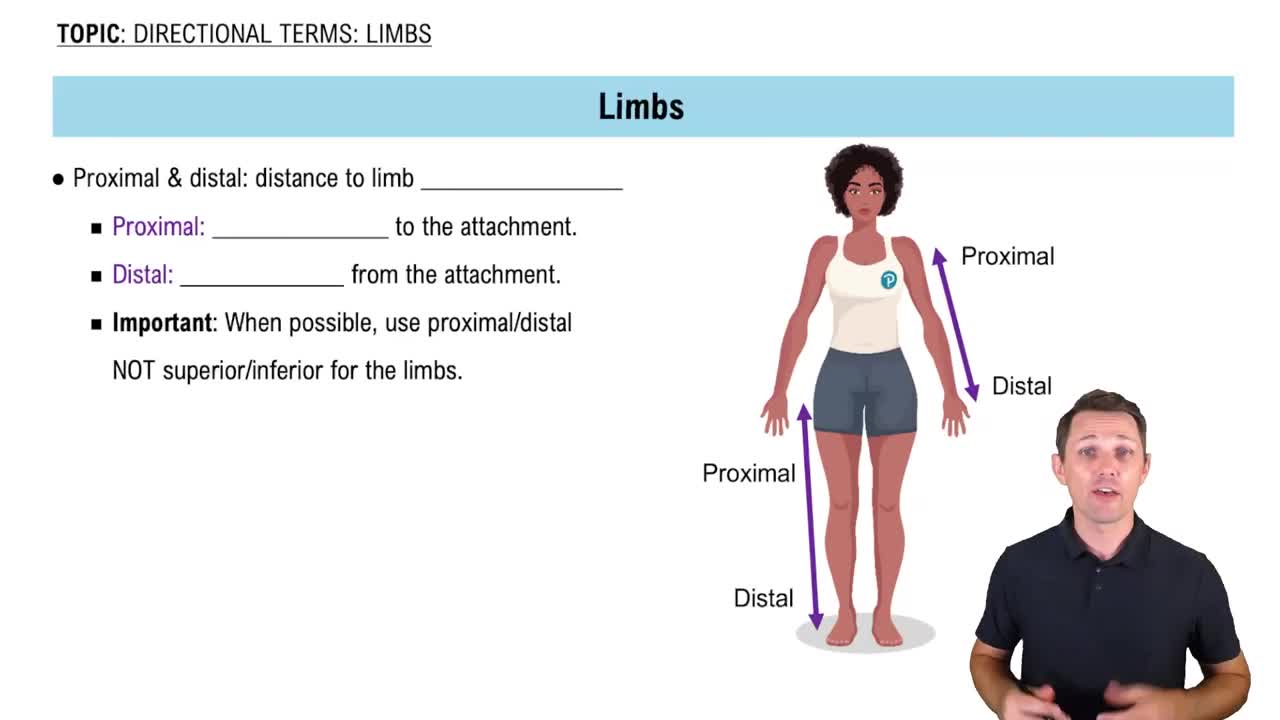
Proximal and Distal

Size

The size of a muscle can also influence its name, with terms like 'maximus' (largest), 'minimus' (smallest), and 'longus' (long) being commonly used. For instance, the 'gluteus maximus' is the largest muscle in the gluteal region. This classification aids in identifying the relative size and potential strength of the muscle.
Video consigliato:
Percorso guidato
03:45
3 Size Classes of Carbohydrates

Function

Muscle names may describe their primary function or action, such as 'flexor' or 'extensor,' indicating whether they primarily flex or extend a joint. For example, the 'biceps brachii' is named for its function in flexing the elbow. Understanding these functional names helps in grasping the biomechanics of movement.
Video consigliato:
Percorso guidato
06:04
Functional Groups