Ch. 6 The Muscular System
Marieb - Essentials of Human Anatomy & Physiology 13th Edition
Marieb13th EditionEssentials of Human Anatomy & PhysiologyISBN: 9780135624340Non è quello che usi tu?Cambia libro di testo
Capitolo 6, Problema 7

Which of these thigh muscles causes movement at the hip joint?
a. Rectus femoris
b. Biceps femoris
c. Vastus lateralis
d. Semitendinosus

Guida verificata passo dopo passo
1
Step 1: Understand the anatomy of the thigh muscles listed in the question. The thigh muscles can be divided into three main groups: the anterior (front), posterior (back), and medial (inner) compartments. Each group contains muscles that perform specific actions at the hip and/or knee joints.
Step 2: Analyze the function of the rectus femoris (option a). The rectus femoris is part of the quadriceps group in the anterior compartment. It is unique among the quadriceps because it crosses both the hip and knee joints, allowing it to cause movement at the hip joint (hip flexion).
Step 3: Analyze the function of the biceps femoris (option b). The biceps femoris is part of the hamstring group in the posterior compartment. It crosses the hip joint and contributes to hip extension, making it a muscle that causes movement at the hip joint.
Step 4: Analyze the function of the vastus lateralis (option c). The vastus lateralis is also part of the quadriceps group, but unlike the rectus femoris, it does not cross the hip joint. Its primary function is knee extension, so it does not cause movement at the hip joint.
Step 5: Analyze the function of the semitendinosus (option d). The semitendinosus is another hamstring muscle in the posterior compartment. Like the biceps femoris, it crosses the hip joint and contributes to hip extension, making it a muscle that causes movement at the hip joint.

Risposta video verificata per un problema simile:

Questa soluzione video è stata consigliata dai nostri tutor come utile per risolvere questo problema.
Durata del video:
1m

Concetti chiave

Ecco i concetti essenziali che devi comprendere per rispondere correttamente alla domanda.

Hip Joint Anatomy

The hip joint is a ball-and-socket joint that allows for a wide range of motion, including flexion, extension, abduction, adduction, and rotation. Understanding the anatomy of the hip joint, including the bones and surrounding muscles, is essential for identifying which muscles contribute to its movement.
Video consigliato:
Percorso guidato
08:25
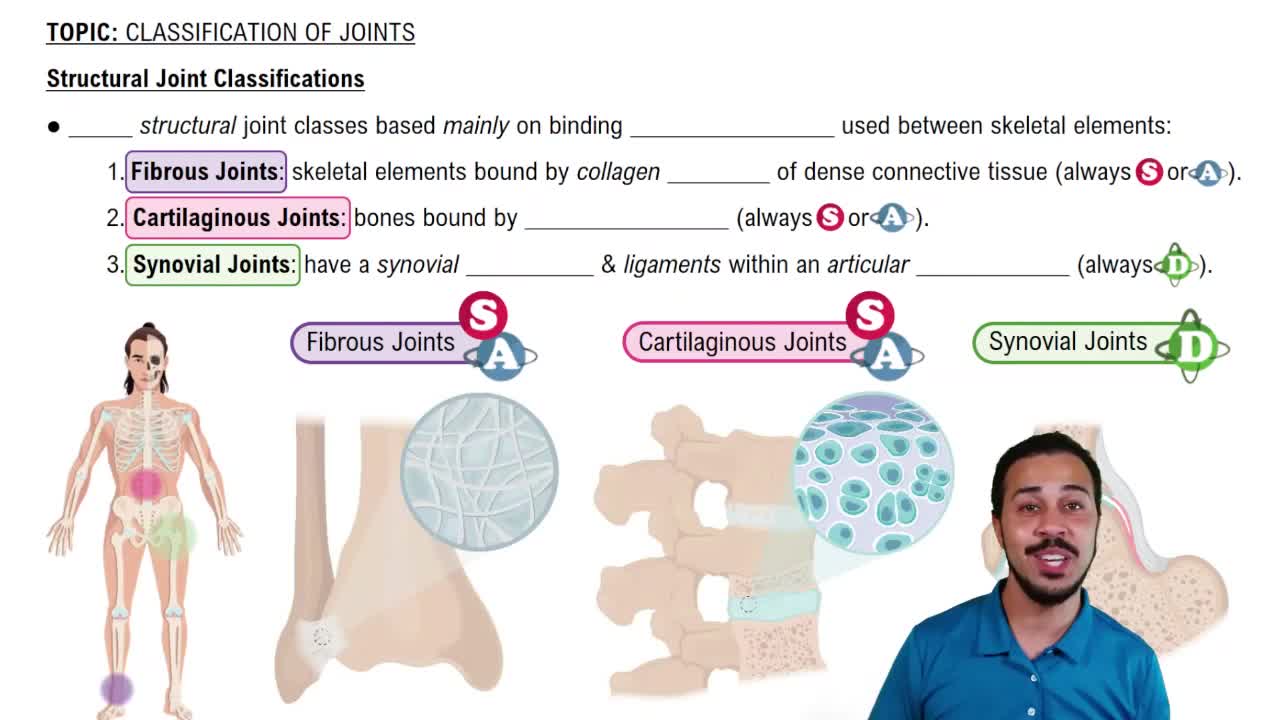
Structural Joint Classifications

Muscle Functions

Different muscles have specific functions based on their location and orientation. For instance, the rectus femoris is a part of the quadriceps group and primarily extends the knee, while the biceps femoris and semitendinosus are part of the hamstrings, which are responsible for flexing the knee and extending the hip.
Video consigliato:
Percorso guidato
06:04
Functional Groups

Muscle Groups Involved in Hip Movement

The primary muscle groups involved in hip movement include the hip flexors, extensors, abductors, and adductors. The hamstrings, including the biceps femoris and semitendinosus, play a significant role in extending the hip joint, while the quadriceps, particularly the rectus femoris, primarily act on the knee.
Video consigliato:
Percorso guidato
06:04
Functional Groups