Ch. 10 Muscle Tissue
Martini - Fundamentals of Anatomy & Physiology 11th Edition
Martini, Nath, Bartholomew11th EditionFundamentals of Anatomy & PhysiologyISBN: 9780136874089Non è quello che usi tu?Cambia libro di testo
Capitolo 10, Problema 24

How does cardiac muscle tissue contract without neural stimulation?

Guida verificata passo dopo passo
1
Understand that cardiac muscle tissue is unique because it can contract without direct neural stimulation due to its intrinsic properties.
Recognize that cardiac muscle cells have specialized pacemaker cells located in the sinoatrial (SA) node, which generate spontaneous electrical impulses.
These pacemaker cells undergo rhythmic depolarization due to the movement of ions (such as Na\^+, K\^+, and Ca\^2\^+) across their membranes, creating action potentials without external stimuli.
The action potentials from the SA node spread through the cardiac muscle via gap junctions in intercalated discs, allowing coordinated contraction of the heart muscle.
Thus, the heart's ability to contract autonomously is due to the pacemaker cells' automaticity and the electrical coupling between cardiac muscle cells, not requiring neural input to initiate contraction.

Risposta video verificata per un problema simile:

Questa soluzione video è stata consigliata dai nostri tutor come utile per risolvere questo problema.
Durata del video:
3m

Concetti chiave

Ecco i concetti essenziali che devi comprendere per rispondere correttamente alla domanda.

Cardiac Muscle Tissue Structure

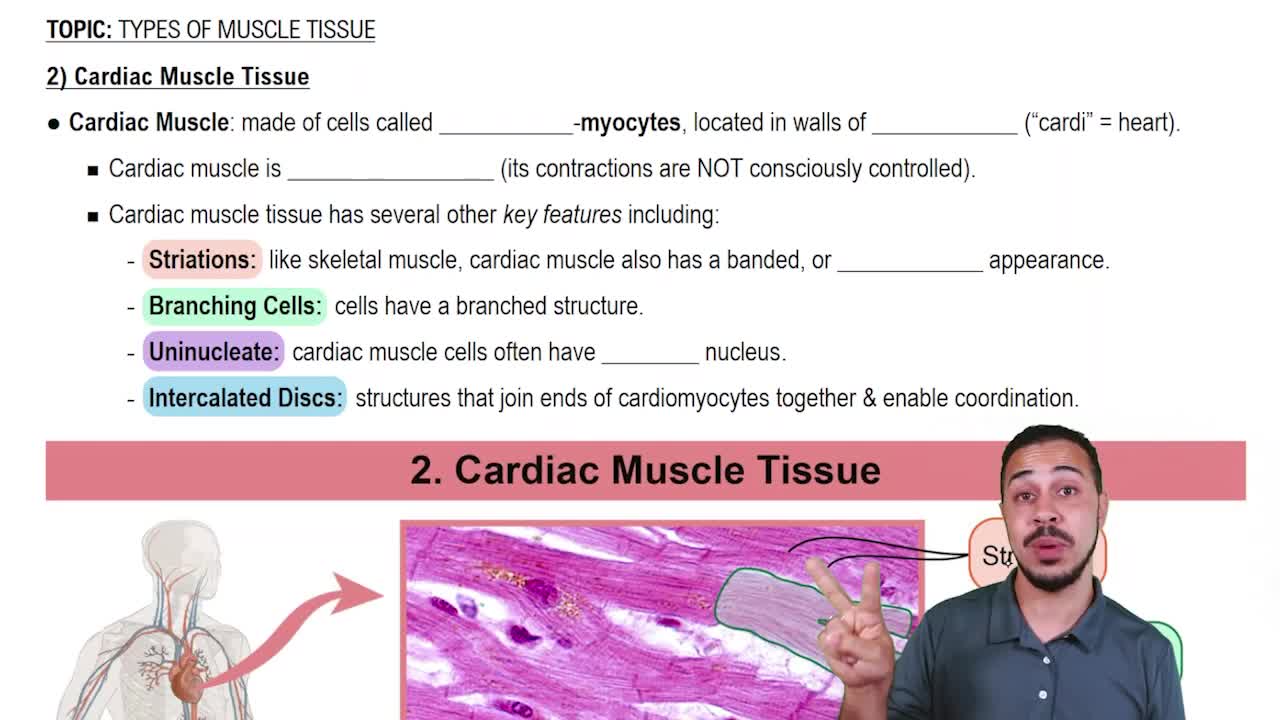
Cardiac muscle tissue is composed of specialized muscle cells called cardiomyocytes, which are interconnected by intercalated discs. These discs contain gap junctions that allow electrical impulses to pass directly between cells, enabling coordinated contraction without external neural input.
Video consigliato:
06:00
Cardiac Muscle Tissue

Autorhythmicity and Pacemaker Cells

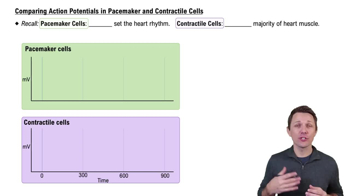
Certain cardiac cells, known as pacemaker cells, have the unique ability to generate spontaneous electrical impulses. This autorhythmicity allows the heart to initiate contractions independently of the nervous system, maintaining a regular heartbeat through intrinsic electrical activity.
Video consigliato:
6:36
Comparing Action Potentials in Pacemaker and Contractile Cells

Role of the Sinoatrial (SA) Node

The SA node, located in the right atrium, acts as the heart's natural pacemaker by producing rhythmic electrical signals. These signals spread through the heart muscle, triggering contraction in a coordinated manner without requiring neural stimulation.
Video consigliato:
Percorso guidato
5:05
Introduction to Lymph Nodes