Ch. 17 The Special Senses
Martini - Fundamentals of Anatomy & Physiology 11th Edition
Martini, Nath, Bartholomew11th EditionFundamentals of Anatomy & PhysiologyISBN: 9780136874089Non è quello che usi tu?Cambia libro di testo
Capitolo 17, Problema 5

The basic receptors in the internal ear are the
(a) Utricles
(b) Saccules
(c) Hair cells
(d) Supporting cells
(e) Ampullae

Guida verificata passo dopo passo
1
Understand that the internal ear contains specialized sensory receptors responsible for detecting sound and balance.
Recognize that the basic sensory receptors in the internal ear are specialized cells that convert mechanical stimuli into nerve impulses.
Recall that hair cells are the primary sensory receptors in the internal ear, located within structures such as the cochlea and vestibular apparatus.
Note that utricles, saccules, and ampullae are parts of the vestibular system that contain hair cells but are not themselves the receptors.
Conclude that the correct answer is (c) Hair cells, as they are the fundamental receptor cells responsible for detecting auditory and balance stimuli.

Risposta video verificata per un problema simile:

Questa soluzione video è stata consigliata dai nostri tutor come utile per risolvere questo problema.

Concetti chiave

Ecco i concetti essenziali che devi comprendere per rispondere correttamente alla domanda.

Structure of the Internal Ear

The internal ear consists of the cochlea, vestibule, and semicircular canals. It houses sensory organs responsible for hearing and balance, including specialized receptor cells that detect sound vibrations and head movements.
Video consigliato:
6:14
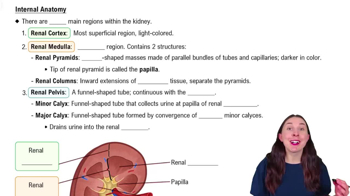
Internal Anatomy

Hair Cells as Sensory Receptors

Hair cells are the primary sensory receptors in the internal ear. They have hair-like projections called stereocilia that convert mechanical stimuli from sound waves or head movements into electrical signals sent to the brain.
Video consigliato:
2:47
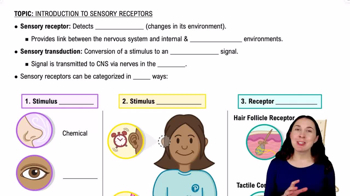
Sensory Receptors

Role of Utricles, Saccules, and Ampullae

Utricles and saccules detect linear acceleration and gravity, while ampullae in semicircular canals detect rotational movements. These structures contain hair cells embedded in gelatinous material that respond to motion, aiding in balance and spatial orientation.
Video consigliato:
1:02
Anatomy of the Female Reproductive System Example 2