Ch. 20 The Heart
Martini - Fundamentals of Anatomy & Physiology 11th Edition
Martini, Nath, Bartholomew11th EditionFundamentals of Anatomy & PhysiologyISBN: 9780136874089Non è quello che usi tu?Cambia libro di testo
Capitolo 20, Problema 30

The following measurements were made on two individuals (the values recorded remained stable for 1 hour):
Person 1: heart rate, 75 bpm; stroke volume, 60 mL
Person 2: heart rate, 90 bpm; stroke volume, 95 mL
Which person has the greater venous return?
Which person has the longer ventricular filling time?

Guida verificata passo dopo passo
1
Understand that venous return is the volume of blood returning to the heart per minute, which in a steady state equals cardiac output. Cardiac output (CO) is calculated as the product of heart rate (HR) and stroke volume (SV): \(CO = HR \times SV\).
Calculate the cardiac output for each person by multiplying their heart rate (in beats per minute) by their stroke volume (in milliliters). For Person 1: \(CO_1 = 75 \times 60\), and for Person 2: \(CO_2 = 90 \times 95\).
Compare the cardiac outputs of both individuals to determine which person has the greater venous return, since venous return must match cardiac output in a steady state.
Understand that ventricular filling time is the duration of diastole (the relaxation phase of the heart) during which the ventricles fill with blood. It is inversely related to heart rate because as heart rate increases, the total cardiac cycle duration decreases, shortening diastole.
Determine which person has the longer ventricular filling time by comparing their heart rates: the person with the lower heart rate will have a longer ventricular filling time because each cardiac cycle lasts longer.

Risposta video verificata per un problema simile:

Questa soluzione video è stata consigliata dai nostri tutor come utile per risolvere questo problema.

Concetti chiave

Ecco i concetti essenziali che devi comprendere per rispondere correttamente alla domanda.

Venous Return

Venous return is the volume of blood flowing back to the heart per minute. It must equal cardiac output in a steady state, as the heart pumps out all the blood it receives. Venous return depends on factors like blood volume, venous pressure, and vessel tone, and it influences stroke volume and heart function.
Video consigliato:
Percorso guidato
6:50
Types of Anastomoses

Cardiac Output and Stroke Volume

Cardiac output is the total volume of blood the heart pumps per minute, calculated as heart rate multiplied by stroke volume. Stroke volume is the amount of blood ejected by the ventricle with each beat. Comparing cardiac outputs helps determine which individual has greater blood flow and venous return.
Video consigliato:
6:28
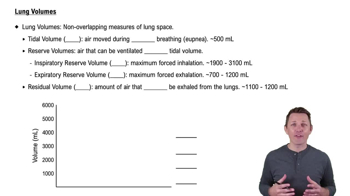
Lung Volumes

Ventricular Filling Time

Ventricular filling time is the duration during diastole when the ventricles fill with blood. It is inversely related to heart rate; a slower heart rate allows more time for filling, while a faster heart rate shortens this period. Longer filling time can increase stroke volume by allowing more blood to enter the ventricle.
Video consigliato:
3:55
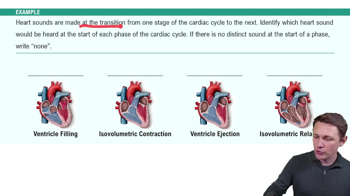
Cardiac Cycle Example 3