

Ch. 26 The Urinary System
Martini - Fundamentals of Anatomy & Physiology 11th Edition
Martini, Nath, Bartholomew11th EditionFundamentals of Anatomy & PhysiologyISBN: 9780136874089Non è quello che usi tu?Cambia libro di testo
Capitolo 25, Problema 29

David’s grandfather suffers from hypertension. His doctor tells him that part of his problem stems from renal arteriosclerosis. Why would this cause hypertension?

Guida verificata passo dopo passo
1
Understand that renal arteriosclerosis refers to the thickening and hardening of the walls of the renal arteries, which supply blood to the kidneys.
Recognize that this thickening narrows the lumen of the renal arteries, reducing blood flow to the kidneys.
Recall that the kidneys regulate blood pressure partly by detecting blood flow and releasing renin when blood flow is low.
Explain that reduced blood flow due to arteriosclerosis causes the kidneys to perceive low blood pressure, triggering the renin-angiotensin-aldosterone system (RAAS) to increase blood pressure.
Conclude that this compensatory mechanism leads to systemic hypertension as the body attempts to restore adequate kidney perfusion.

Risposta video verificata per un problema simile:

Questa soluzione video è stata consigliata dai nostri tutor come utile per risolvere questo problema.

Concetti chiave

Ecco i concetti essenziali che devi comprendere per rispondere correttamente alla domanda.

Renal Arteriosclerosis

Renal arteriosclerosis refers to the thickening and hardening of the small arteries in the kidneys. This condition reduces blood flow to the kidney tissues, impairing their function and triggering compensatory mechanisms that can elevate blood pressure.
Video consigliato:
4:58
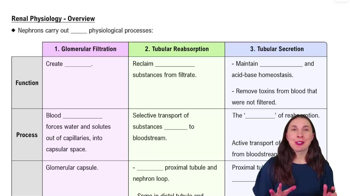
Overview of Renal Physiology

Renin-Angiotensin-Aldosterone System (RAAS)

The RAAS is a hormone system that regulates blood pressure and fluid balance. When kidney blood flow decreases due to arteriosclerosis, the kidneys release renin, activating RAAS, which causes vasoconstriction and sodium retention, leading to increased blood pressure.
Video consigliato:
Percorso guidato
11:30
Renin-Angiotensin-Aldosterone-System

Hypertension Pathophysiology

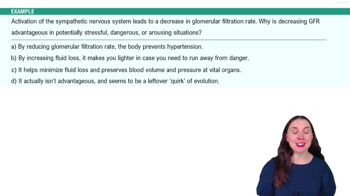
Hypertension is a condition characterized by persistently elevated blood pressure. Reduced renal perfusion from arteriosclerosis stimulates mechanisms like RAAS activation and sympathetic nervous system responses, which increase vascular resistance and blood volume, causing hypertension.
Video consigliato:
1:38
Renal Physiology: Regulation of Glomerular Filtration Example 4
Pratica correlata
Domanda del libro di testo

In a normal kidney, which of the following conditions would cause an increase in the glomerular filtration rate (GFR)? 

(a) Constriction of the afferent arteriole

(b) A decrease in the pressure of the glomerulus

(c) An increase in the capsular hydrostatic pressure

(d) A decrease in the concentration of plasma proteins in the blood

(e) A decrease in the net glomerular filtration process

108
views
Domanda del libro di testo

Sylvia is suffering from severe edema in her arms and legs. Her physician prescribes a diuretic (a substance that increases the volume of urine produced). Why might this help alleviate Sylvia’s problem?

59
views
Domanda del libro di testo

The drug Diamox is sometimes used to treat mountain sickness. Diamox inhibits the action of carbonic anhydrase in the proximal convoluted tubule. Polyuria (excessive urine production resulting in frequent urination) is a side effect associated with the medication. Why does polyuria occur?

44
views
Domanda del libro di testo

Mannitol is a sugar that is filtered, but not reabsorbed, by the kidneys. What effect would drinking a solution of mannitol have on the volume of urine produced?

81
views
Domanda del libro di testo

In response to excess water in the body, 

(a) Antidiuretic hormone is secreted by the anterior lobe of the pituitary gland.

(b) The active transport mechanisms in the ascending thick limb of the nephron loop cease functioning.

(c) The permeability of the distal convoluted tubules and collecting ducts to water is decreased.

(d) The permeability of the ascending limb of the nephron loop is increased.

(e) The glomerular filtration rate is reduced.

53
views