Ch. 26 The Urinary System
Martini - Fundamentals of Anatomy & Physiology 11th Edition
Martini, Nath, Bartholomew11th EditionFundamentals of Anatomy & PhysiologyISBN: 9780136874089Non è quello che usi tu?Cambia libro di testo
Capitolo 25, Problema 1

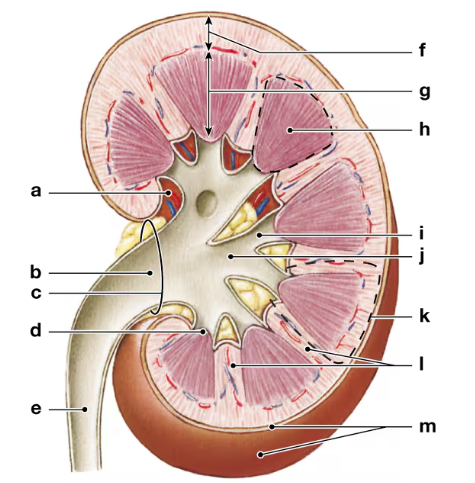
Identify the structures of the kidney in the following diagram.
Cross-sectional diagram of a kidney with labeled internal structures for identification and study.
a. ___
b. ___
c. ___
d. ___
e. ___
f. ___
g. ___
h. ___
i. ___
j. ___
k. ___
l. ___
m. ___

Guida verificata passo dopo passo
1
Step 1: Familiarize yourself with the major anatomical structures of the kidney, such as the renal cortex, renal medulla, renal pelvis, ureter, renal artery, renal vein, and nephron components. This foundational knowledge will help you identify each labeled part in the diagram.
Step 2: Examine the diagram carefully and locate the outermost layer of the kidney, which is typically the renal cortex. This is usually labeled near the outer edge of the kidney structure.
Step 3: Identify the inner region of the kidney, known as the renal medulla, which contains the renal pyramids. These pyramids are cone-shaped and are often labeled distinctly in kidney diagrams.
Step 4: Look for the central cavity or funnel-shaped structure called the renal pelvis, which collects urine before it passes into the ureter. The ureter is the tube that carries urine from the kidney to the bladder.
Step 5: Identify the blood vessels associated with the kidney: the renal artery (bringing blood into the kidney) and the renal vein (carrying filtered blood away). These vessels are usually shown entering or exiting the kidney near the renal hilum.

Risposta video verificata per un problema simile:

Questa soluzione video è stata consigliata dai nostri tutor come utile per risolvere questo problema.

Concetti chiave

Ecco i concetti essenziali che devi comprendere per rispondere correttamente alla domanda.

Anatomy of the Kidney

The kidney is a vital organ with distinct structures such as the cortex, medulla, renal pelvis, and calyces. Understanding these parts helps identify their roles in filtering blood, producing urine, and maintaining homeostasis. Recognizing these structures in diagrams is essential for anatomical comprehension.
Video consigliato:
1:00
The Kidneys Example 1

Renal Blood Supply and Filtration Units

The kidney's blood supply includes the renal artery, arterioles, and glomeruli, which are crucial for filtration. The nephron, the functional unit, consists of the glomerulus and tubules that process blood to form urine. Identifying these components aids in understanding kidney function and structure.
Video consigliato:
6:37
Blood Supply to the Kidneys

Urine Collection and Drainage System

After filtration, urine flows through structures like the collecting ducts, minor and major calyces, renal pelvis, and ureter. These pathways transport urine from the kidney to the bladder. Recognizing these parts in diagrams is key to understanding the kidney’s excretory role.
Video consigliato:
3:50
The Collecting Duct