Ch. 26 The Urinary System
Martini - Fundamentals of Anatomy & Physiology 11th Edition
Martini, Nath, Bartholomew11th EditionFundamentals of Anatomy & PhysiologyISBN: 9780136874089Non è quello che usi tu?Cambia libro di testo
Capitolo 25, Problema 11

What is the function of the juxtaglomerular complex?

Guida verificata passo dopo passo
1
Understand that the juxtaglomerular complex (JGC) is a specialized structure in the kidney located near the glomerulus, where the distal convoluted tubule contacts the afferent arteriole.
Recognize that the JGC plays a crucial role in regulating blood pressure and the filtration rate of the glomerulus by sensing changes in blood pressure and sodium concentration.
Identify the three main components of the JGC: juxtaglomerular cells (which release renin), the macula densa (which senses sodium levels), and the extraglomerular mesangial cells (which support communication between the other two).
Explain that when blood pressure drops or sodium levels are low, the juxtaglomerular cells release renin, initiating the renin-angiotensin-aldosterone system (RAAS) to increase blood pressure and sodium retention.
Summarize that the primary function of the juxtaglomerular complex is to regulate blood pressure and maintain fluid and electrolyte balance by controlling renin release and glomerular filtration.

Risposta video verificata per un problema simile:

Questa soluzione video è stata consigliata dai nostri tutor come utile per risolvere questo problema.

Concetti chiave

Ecco i concetti essenziali che devi comprendere per rispondere correttamente alla domanda.

Juxtaglomerular Complex Structure

The juxtaglomerular complex is a specialized structure in the kidney located near the glomerulus. It consists of juxtaglomerular cells, macula densa, and extraglomerular mesangial cells, which work together to regulate kidney function.
Video consigliato:
Percorso guidato
2:31
Major Histocompatibility Complexes

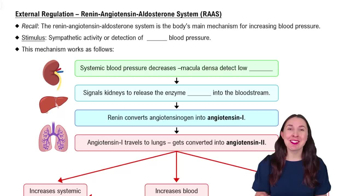
Renin Secretion and Blood Pressure Regulation

Juxtaglomerular cells release renin in response to low blood pressure or decreased sodium levels. Renin initiates the renin-angiotensin-aldosterone system, which helps increase blood pressure and maintain fluid balance.
Video consigliato:
7:02
External Regulation – Renin-Angiotensin-Aldosterone Mechanism

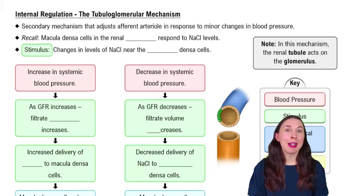
Tubuloglomerular Feedback Mechanism

The macula densa senses sodium concentration in the distal tubule and signals the juxtaglomerular cells to adjust renin release. This feedback helps regulate glomerular filtration rate and maintain homeostasis.
Video consigliato:
3:31
Internal Regulation - The Tubuloglomerular Mechanism