Ch. 27 Fluids & Electrolytes
Martini - Fundamentals of Anatomy & Physiology 11th Edition
Martini, Nath, Bartholomew11th EditionFundamentals of Anatomy & PhysiologyISBN: 9780136874089Non è quello che usi tu?Cambia libro di testo
Capitolo 26, Problema 20

How do respiratory and renal mechanisms support the buffer systems?

Guida verificata passo dopo passo
1
Understand that buffer systems in the body help maintain pH balance by neutralizing excess acids or bases, and that respiratory and renal mechanisms support these buffers by regulating levels of carbon dioxide and hydrogen ions.
Recognize that the respiratory system controls blood pH by adjusting the rate of carbon dioxide (CO\_2) exhalation; since CO\_2 reacts with water to form carbonic acid, changing CO\_2 levels influences acidity.
Note that when blood pH drops (becomes more acidic), the respiratory rate increases to expel more CO\_2, reducing carbonic acid concentration and raising pH back toward normal.
Understand that the renal system supports buffer systems by selectively excreting hydrogen ions (H\^+) and reabsorbing bicarbonate ions (HCO\_3\^-) in the kidneys, which helps to regulate blood pH over a longer term.
Combine these concepts to see how respiratory adjustments provide rapid pH regulation by controlling CO\_2 levels, while renal mechanisms provide slower, but more precise, control by managing acid-base balance through ion exchange.

Risposta video verificata per un problema simile:

Questa soluzione video è stata consigliata dai nostri tutor come utile per risolvere questo problema.

Concetti chiave

Ecco i concetti essenziali che devi comprendere per rispondere correttamente alla domanda.

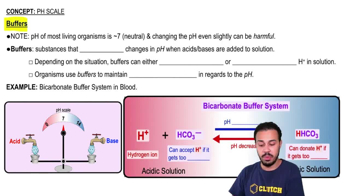
Buffer Systems in the Body

Buffer systems are chemical systems that help maintain the body's pH balance by neutralizing excess acids or bases. The primary buffers include the bicarbonate, phosphate, and protein buffers, which act quickly to minimize pH changes in bodily fluids.
Video consigliato:

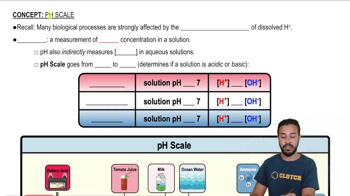
Respiratory Mechanism in pH Regulation

The respiratory system regulates pH by controlling the level of carbon dioxide (CO2) in the blood. By adjusting breathing rate, it influences CO2 concentration, which affects carbonic acid levels and thus helps maintain acid-base balance rapidly.
Video consigliato:

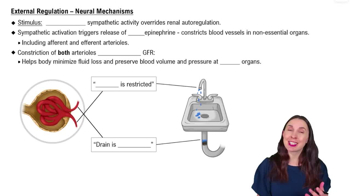
Renal Mechanism in pH Regulation

The kidneys maintain pH balance by excreting hydrogen ions and reabsorbing bicarbonate from urine. This slower but long-term mechanism adjusts the blood’s acid-base status by controlling the concentration of acids and bases over hours to days.
Video consigliato:
1:52
External Regulation – Neural Mechanisms