Ch. 28 The Reproductive System
Martini - Fundamentals of Anatomy & Physiology 11th Edition
Martini, Nath, Bartholomew11th EditionFundamentals of Anatomy & PhysiologyISBN: 9780136874089Non è quello che usi tu?Cambia libro di testo
Capitolo 27, Problema 18

Describe the erectile tissues of the penis. How does erection occur?

Guida verificata passo dopo passo
1
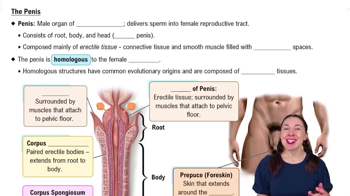
Identify the three main erectile tissues of the penis: two corpora cavernosa and one corpus spongiosum. The corpora cavernosa are paired cylindrical structures located dorsally, while the corpus spongiosum surrounds the urethra ventrally.
Explain the structure of these tissues, emphasizing that they consist of spongy vascular spaces (sinusoids) lined with endothelium and surrounded by smooth muscle and connective tissue, which allow them to fill with blood.
Describe the physiological process of erection, starting with sexual arousal that triggers parasympathetic nerve signals leading to the release of nitric oxide (NO) in the penile arteries.
Explain how nitric oxide causes relaxation of the smooth muscle in the walls of the arteries and the trabeculae within the erectile tissues, resulting in vasodilation and increased blood flow into the sinusoids of the corpora cavernosa and corpus spongiosum.
Detail how the increased blood volume expands the erectile tissues, compressing the veins that normally drain blood from the penis, thus trapping blood within the tissues and maintaining the erection until sympathetic signals cause muscle contraction and blood outflow resumes.

Risposta video verificata per un problema simile:

Questa soluzione video è stata consigliata dai nostri tutor come utile per risolvere questo problema.

Concetti chiave

Ecco i concetti essenziali che devi comprendere per rispondere correttamente alla domanda.

Erectile Tissues of the Penis

The penis contains three main erectile tissues: two corpora cavernosa and one corpus spongiosum. The corpora cavernosa are paired cylindrical structures that fill with blood during erection, while the corpus spongiosum surrounds the urethra and prevents it from being compressed. These tissues are composed of spongy vascular spaces lined with endothelium.
Video consigliato:
5:22
The Penis

Physiology of Erection

Erection occurs when the smooth muscles in the erectile tissues relax, allowing blood to fill the vascular spaces. This process is triggered by neural signals that cause vasodilation of penile arteries and restrict venous outflow, leading to increased pressure and rigidity. Parasympathetic stimulation plays a key role in initiating this response.
Video consigliato:
02:52
What is Anatomy & Physiology? Example 1

Neural and Vascular Mechanisms

Erection is controlled by a complex interaction between the nervous system and blood vessels. Parasympathetic nerves release nitric oxide, which induces smooth muscle relaxation and vasodilation. The increased arterial inflow and restricted venous drainage result in engorgement of erectile tissues, producing an erection.
Video consigliato:
6:55
Vascular Layer