Ch. 29 Development and Inheritance
Martini - Fundamentals of Anatomy & Physiology 11th Edition
Martini, Nath, Bartholomew11th EditionFundamentals of Anatomy & PhysiologyISBN: 9780136874089Non è quello che usi tu?Cambia libro di testo
Capitolo 28, Problema 18

After implantation, how does the developing embryo obtain nutrients? What structures and processes are involved?

Guida verificata passo dopo passo
1
Understand that after implantation, the developing embryo obtains nutrients primarily through the maternal blood supply, as it can no longer rely on the yolk sac alone for nourishment.
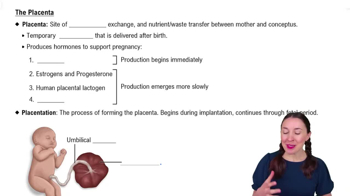
Identify the key structure involved: the placenta, which forms at the site of implantation and serves as the interface between maternal and embryonic tissues.
Explain that the placenta contains chorionic villi, finger-like projections that extend into the maternal endometrium, increasing surface area for exchange.
Describe the process of nutrient transfer: maternal blood flows through the intervillous spaces surrounding the chorionic villi, allowing diffusion and active transport of nutrients, oxygen, and waste products between maternal and fetal blood without direct mixing.
Note that the umbilical cord connects the embryo (via the fetus) to the placenta, containing blood vessels that carry oxygenated, nutrient-rich blood to the embryo and return deoxygenated blood and waste products to the placenta for removal.

Risposta video verificata per un problema simile:

Questa soluzione video è stata consigliata dai nostri tutor come utile per risolvere questo problema.

Concetti chiave

Ecco i concetti essenziali che devi comprendere per rispondere correttamente alla domanda.

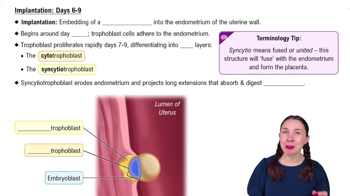
Implantation of the Embryo

Implantation is the process by which the blastocyst attaches to and embeds itself into the uterine lining (endometrium). This critical step allows the embryo to establish a connection with the maternal tissue, enabling nutrient and gas exchange essential for further development.
Video consigliato:
2:34
Implantation: Days 6-9

Formation and Role of the Placenta

The placenta is a specialized organ that forms from both embryonic and maternal tissues after implantation. It facilitates the transfer of nutrients, oxygen, and waste products between mother and embryo through a network of blood vessels, supporting embryonic growth and development.
Video consigliato:
2:19
The Placenta

Nutrient Transfer Mechanisms

Nutrients reach the embryo primarily via diffusion and active transport across the placental barrier. Maternal blood supplies glucose, amino acids, and oxygen, which cross into embryonic blood vessels, while waste products are removed, ensuring a balanced environment for the embryo.
Video consigliato:
3:02
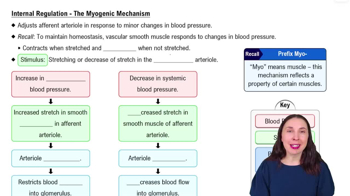
Internal Regulation - The Myogenic Mechanism