Ch. 29 Development and Inheritance
Martini - Fundamentals of Anatomy & Physiology 11th Edition
Martini, Nath, Bartholomew11th EditionFundamentals of Anatomy & PhysiologyISBN: 9780136874089Non è quello che usi tu?Cambia libro di testo
Capitolo 28, Problema 23c

Distinguish between the following paired terms: 
(c) simple inheritance and polygenic inheritance.

Guida verificata passo dopo passo
1
Understand the concept of inheritance: Inheritance refers to the transmission of genetic traits from parents to offspring. Traits are determined by genes, which are segments of DNA located on chromosomes.
Define simple inheritance: Simple inheritance involves traits controlled by a single gene with two alleles. These traits follow Mendelian patterns of inheritance, such as dominant and recessive alleles. For example, the ability to roll your tongue is determined by a single gene.
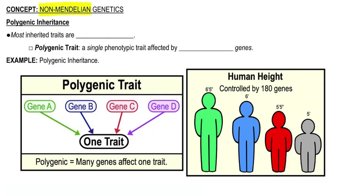
Define polygenic inheritance: Polygenic inheritance involves traits controlled by multiple genes, often located on different chromosomes. These traits do not follow simple Mendelian patterns and result in a continuous range of phenotypes, such as height, skin color, or eye color.
Compare the two types of inheritance: Simple inheritance results in discrete phenotypes (e.g., tongue rolling: yes or no), while polygenic inheritance produces a spectrum of phenotypes due to the combined effect of multiple genes.
Relate the concepts to real-world examples: Use examples like Mendelian traits (e.g., tongue rolling or attached earlobes) for simple inheritance and complex traits (e.g., height or skin color) for polygenic inheritance to illustrate the differences clearly.

Risposta video verificata per un problema simile:

Questa soluzione video è stata consigliata dai nostri tutor come utile per risolvere questo problema.

Concetti chiave

Ecco i concetti essenziali che devi comprendere per rispondere correttamente alla domanda.

Simple Inheritance

Simple inheritance, also known as Mendelian inheritance, refers to the genetic transmission of traits controlled by a single gene with two alleles. In this model, one allele is dominant over the other, leading to distinct phenotypic outcomes. For example, in pea plants, the trait for flower color can be either purple (dominant) or white (recessive), resulting in clear, predictable ratios in offspring.
Video consigliato:
Percorso guidato
02:27
Polygenic Inheritance

Polygenic Inheritance

Polygenic inheritance involves multiple genes contributing to a single trait, resulting in a continuous range of phenotypes rather than discrete categories. Traits such as height, skin color, and weight in humans are influenced by several genes, each having a small additive effect. This complexity leads to a bell-shaped distribution of traits in a population, making it more challenging to predict outcomes compared to simple inheritance.
Video consigliato:
Percorso guidato
02:27
Polygenic Inheritance

Phenotype

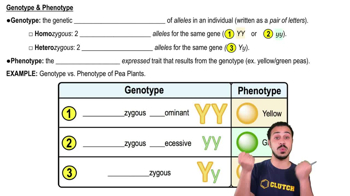
Phenotype refers to the observable characteristics or traits of an organism, which result from the interaction of its genotype (genetic makeup) with the environment. In the context of inheritance, phenotypes can be influenced by single genes in simple inheritance or by multiple genes in polygenic inheritance. Understanding phenotypes is crucial for distinguishing between these two inheritance patterns, as they manifest differently in populations.
Video consigliato:
Percorso guidato
06:36
Genotype & Phenotype