
Ch. 3 The Cellular Level of Organization
Martini - Fundamentals of Anatomy & Physiology 11th Edition
Martini, Nath, Bartholomew11th EditionFundamentals of Anatomy & PhysiologyISBN: 9780136874089Non è quello che usi tu?Cambia libro di testo
Capitolo 3, Problema 7

The synthesis of a functional polypeptide using the information in an mRNA strand is
(a) Translation
(b) Transcription
(c) Replication
(d) Gene activation

Guida verificata passo dopo passo
1
Understand the central dogma of molecular biology, which describes the flow of genetic information from DNA to RNA to protein.
Recall that transcription is the process where DNA is used as a template to synthesize messenger RNA (mRNA).
Recognize that translation is the process where the information in the mRNA strand is used to assemble amino acids into a polypeptide chain (protein).
Identify that replication refers to the copying of DNA to produce identical DNA molecules, not protein synthesis.
Conclude that the synthesis of a functional polypeptide from mRNA is called translation.

Risposta video verificata per un problema simile:

Questa soluzione video è stata consigliata dai nostri tutor come utile per risolvere questo problema.
Durata del video:
2m

Concetti chiave

Ecco i concetti essenziali che devi comprendere per rispondere correttamente alla domanda.

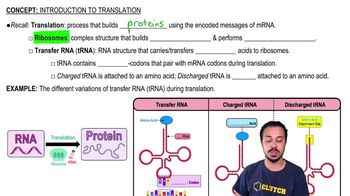
Translation

Translation is the process by which the genetic code carried by mRNA is decoded to produce a specific polypeptide or protein. It occurs in the ribosome, where tRNA molecules bring amino acids that are linked together in the order specified by the mRNA sequence.
Video consigliato:
Percorso guidato
06:12
Introduction to Translation

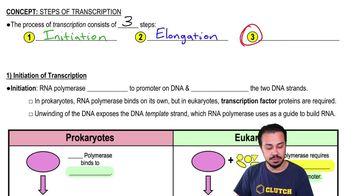
Transcription

Transcription is the synthesis of an RNA strand from a DNA template. During this process, the DNA sequence of a gene is copied into mRNA, which then carries the genetic information needed for protein synthesis.
Video consigliato:
Percorso guidato
04:16
1) Initiation of Transcription

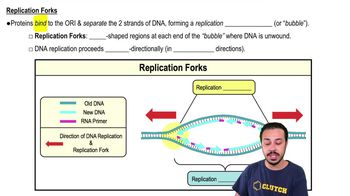
Replication

Replication is the process of copying the entire DNA molecule to produce two identical DNA strands. This is essential for cell division but does not involve the synthesis of proteins or polypeptides.
Video consigliato:
Percorso guidato
04:
Replication Forks