Ch. 3 The Cellular Level of Organization
Martini - Fundamentals of Anatomy & Physiology 11th Edition
Martini, Nath, Bartholomew11th EditionFundamentals of Anatomy & PhysiologyISBN: 9780136874089Non è quello che usi tu?Cambia libro di testo
Capitolo 3, Problema 27

The transport of a certain molecule exhibits the following characteristics:
(1) The molecule moves down its concentration gradient;
(2) at concentrations above a given level, the rate of transport does not increase; and
(3) cellular energy is not required for transport to occur.
Which transport process is at work?

Guida verificata passo dopo passo
1
Step 1: Identify the key characteristics of the transport process described: (1) movement down the concentration gradient, (2) saturation at high concentrations, and (3) no cellular energy required.
Step 2: Understand that movement down the concentration gradient means the molecule moves from an area of higher concentration to an area of lower concentration, which is typical of passive transport.
Step 3: Recognize that saturation of the transport rate at high concentrations suggests the involvement of specific carrier proteins or channels that can become fully occupied, indicating facilitated transport rather than simple diffusion.
Step 4: Note that no cellular energy (ATP) is required, which rules out active transport mechanisms that move molecules against their concentration gradient.
Step 5: Conclude that the transport process described is facilitated diffusion, a passive transport mechanism where molecules move down their concentration gradient through specific carrier proteins or channels until saturation is reached.

Risposta video verificata per un problema simile:

Questa soluzione video è stata consigliata dai nostri tutor come utile per risolvere questo problema.
Durata del video:
2m

Concetti chiave

Ecco i concetti essenziali che devi comprendere per rispondere correttamente alla domanda.

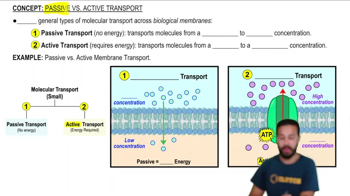
Passive Transport

Passive transport is the movement of molecules across a cell membrane without the use of cellular energy. It occurs down the concentration gradient, from areas of higher to lower concentration, allowing substances to move freely or via specific proteins.
Video consigliato:
Percorso guidato
05:05
Passive vs. Active Transport

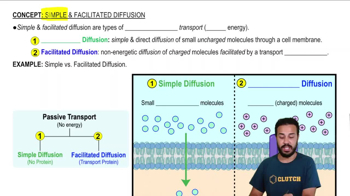
Facilitated Diffusion

Facilitated diffusion is a type of passive transport where molecules move down their concentration gradient through specific carrier or channel proteins. It exhibits saturation kinetics, meaning the transport rate plateaus when all transport proteins are occupied.
Video consigliato:
Percorso guidato
04:59
Simple and Facilitated Diffusion

Saturation Kinetics in Transport Proteins

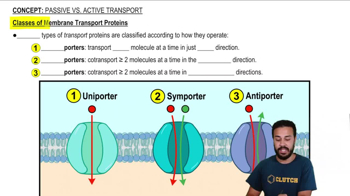
Saturation kinetics refers to the phenomenon where increasing substrate concentration no longer increases the transport rate because all carrier proteins are fully engaged. This characteristic distinguishes facilitated diffusion from simple diffusion.
Video consigliato:
Percorso guidato
03:41
Classes of Membrane Transport Proteins