Ch. 4 The Tissue Level of Organization
Martini - Fundamentals of Anatomy & Physiology 11th Edition
Martini, Nath, Bartholomew11th EditionFundamentals of Anatomy & PhysiologyISBN: 9780136874089Non è quello che usi tu?Cambia libro di testo
Capitolo 4, Problema 2

Collections of specialized cells and cell products that perform a relatively limited number of functions are called
(a) Cellular aggregates,
(b) Tissues
(c) Organs
(d) Organ systems
(e) Organisms

Guida verificata passo dopo passo
1
Understand the definitions of each term provided in the options to identify which best fits the description of 'collections of specialized cells and cell products that perform a relatively limited number of functions.'
Recall that 'cellular aggregates' generally refer to groups of cells but do not specify function or specialization clearly.
Recognize that 'tissues' are groups of similar cells and their products that work together to perform a specific function or a limited set of functions.
Note that 'organs' are structures composed of multiple tissue types working together to perform complex functions, which is broader than the description given.
Understand that 'organ systems' and 'organisms' represent higher levels of biological organization involving multiple organs or the entire living being, respectively, which exceed the scope of the question.

Risposta video verificata per un problema simile:

Questa soluzione video è stata consigliata dai nostri tutor come utile per risolvere questo problema.
Durata del video:
2m

Concetti chiave

Ecco i concetti essenziali che devi comprendere per rispondere correttamente alla domanda.

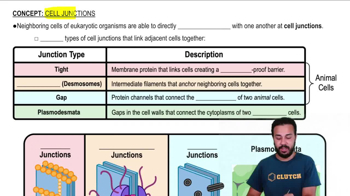
Cells and Cell Specialization

Cells are the basic units of life, and specialization refers to cells developing specific structures and functions. Specialized cells work together to perform particular tasks, forming the foundation for higher levels of biological organization.
Video consigliato:

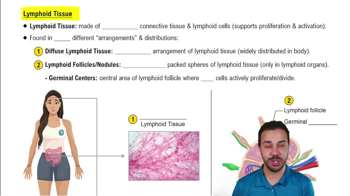
Tissues

Tissues are groups of similar specialized cells and their products that work together to perform a limited set of functions. They represent the first level of organization beyond individual cells, such as muscle tissue or nervous tissue.
Video consigliato:
Percorso guidato
4:55
Lymphoid Tissue

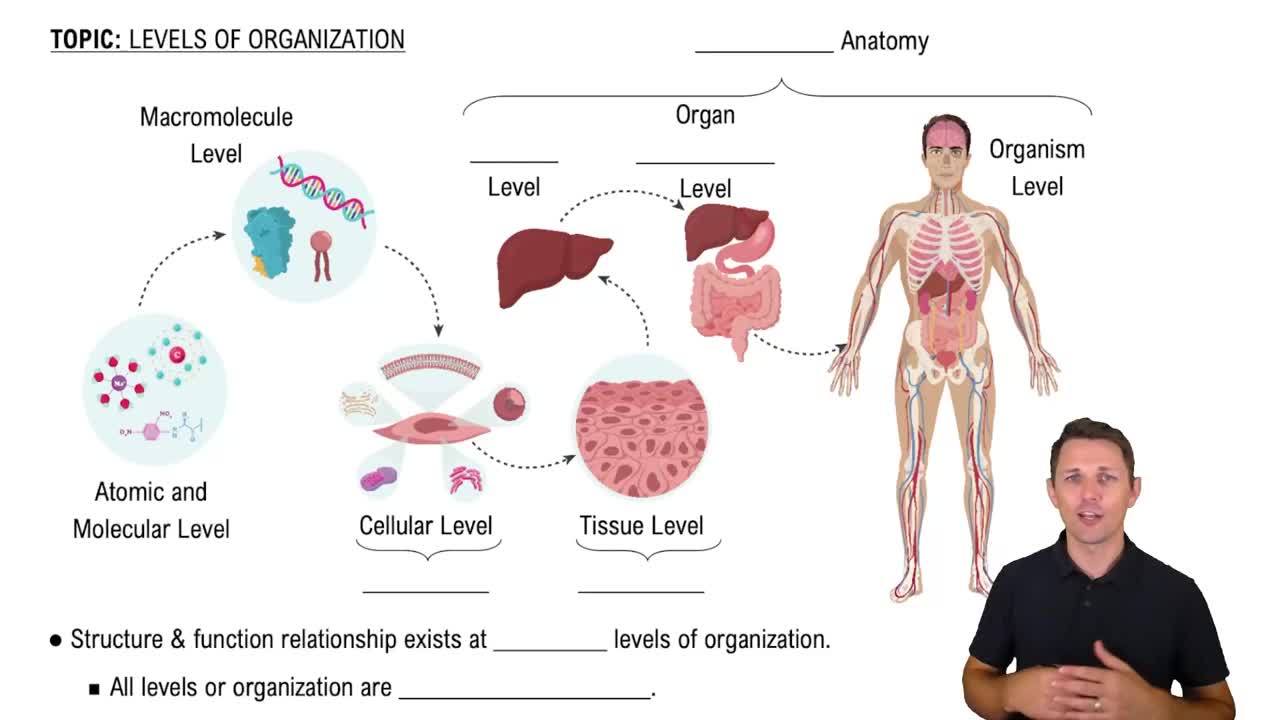
Biological Organization Levels

Biological organization progresses from cells to tissues, organs, organ systems, and organisms. Each level represents increasing complexity and integration, with tissues forming organs, organs forming systems, and systems forming whole organisms.
Video consigliato:
05:04
The Levels of Organization