List the four distinctive cell populations of bone tissue.
Ch. 6 Bones and Bone Structure
Martini, Nath, Bartholomew11th EditionFundamentals of Anatomy & PhysiologyISBN: 9780136874089Non è quello che usi tu?Cambia libro di testo
Tutti i libri di testo
Martini, Nath, Bartholomew 11th Edition
Ch. 6 Bones and Bone Structure
Problema 11
Martini, Nath, Bartholomew 11th Edition
Ch. 6 Bones and Bone Structure
Problema 11Capitolo 6, Problema 11
Name the major functions of the skeletal system.
Guida verificata passo dopo passo1
Understand that the skeletal system is composed of bones, cartilage, ligaments, and joints, and it serves multiple essential functions in the body.
Identify the first major function: Support. The skeleton provides a structural framework that supports the body and maintains its shape.
Recognize the second function: Protection. Bones protect vital organs, such as the skull protecting the brain and the rib cage protecting the heart and lungs.
Consider the third function: Movement. Bones act as levers and attachment points for muscles, enabling body movement when muscles contract.
Acknowledge additional functions such as mineral storage (e.g., calcium and phosphorus), blood cell production (hematopoiesis in bone marrow), and fat storage in yellow marrow.

Risposta video verificata per un problema simile:
Questa soluzione video è stata consigliata dai nostri tutor come utile per risolvere questo problema.
Durata del video:
3mConcetti chiave
Ecco i concetti essenziali che devi comprendere per rispondere correttamente alla domanda.
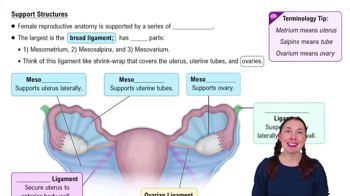
Support and Structure
The skeletal system provides a rigid framework that supports the body and maintains its shape. Bones act as the structural foundation for muscles and organs, enabling upright posture and physical form.
Video consigliato:
Support Structures
Protection of Vital Organs
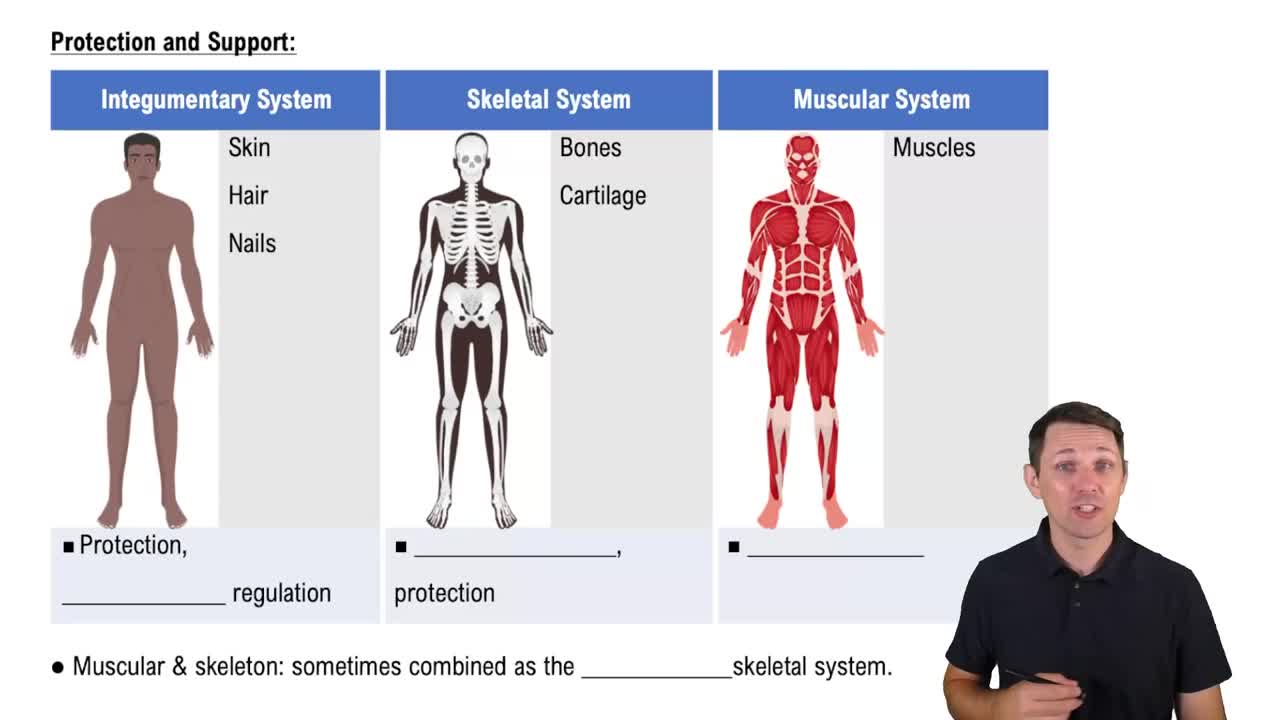
Bones protect critical internal organs from injury. For example, the skull shields the brain, the rib cage guards the heart and lungs, and the vertebrae protect the spinal cord.
Video consigliato:
Protection and Support
Movement Facilitation
Bones serve as attachment points for muscles, enabling movement through joints. When muscles contract, they pull on bones, producing motion essential for daily activities and locomotion.
Video consigliato:
Percorso guidato
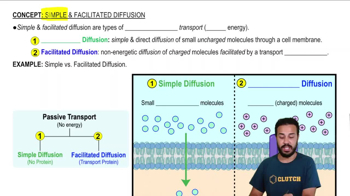
Simple and Facilitated Diffusion
Pratica correlata
Domanda del libro di testo
564
views
Domanda del libro di testo
The presence of an epiphyseal line indicates:
(a) Epiphyseal growth has ended
(b) Epiphyseal growth is just beginning
(c) Growth of bone diameter is just beginning
(d) The bone is fractured at the location
(e) No particular event
579
views
Domanda del libro di testo
What are the primary parts of a typical long bone?
936
views
Domanda del libro di testo
The primary reason that osteoporosis accelerates after menopause in women is:
(a) Reduced levels of circulating estrogens
(b) Reduced levels of vitamin C
(c) Diminished osteoclast activity
(d) Increased osteoblast activity
640
views
Domanda del libro di testo
What is the primary difference between endochondral ossification and intramembranous ossification?
883
views
Domanda del libro di testo
The nonpathologic loss of bone that occurs with aging is called:
(a) Osteomyelitis
(b) Osteoporosis
(c) Osteopenia
(d) Osteitis
(e) Osteomalacia
687
views