 Indietro
General Biology I: Foundations, Chemistry, Cells, and Photosynthesis
Guida di studio - Note intelligenti
 Appunti personalizzati basati sui tuoi materiali, ampliati con definizioni chiave, esempi e contesto.
Introduction to Biology
The Nature of Science and Biology
Biology is the scientific study of life, focusing on understanding how living organisms function, interact, and evolve. Scientific inquiry in biology relies on observation, hypothesis formation, experimentation, and theory development.
Fact: An observation repeatedly confirmed (e.g., Comb Jellies are not jellyfish).
Hypothesis: A testable, measurable explanation for an observation (e.g., "Medication X lowers blood sugar").
Theory: A broad, well-supported explanation of natural phenomena (e.g., Theory of Evolution).
Deductive Reasoning: Predicting specific results from general principles.
Null Hypothesis: The default assumption that there is no effect or difference.
Properties of Life:
Reproduction
Adaptation and evolution
Growth and development
Regulation and homeostasis
Energy processing
Response to stimuli
Order and organization
Homeostasis: The maintenance of internal balance in an organism (e.g., humans maintaining body temperature).
Chemistry of Life
Atoms, Bonds, and Water
Understanding the chemical basis of life is essential for biology. Atoms form molecules through different types of bonds, which determine the properties of biological molecules.
Ionic Bond: Formed between ions of opposite charges (cation: positive, anion: negative).
Covalent Bond: Electrons are shared between atoms.
Polar Covalent Bond: Unequal sharing of electrons (e.g., in water).
Nonpolar Covalent Bond: Equal sharing of electrons.
Hydrogen Bond: Weak interaction between a hydrogen atom (attached to O, N, or F) and another electronegative atom; important in water and DNA structure.
Electronegativity: The ability of an atom to attract electrons.
Hydrophilic: Water-loving, polar or ionic compounds. Hydrophobic: Water-fearing, nonpolar compounds. Amphipathic: Molecules with both hydrophilic and hydrophobic regions (e.g., phospholipids).
Water and Its Properties
Importance and Unique Properties of Water
Water is vital for life due to its unique chemical and physical properties, which arise from its polarity and hydrogen bonding.
Polarity: Allows water to interact with other polar or charged molecules.
Solvent: Dissolves many substances, facilitating chemical reactions.
High Specific Heat: Resists temperature changes, stabilizing environments.
High Heat of Vaporization: Allows for effective cooling via evaporation.
Cohesion: Water molecules stick together (surface tension).
Adhesion: Water molecules stick to other surfaces (capillary action).
Examples: Water is essential for plant germination, photosynthesis, nutrient transport, cooling (transpiration), and maintaining cellular structure.
Biomolecules
Macromolecules: Structure and Function
Living organisms are composed of four major classes of biomolecules: proteins, nucleic acids, carbohydrates, and lipids.
Monomers: Small molecules that can join to form polymers.
Polymers: Large molecules made of repeating monomers.
Dehydration Synthesis: Builds polymers by removing water.
Hydrolysis: Breaks polymers into monomers by adding water.
Proteins: Polymers of amino acids; function in structure, catalysis (enzymes), transport, and signaling. Nucleic Acids: Polymers of nucleotides; store and transmit genetic information (DNA, RNA, ATP). Carbohydrates: Polymers of sugars; provide energy and structural support (e.g., glucose, glycogen, cellulose). Lipids: Nonpolar molecules; energy storage, membrane structure (phospholipids), signaling.
Cell Components
Prokaryotic vs. Eukaryotic Cells
Cells are the basic units of life, classified as prokaryotic or eukaryotic based on their structure.
Prokaryotic Cells: Lack a nucleus and membrane-bound organelles; found in bacteria and archaea.
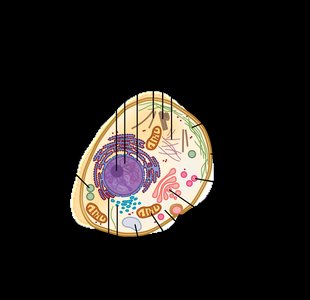
Eukaryotic Cells: Have a nucleus and membrane-bound organelles; found in plants, animals, fungi, and protists.
All cells contain nucleic acids, proteins, carbohydrates, and a plasma membrane.
Major Organelles and Their Functions
Nucleus: Stores genetic information (DNA).
Ribosomes: Synthesize proteins; found free in cytoplasm or bound to rough ER.
Endoplasmic Reticulum (ER): Rough ER synthesizes proteins; smooth ER synthesizes lipids.
Golgi Apparatus: Modifies, sorts, and packages proteins and lipids.
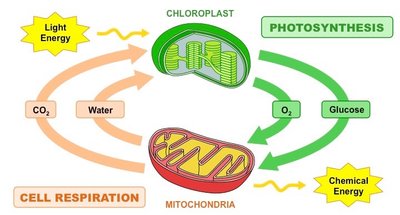
Mitochondria: Produce ATP via cellular respiration; contain their own DNA and ribosomes.
Lysosomes: Digest macromolecules and recycle cellular components.
Peroxisomes: Metabolize waste and carry out oxidation reactions.
Vacuoles: Storage and breakdown of substances (large central vacuole in plants).
Cytoskeleton: Provides structure, movement, and transport within the cell (actin filaments, intermediate filaments, microtubules).
The Membrane
Structure and Function of the Plasma Membrane
The plasma membrane is a selectively permeable barrier composed of a phospholipid bilayer with embedded proteins, carbohydrates, and cholesterol.
Phospholipid Bilayer: Amphipathic molecules with hydrophilic heads and hydrophobic tails.
Membrane Proteins: Facilitate transport, signaling, and cell recognition.
Carbohydrates: Found on the exterior surface, involved in cell recognition.
Membrane Permeability and Transport
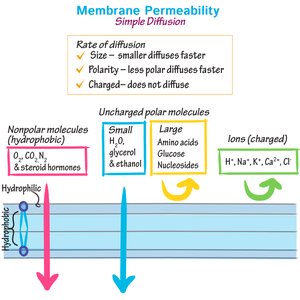
Membrane permeability depends on molecule size, polarity, and charge. Transport can be passive (no energy required) or active (requires ATP).
Simple Diffusion: Movement of small, nonpolar molecules (e.g., O2, CO2) across the membrane.
Facilitated Diffusion: Movement of larger or charged molecules via protein channels (no energy required).
Osmosis: Diffusion of water across a membrane.
Active Transport: Movement against the concentration gradient using energy (ATP).
Energy and Metabolism
Enzymes and Metabolic Pathways
Metabolism includes all chemical reactions in a cell, divided into catabolism (breaking down molecules, releasing energy) and anabolism (building molecules, requiring energy).
Enzymes: Biological catalysts that lower activation energy and speed up reactions.
Substrate: The molecule upon which an enzyme acts.
Active Site: The region of the enzyme where the substrate binds.
Inhibition: Competitive (inhibitor binds active site) or noncompetitive (inhibitor binds elsewhere, allosteric site).
Cofactors: Inorganic enzyme helpers; Coenzymes: Organic enzyme helpers.
Energy Types: Kinetic (motion), potential (stored), chemical (in bonds). Gibbs Free Energy: Determines if a reaction is spontaneous. Exergonic: Releases energy; Endergonic: Requires energy.
Laws of Thermodynamics:
First Law: Energy cannot be created or destroyed.
Second Law: Energy transformations increase entropy (disorder).
Photosynthesis
Overview and Importance
Photosynthesis is the process by which plants, algae, and some bacteria convert light energy into chemical energy, producing glucose and oxygen from carbon dioxide and water.
Occurs in: Chloroplasts (in eukaryotes), thylakoid membranes (in prokaryotes).
Equation:
Light-Dependent and Light-Independent Reactions
Photosynthesis consists of two main stages: light-dependent reactions and the Calvin cycle (light-independent reactions).
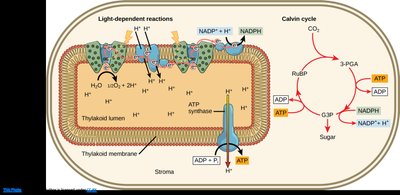
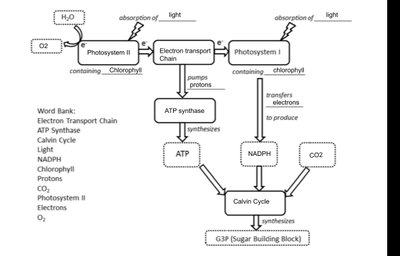
Light-Dependent Reactions: Occur in the thylakoid membrane; use light energy to produce ATP and NADPH, and release O2.
Calvin Cycle: Occurs in the stroma; uses ATP and NADPH to fix CO2 into glucose.
Photosystems and Electron Transport
Photosystems II and I capture light energy, exciting electrons that move through an electron transport chain, generating a proton gradient used to synthesize ATP.
Photosystem II: Splits water, releases O2, and provides electrons.
Electron Transport Chain: Transfers electrons, pumps protons, and generates ATP via ATP synthase.
Photosystem I: Re-energizes electrons to reduce NADP+ to NADPH.
Chlorophyll and Light Absorption
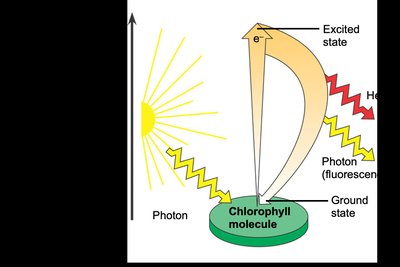
Chlorophyll molecules absorb light energy, exciting electrons to higher energy states. This energy is used to drive the light-dependent reactions.
Chlorophyll a and b: Absorb red and blue light; reflect green.
Carotenoids: Absorb blue and green light; reflect yellow, orange, and red.
Redox Reactions in Photosynthesis
Photosynthesis involves redox reactions, where electrons are transferred between molecules. CO2 is reduced to glucose, and H2O is oxidized to O2.
Reduction: Gain of electrons (CO2 to glucose).
Oxidation: Loss of electrons (H2O to O2).
Rubisco: The enzyme that fixes carbon in the Calvin cycle; can also act on O2 (photorespiration), reducing efficiency.
Study and Exam Preparation Strategies
Effective Study Techniques
Interleaving: Switch between topics to improve retention.
Recall: Actively retrieve information without looking at notes.
Practice Teaching: Explain concepts to others to reinforce understanding.
Focus on Learning Outcomes: Prioritize understanding over memorization.
Additional info: Regular review, use of practice quizzes, and attending office hours are recommended for success in General Biology I.
