 Indietro
Transport Across Membranes, Plant Structure, and Nutrition: General Biology Study Notes
Guida di studio - Note intelligenti
 Appunti personalizzati basati sui tuoi materiali, ampliati con definizioni chiave, esempi e contesto.
Transport of Substances Across Membranes
Membrane Structure and Properties
Biological membranes are primarily composed of lipid bilayers, which provide a selectively permeable barrier for cells. The arrangement of hydrophilic heads and hydrophobic tails of phospholipids allows for dynamic movement and selective transport of substances.
Lipid bilayer: Two layers of phospholipids with hydrophilic heads facing outward and hydrophobic tails inward.
Selective permeability: Small, uncharged molecules cross easily; ions and large molecules require assistance from membrane proteins.
Fluidity: Increased temperature raises membrane fluidity; phospholipids move laterally but rarely flip-flop.
Diffusion and Rate of Diffusion
Diffusion is the passive movement of molecules from regions of high concentration to low concentration, driven by random molecular motion. It does not require energy input.
Concentration gradient: Drives net movement of solutes until equilibrium is reached.
Equation for rate of diffusion:
F: Rate of diffusion
k: Diffusion constant (depends on solute, membrane, temperature)
A: Surface area for diffusion
\Delta c: Change in concentration
d: Distance for diffusion (e.g., membrane thickness)
Electrochemical Gradients
For charged particles, diffusion is influenced by both concentration and electrical gradients, forming an electrochemical gradient. Equilibrium is reached when both gradients are balanced.
Consequences of Size and Shape
As organisms increase in size, their surface area to volume ratio decreases, reducing the efficiency of diffusion. Adaptations include subdivision into smaller units, increased surface complexity, and elongated or flattened shapes.
Osmosis
Osmosis is the diffusion of water across a semi-permeable membrane. Water moves from regions of high water potential (low solute concentration) to low water potential (high solute concentration).
Water is polar: Forms hydrogen bonds with other molecules.
Semi-permeable membrane: Allows water but not all solutes to cross.
Passive and Active Transport
Passive transport: Movement along the electrochemical gradient without energy input (includes simple diffusion, facilitated diffusion via channel or carrier proteins).
Active transport: Movement against the electrochemical gradient, requiring energy (often from ATP). Includes primary (direct ATP use) and secondary (uses gradients established by pumps) active transport.
Diversification of Eukaryotes and Protists
Tree of Life and Domains
Life is classified into three domains: Bacteria, Archaea, and Eukarya. Eukaryotes possess a nucleus and complex organelles, while prokaryotes (Bacteria and Archaea) do not.
Protists
Protists are a paraphyletic group of eukaryotes, excluding land plants, fungi, and animals. They exhibit diverse forms, modes of nutrition (autotrophic and heterotrophic), and life cycles (asexual and sexual reproduction).
Amoeboid motion: Movement via pseudopodia.
Cilia: Short projections for movement or fluid circulation.
Role in Ecosystems
Protists are primary producers in aquatic ecosystems, forming the base of the food chain and playing a key role in the global carbon cycle.
Plant Diversity and Evolution
Clades and Adaptations
Plants are organized into nested clades, with adaptations for terrestrial life such as cuticles, pores, and stomata for gas exchange. Land plants (embryophytes) protect their embryos and exhibit alternation of generations.
Alternation of Generations
Plants alternate between haploid (gametophyte) and diploid (sporophyte) generations. Meiosis produces spores; mitosis produces gametes.
Sporophyte: Diploid, produces spores.
Gametophyte: Haploid, produces gametes.
Syngamy: Fusion of gametes to form a zygote.
Vascular and Seed Plants
Vascular plants have specialized tissues for transport (xylem and phloem). Seed plants (gymnosperms and angiosperms) have pollen and seeds, with reduced gametophytes.
Plant Form and Function
Plant Body Organization
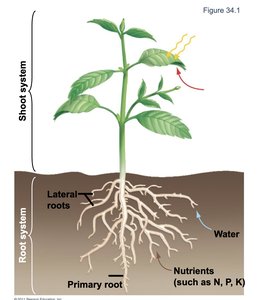
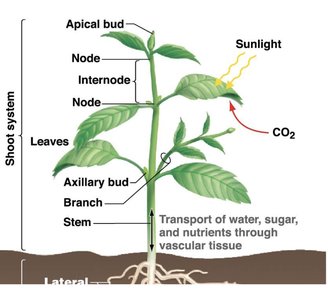
The plant body is divided into the shoot system (above ground) and root system (below ground), each with specialized functions.
Root system: Water and nutrient uptake, anchorage, storage.
Shoot system: Light and CO2 harvesting, gas exchange, transport, reproduction.
Root System
Primary root (taproot): Main root, with lateral roots branching off.
Root hairs: Increase surface area for absorption.
Root cap: Protects growing tip, senses gravity.
Phenotypic plasticity: Root form changes with environment.
Shoot System and Leaves
Stems, leaves, flowers: Main components of the shoot system.
Leaf structure: Blade (expanded portion), petiole (stalk), various adaptations (e.g., bulbs, tendrils).
Surface area to volume ratio: Maximized in leaves for efficient absorption of sunlight and gas exchange.
Plant Cells and Tissues
Cell wall: Provides support and defines shape; primary wall (cellulose, pectin), secondary wall (lignin, rigid).
Plasmodesmata: Cytoplasmic channels connecting adjacent cells.
Plastids: Chloroplasts (photosynthesis), amyloplasts (starch storage), chromoplasts (pigments).
Vacuole: Stores water, ions, pigments; maintains turgor pressure.
Types of Plant Tissues
Dermal tissue: Outer protective layer (epidermis, periderm), includes cuticle, guard cells, trichomes.
Ground tissue: Photosynthesis, storage, support (parenchyma, collenchyma, sclerenchyma).
Vascular tissue: Transport of water, nutrients, and sugars (xylem, phloem).
Primary Growth and Meristems
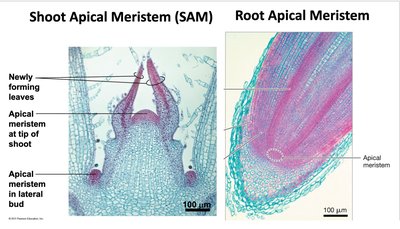
Primary growth increases plant length via apical meristems at root and shoot tips. Meristematic cells are totipotent and give rise to all cell types.
Secondary Growth
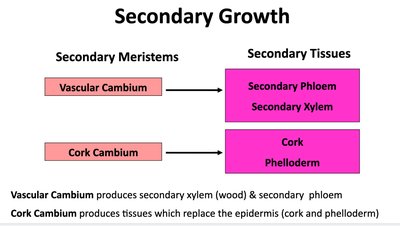
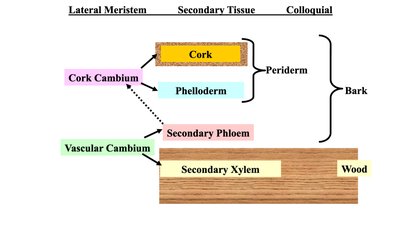
Secondary growth increases plant girth via lateral meristems (vascular cambium and cork cambium). Produces secondary xylem (wood), secondary phloem, cork, and phelloderm.
Water and Sugar Transport in Plants
Water Potential
Water potential (ψ) is the potential energy of water in a system, determining the direction of water movement. It is measured in megapascals (MPa).

Water moves from high to low water potential.
Solute potential (osmotic potential): Lowered by higher solute concentration.
Pressure potential: Physical pressure on water; turgor pressure in plant cells maintains rigidity.
Ψ: Water potential
Ψs: Solute potential
Ψp: Pressure potential
Water Uptake and Transport
Water enters roots by osmosis, moves through symplast (cytoplasm) and apoplast (cell wall matrix).
Casparian strip in endodermis blocks apoplastic flow, forcing water through cell membranes.
Water is transported upward via xylem, driven by transpiration and cohesion-tension mechanism.
Transpiration and Stomata
Transpiration: Evaporation of water from leaf surfaces, creating negative pressure that pulls water upward.
Stomata: Pores regulated by guard cells, control gas exchange and water loss.
Mechanisms to Prevent Water Loss
Sunken stomata, trichomes, thick cuticle, reduced surface area, and timing of stomatal opening (e.g., CAM plants) reduce water loss.
Translocation of Sugars
Translocation is the bulk flow of sugars from sources (production/storage sites) to sinks (utilization/storage sites) via phloem, driven by pressure gradients (pressure-flow model).
Phloem loading (active) increases turgor pressure at source; unloading (passive or active) decreases pressure at sink.
Plant Nutrition
Essential Nutrients
Plants require essential elements for growth and reproduction. These include macronutrients (needed in large amounts) and micronutrients (needed in trace amounts).
Element | Form Available to Plants | Functions | Average % Dry Mass | Deficiency Symptoms |
|---|---|---|---|---|
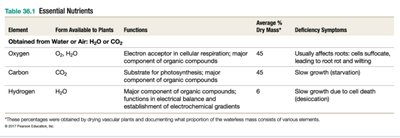
Oxygen | O2, H2O | Electron acceptor in respiration; organic compounds | 45 | Root suffocation, wilting |
Carbon | CO2 | Photosynthesis substrate; organic compounds | 45 | Slow growth (starvation) |
Hydrogen | H2O | Organic compounds; cell balance | 6 | Slow growth, desiccation |
Element | Form Available to Plants | Functions | Average % Dry Mass | Deficiency Symptoms |
|---|---|---|---|---|
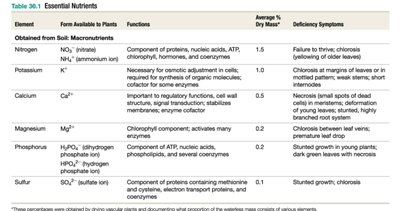
Nitrogen | NO3-, NH4+ | Proteins, nucleic acids, ATP, hormones | 1.5 | Chlorosis, stunted growth |
Potassium | K+ | Osmotic adjustment, enzyme cofactor | 1.0 | Chlorosis, necrosis |
Calcium | Ca2+ | Cell wall, regulatory functions | 0.5 | Necrosis, stunted growth |
Magnesium | Mg2+ | Chlorophyll, enzyme activator | 0.2 | Chlorosis |
Phosphorus | H2PO4-, HPO42- | ATP, nucleic acids, phospholipids | 0.2 | Stunted growth, dark green leaves |
Sulfur | SO42- | Methionine, coenzymes | 0.1 | Stunted growth, chlorosis |
Element | Form Available to Plants | Functions | Average % Dry Mass | Deficiency Symptoms |
|---|---|---|---|---|
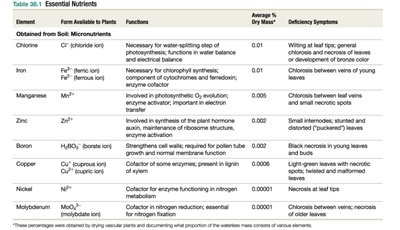
Chlorine | Cl- | Photosynthesis, water balance | 0.01 | Wilting, chlorosis |
Iron | Fe2+, Fe3+ | Chlorophyll synthesis, cytochromes | 0.01 | Chlorosis between veins |
Manganese | Mn2+ | Photosynthesis, enzyme activator | 0.005 | Chlorosis between veins |
Zinc | Zn2+ | Enzyme activator, auxin synthesis | 0.002 | Chlorosis, stunted growth |
Boron | H2BO3- | Cell wall synthesis, pollen tube growth | 0.002 | Black necrosis, brittle leaves |
Copper | Cu+, Cu2+ | Enzyme cofactor, lignin synthesis | 0.0006 | Necrosis, wilted leaves |
Nickel | Ni2+ | Enzyme cofactor | 0.0001 | Necrosis at leaf tips |
Molybdenum | MoO42- | Nitrogen metabolism | 0.00001 | Chlorosis, necrosis |
Nutrient Uptake and Transport
Root hairs: Increase surface area for absorption; contain transport proteins.
Proton pumps: Establish electrochemical gradients for nutrient uptake.
Cotransporters: Move anions into cells by coupling with proton movement.
Casparian strip: Forces selective uptake through endodermal cells.
Nitrogen Fixation and Crop Rotation
Some bacteria and archaea convert atmospheric N2 to usable forms (ammonium, nitrate) via nitrogenase.
Legumes form symbiotic relationships with rhizobia in root nodules, aided by leghemoglobin to protect nitrogenase from O2.
Crop rotation with legumes restores soil nitrogen and improves sustainability.
Specialized Plant Nutrition Strategies
Parasitic plants: Obtain water/nutrients from host plants via haustoria.
Epiphytes: Grow on other plants, absorb water/nutrients from the environment.
Carnivorous plants: Trap and digest insects to supplement nitrogen intake.
Phytoremediation: Use of plants to clean up environmental contaminants.
